
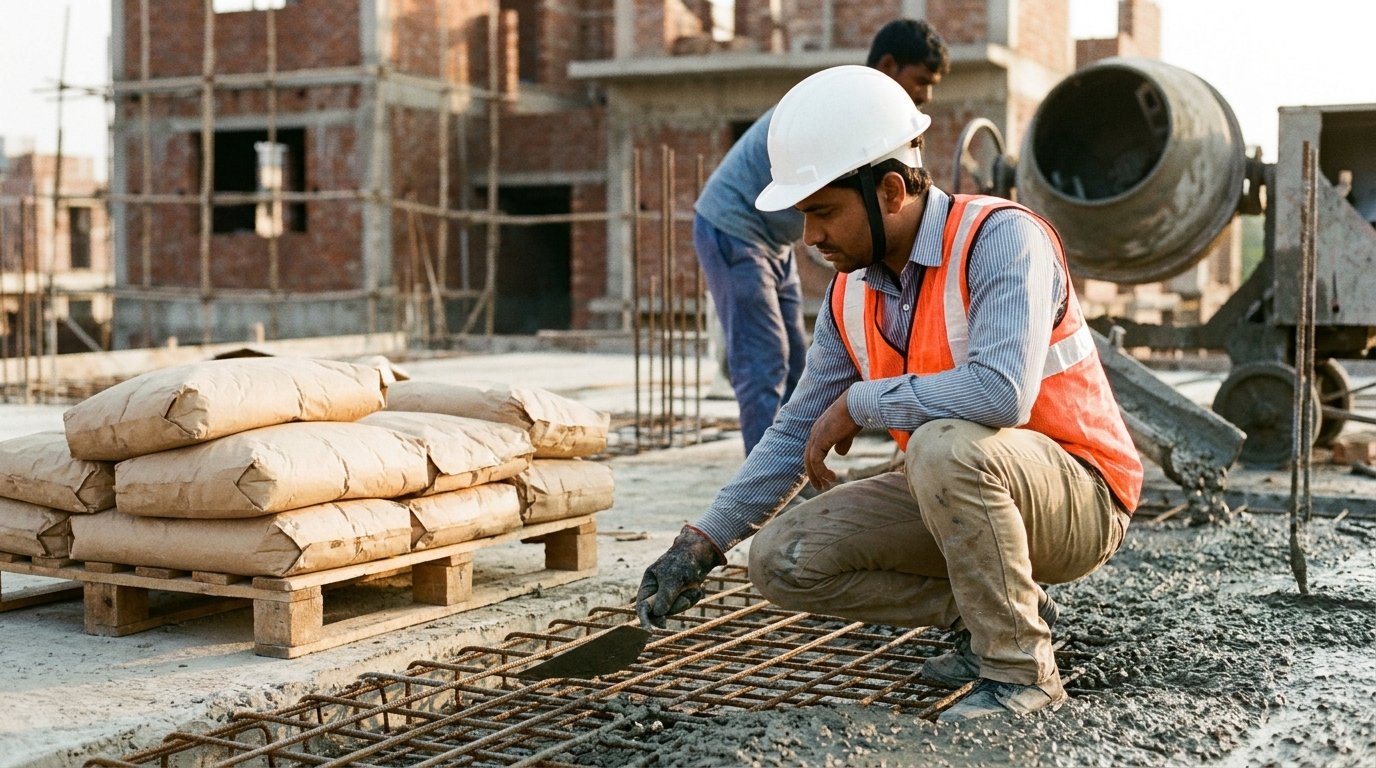

Stand outside any cement dealer yard or residential construction site, and you will hear the exact same argument between the homeowner and the mason: “Order OPC 53—it sets rock-hard quickly” versus “Bring PPC—it stops roof leaks and never cracks plaster.”
Getting the OPC vs PPC cement decision wrong is rarely a structural collapse issue. Instead, it shows up quietly six months later as spider-web plastic shrinkage cracks across an exposed terrace slab, dampness bleeding through basement retaining walls, or hollow-sounding plaster that pops off interior brickwork.
Choosing the right binder is simple once you stop reading marketing bags and compare how OPC 43 (IS 269), OPC 53 (IS 269), PPC Fly-Ash Cement (IS 1489), and PSC Slag Cement (IS 455) actually behave inside wet concrete. This practical 2026 site guide breaks down early vs. 56-day strength curves, thermal heat of hydration, winter deshuttering traps, exact prices, and the member-by-member rulebook every engineer should follow. You can also test batch weights directly in our free Concrete Mix Design Calculator (IS 10262 & ACI 211).
Quick Verdict: OPC vs PPC Cement for House Construction
If you want a straight site answer before diving into IS code tables:
- Use PPC (Portland Pozzolana Cement) or PSC (Slag Cement) for 75% of residential building work—isolated/raft footings, brick & AAC block masonry, wall plastering, screed, underground water sumps, and residential G+1/G+2 slabs where proper 10–14 day curing is guaranteed.
- Use OPC 53 Grade Cement when speed and early formwork turnaround matter most—columns, heavy multi-story beams, precast lintels, prestressed girders, winter concreting below 12°C, and tall industrial framing where slab props must strike fast at 7 days.
- Never choose cement on “53 Grade” hype alone: In long-term durability, PPC actually overtakes OPC 43/53 in watertight density and chloride resistance after 56–90 days—provided you cure it patiently.
Why Chemical Chemistry Separates OPC, PPC & PSC
Ordinary Portland Cement (OPC) is ground roughly 95% limestone-clay clinker plus 5% gypsum. When water hits OPC clinker, two compounds—C3S and C2S—react to form strength-giving C-S-H (Calcium Silicate Hydrate) gel alongside a weak crystalline byproduct: free Calcium Hydroxide (Ca(OH)2), commonly called lime. Over time, water leaks dissolve this soluble free lime out of concrete, leaving pores behind.
PPC (IS 1489 Part 1) blends pure OPC clinker with 15% to 35% processed siliceous fly ash. Fly ash itself has zero binding power on day one—but over weeks 2 through 8, its reactive silica chemically consumes that leftover weak free lime and converts it into secondary C-S-H gel! PSC (IS 455) works similarly using 25% to 70% granulated blast-furnace slag, producing ultra-dense, sulfate-resistant concrete ideal for coastal cities and sewage/sump structures.
In plain field terms:
- OPC sprints fast out of the blocks (high 3-day & 7-day punch) and runs hot.
- PPC & PSC run cool, pack fine particles into microscopic pores, and finish stronger and tighter over time.
OPC 43 vs OPC 53 vs PPC vs PSC: Technical & Cost Comparison (2026)
Compare all four mainstream structural cements sold across Indian and South Asian markets in this OPC vs PPC cement engineering breakdown under current Bureau of Indian Standards (BIS) revisions (note: IS 269:2015 consolidated earlier IS 8112 and IS 12269 OPC grades into one unified standard).
| Engineering Property | OPC 43 Grade | OPC 53 Grade | PPC (Fly-Ash Based) | PSC (Slag Based) |
|---|---|---|---|---|
| Governing BIS Code | IS 269:2015 | IS 269:2015 | IS 1489 (Part 1):2015 | IS 455:2015 |
| Min. 3-Day Strength | 23 MPa |
27 MPa |
16 MPa |
16 MPa |
| Min. 7-Day Strength | 33 MPa |
37 MPa |
22 MPa |
22 MPa |
| Min. 28-Day Strength | 43 MPa |
53 MPa |
33 MPa (often tests 46–52 MPa) |
33 MPa (often tests 45–50 MPa) |
| Heat of Hydration | Moderate–High | Very High (Crack risk in mass pours) | Low (Cool hydration) | Very Low (Best for thick rafts) |
| Initial / Final Set Time | 30 min / 600 min max |
30 min / 600 min max |
30 min / 600 min max (slower stiff set) |
30 min / 600 min max |
| Workability & Finish | Standard | Harsh if sand is coarse | Creamy & cohesive (easier pumping) | Smooth, dense pumpability |
| Minimum Moist Curing | 7 Days min |
7–10 Days (critical in summer) |
10–14 Days (IS 456 Cl. 13.5) |
10–14 Days (mandatory) |
| 2026 Avg. Rate (50 kg Bag) | Rs. 375 – 410 |
Rs. 395 – 440 |
Rs. 355 – 390 |
Rs. 360 – 395 |
Testing Tip: Never panic if 7-day concrete cubes cast with PPC show only 62% of target fck while OPC cubes hit 75%. Verify 28-day and reserve cube pass/fail acceptance rules inside our Aggregate Sieve Analysis & 28-Day Cube Strength QA/QC Calculator.
Member-by-Member Guide: Which Cement Goes Where?
Smart contractors rarely buy a single grade for the entire building unless bulk silo RMC orders dictate one mix. Matching binder chemistry to each structural element cuts cost and extends building life without slowing slab cycles.
| Structural Element | Best Choice (2026) | Why This Cement Performs Better Here | Mandatory Site Caution |
|---|---|---|---|
| Isolated Footings & Thick Rafts | PPC or PSC | Massive footing thickness traps heat; PPC low heat of hydration prevents internal thermal cracks & resists ground sulfates. | Cast over 100 mm lean M10 PCC bed; maintain 50 mm clear cover. |
| RCC Columns & Shear Walls | OPC 53 (or Blended M30 RMC) | Columns see early axial load from upper shuttering props within 48 hours—high 3-day/7-day OPC strength supports rapid vertical lifts. | Wrap column tightly with wet hessian cloth for 10 days; cure high hydration heat! |
| Residential Roof Slab & Beams | PPC (or OPC 53 if fast cycling) | PPC improves impermeability and reduces roof terrace micro-cracking from summer sun expansion. | Keep slab props intact 14 days when using PPC (IS 456 Cl. 11.3.1 caution). |
| Underground Water Sump (UGWT) | PSC or PPC (M30) | Pozzolanic reaction closes capillary bleed pores against hydrostatic pressure. | Add integral waterproof compound & 230 mm PVC water-stopper at kicker joint. |
| Brick / AAC Masonry & Plaster | PPC | Finer fly-ash particles create buttery, cohesive mortar that glides smoothly off trowels without drying out too fast on hot bricks. | Never use OPC 53 for wall plaster—high shrinkage virtually guarantees spiderweb crazing! |
If you are pouring a waterproof underground tank, inspect full IS 3370 double-mesh rules in our Underground Water Tank Size & Cost Guide or calculate storage volumes directly with the RCC Water Tank & Sump Calculator.
Two Expensive Site Mistakes with OPC & PPC Cement
Having audited failed residential slabs and basement pours over the past decade, two common OPC vs PPC cement site mistakes repeat across almost every budget build:
Mistake 1: Using OPC 53 for Interior & Exterior Wall Plaster
Contractors sometimes finish a roof pour with 40 leftover bags of OPC 53 and ask masons to burn through them for wall plastering. Because OPC 53 grinds ultra-fine to hit high 3-day concrete strength, it hydrates violently and shrinks sharply across thin 12–15 mm wall plaster layers. Within 45 days, hairline map cracking appears over every plastered wall. Rule: Keep OPC 53 strictly for structural RCC members and order fresh PPC for all brickwork, plastering, and flooring mortar beds.
Mistake 2: Stripping Slab Props on Day 7 After Pouring PPC Concrete
Every engineer remembers IS 456 Clause 11.3.1, which permits striking slab props after 7 days (for spans up to 4.5 m). However, read the fine print of IS 456: that 7-day schedule was calibrated strictly for Ordinary Portland Cement above 15°C! When contractors pour a G+2 roof slab with PPC or PSC cement during chilly December/January nights and knock props down on Day 7, concrete has reached barely 55%–60% design modulus of elasticity. The slab sags noticeably under its own weight and locks in permanent deflection cracks. Plan exact prop durations with our Formwork & Shuttering Stripping Calculator—always hold PPC slab props at least 10 to 14 days.
4 Fast Site Quality Checks Before Unloading a Cement Truck
Expired or moisture-exposed cement loses up to 20% compressive strength in 3 months and 30% in 6 months. Run these four 60-second checks before signing any cement delivery challan:
- Read the Side-Edge Week Stamp (
W / M / Y): Under BIS marking, every 50 kg bag prints the Date / Week, Month, and Year of packing along its side seam. Reject bags older than 6 weeks (and legally per IS 456, any bag over 90 days old must be lab re-tested before structural RCC use). - The Bare-Hand Warmth Test: Plunge your clean dry hand deep into an opened bag. Fresh good cement feels cool, whereas damp partially hydrated cement feels slightly warm because slow hydration has already begun inside the sack.
- The Float-and-Sink Water Bucket Test: Sprinkle one pinch of cement onto calm clean water in a transparent glass. Fresh cement particles float briefly for several seconds before sinking gently to the bottom—caked adulterated powder drops like sand instantly.
- Squeeze-and-Lump Check: Rub a pinch between thumb and index finger; it must feel silky-smooth like talcum powder with zero gritty stones or hard lumps. Hard stone-like lumps that cannot crush easily under finger pressure indicate humid storage hydration—reject that stack immediately.
OPC vs PPC Cement Site Rules: Can We Mix Two Brands or Grades?
During unexpected transit delays mid-slab, site supervisors often face a tough question: “We ran 15 bags short—can we finish the last beam bay with PPC while the first half used OPC 53?”
- Same Grade, Different Fresh Brands: Generally safe in non-critical slabs if water-cement ratios stay controlled, though color tint shifts slightly.
- Never Blend OPC & PPC Inside the Same Mixer Batch: Differential setting speeds and admixture incompatibility cause uneven shrinkage stresses at the finish edge.
- If Emergency Switching Happens Mid-Pour: Finish cleanly to a proper planned construction joint (
1/3rdspan shear-low zone), cure consistently for 14 days, and run follow-up NDT/rebound verification after 28 days. Prepare for structural and QA/QC interview cross-questions on cement selection and testing inside our interactive Topic-Wise Civil Engineering Interview Q&A Hub.
Frequently Asked Questions (FAQs)
Which cement is better for concrete roof slabs: OPC or PPC?
Both work well if cured properly, but PPC is better for residential G+1/G+2 roof slabs because its low heat of hydration minimizes summer shrinkage cracks and makes finished terraces more watertight—provided formwork props stay intact for 10 to 14 days instead of 7.
Can we use OPC 53 grade cement for house foundations and brickwork?
You can use OPC 53 in structural foundations if soil sulfates are negligible and curing is continuous, but PPC or PSC is superior for deep footings because low hydration heat avoids thermal micro-cracking and improves soil chemical resistance. Never use OPC 53 for plastering or brickwork mortar due to high shrinkage cracking.
Why is PPC cement cheaper per bag than OPC 53 if it lasts longer?
PPC blends 15%–35% thermal power-plant fly ash in place of high-temperature clinker firing, cutting limestone kiln fuel and coal cost per ton. That lower energy footprint makes OPC vs PPC cement pricing roughly Rs. 30–50/bag cheaper in favor of PPC while improving long-term 56-day pore tightness.
What is the minimum curing period for PPC vs OPC concrete per IS 456?
Under IS 456 Clause 13.5, newly poured OPC concrete must be kept moist for minimum 7 days under mild weather, whereas blended cements (PPC and PSC) require at least 10 days—and strictly 14 days in dry, windy, or cold conditions—for pozzolanic strength gain to complete.
Is OPC 43 grade still sold in India in 2026?
Yes. Under unified IS 269:2015, both OPC 43 and OPC 53 grades continue manufacturing—though retail residential markets increasingly favor OPC 53 for fast-cycle precast/columns and PPC for general RCC and plastering.
Which test checks cement fineness and setting time quickly on site?
Field labs verify initial setting time (>= 30 min) and final setting time (<= 600 min) using the Vicat Apparatus (IS 4031 Part 5), cement soundness (<= 10 mm expansion) using Le Chatelier Molds, and fineness (<= 10% residue) via a 90-micron IS sieve.
Need step-by-step lab procedures and IS/ASTM acceptance limits for Vicat setting time, Le Chatelier soundness, 90-micron fineness, cube crushing, and 35+ other site checks? Browse our All 43 Civil Engineering Lab & Field Tests Directory.