
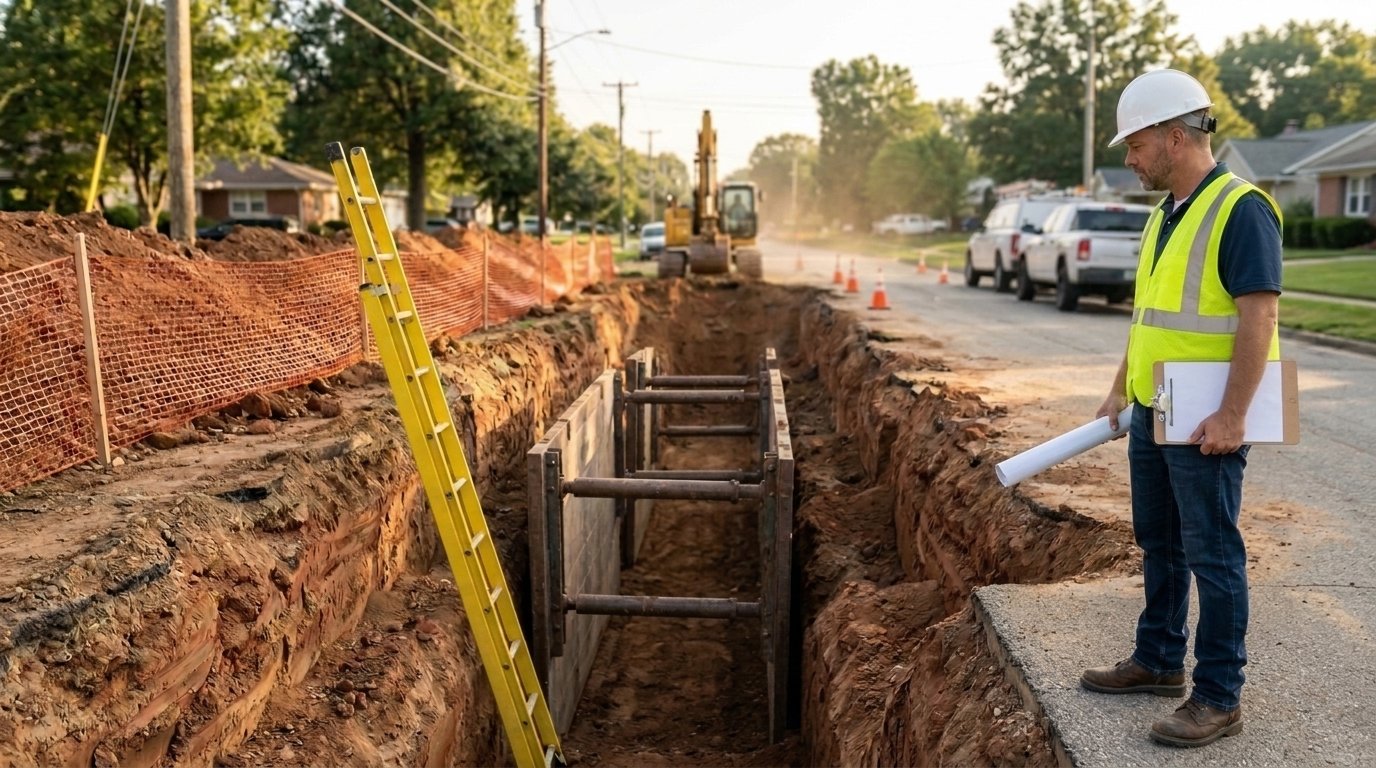

One cubic yard of moist clay soil weighs roughly 2,700 to 3,000 pounds—about the same weight as a compact sedan. When an unprotected trench wall collapses, a worker gets buried under several tons of soil in less than a second, with almost zero chance to dig themselves out. That sobering physics is exactly why osha trench sloping requirements under 29 CFR 1926 Subpart P remain one of the most heavily enforced—and most heavily fined—construction safety standards in the United States in 2026.
Whether you are a utility contractor installing a 10-foot sewer main, a project engineer estimating earthwork volumes for a municipal bid, or a designated Competent Person running daily site inspections, guessing trench angles by eye is both illegal and expensive. Too steep, and you risk a catastrophic cave-in plus willful OSHA citations exceeding $160,000 per violation. Too flat, and you pay for hundreds of unnecessary cubic yards of excavation, haul-off, and imported select backfill.
In this practical field guide, we break down every rule inside 29 CFR 1926.650–652, give you quick-reference Type A, B, and C soil sloping and benching charts, walk through manual soil testing in the field, and work through a real 10-foot-deep trench calculation showing exact top widths and excavation volumes.
Table of Contents
- What Are the Core OSHA Trench Sloping Requirements?
- The Critical Depth Thresholds: 4 ft, 5 ft, and 20 ft Rules
- OSHA Soil Classification Explained: Stable Rock, Type A, Type B & Type C
- Quick-Reference OSHA Sloping & Benching Chart (29 CFR 1926 Subpart P)
- How a Competent Person Tests Soil on Site (Visual + Manual Tests)
- Worked Numerical Example: 10-Foot-Deep Utility Trench (Type A vs B vs C)
- Sloping vs. Benching vs. Trench Boxes (Shielding) vs. Shoring
- Spoil Piles, Ladders, Water Accumulation & Atmospheric Testing Rules
- Daily Competent Person Trench Inspection Checklist
- 5 Field-Tested Pro Tips from Senior Geotechnical & Civil Engineers
- 7 Fatal Trenching Mistakes That Trigger Cave-Ins and OSHA Fines
- Frequently Asked Questions (FAQs)
- Final Key Takeaways
What Are the Core OSHA Trench Sloping Requirements?
Under federal law—specifically 29 CFR 1926 Subpart P (Excavations)—every worker entering a trench 5 feet (1.52 m) or deeper must be protected from cave-ins by an approved protective system, unless the excavation is made entirely in stable rock. Even trenches shallower than 5 feet require protection if the site’s Competent Person spots signs of potential wall collapse, tension cracks, or flowing groundwater.
Sloping protects workers by cutting the trench walls back at an angle inclined away from the excavation floor. The flatter the slope, the lower the driving shear stress along potential failure planes. Because soil shear strength varies dramatically between stiff clay and loose granular sand, osha trench sloping requirements tie the maximum allowable slope directly to the soil’s tested classification.
If you want instant slope geometry, top-width dimensions, and safe bearing checks before mobilizing an excavator, run your trench depth and soil type directly through our free Soil Bearing & OSHA Trench Safety Calculator.
The Critical Depth Thresholds: 4 ft, 5 ft, and 20 ft Rules
Every field engineer and foreman should memorize four non-negotiable numbers from OSHA Trenching & Excavation Safety:
- 2 Feet (0.61 m) — Spoil Pile Setback: All excavated dirt, pipes, tools, and surcharge loads must stay at least 2 feet back from the top edge of the excavation.
- 4 Feet (1.22 m) — Safe Egress (Ladders / Ramps): Trenches 4 feet or deeper must have a stairway, ladder, or ramp positioned so no worker ever travels more than 25 feet laterally to reach an exit.
- 5 Feet (1.52 m) — Cave-In Protection Trigger: Protective systems (sloping, benching, shoring, or trench shields) are mandatory at 5 feet and deeper (or shallower if unstable).
- 20 Feet (6.10 m) — Registered Professional Engineer (PE) Stamp Required: Standard OSHA Appendix B sloping tables stop at 20 feet. Any excavation deeper than 20 feet must be designed and sealed by a Registered Professional Engineer (PE)—no exceptions.
OSHA Soil Classification Explained: Stable Rock, Type A, Type B & Type C
OSHA Appendix A groups all soils into four categories based on unconfined compressive strength (q_u), cohesiveness, fissuring, prior disturbance, and groundwater seepage. When in doubt—or if no manual soil test is performed—you must default immediately to Type C (the safest, flattest slope).
Stable Rock
Natural solid mineral matter that can be excavated with vertical sides and remains intact while exposed. True stable rock is rare on urban utility sites; fractured, weathered, or layered rock with joints dipping into the trench does not qualify.
Type A Soil (Most Cohesive — Strongest)
Cohesive soils with an unconfined compressive strength of 1.5 tons per square foot (tsf) (144 kPa) or greater. Classic examples include stiff clay, silty clay, sandy clay, clay loam, and cemented hardpan.
Critical Downgrade Triggers: Even stiff 2.0 tsf clay is automatically disqualified from Type A if ANY of the following apply:
- The soil is fissured (shows cracks or breaks into chunks when excavated).
- The trench is subject to vibration from highway traffic, railroads, pile driving, or heavy compaction nearby.
- The soil was previously disturbed (such as an existing utility corridor or backfilled subdivision lot).
- Water is freely seeping through the trench wall, or sloped layers dip into the excavation at
4H:1Vor steeper.
In practice, on most developed urban and suburban American job sites, previously disturbed soil automatically eliminates Type A—leaving Type B or Type C as the real-world design standard.
Type B Soil (Medium Cohesive or Angular Granular)
Cohesive soils with unconfined compressive strength greater than 0.5 tsf (48 kPa) but less than 1.5 tsf (144 kPa), OR:
- Granular cohesionless soils with angular interlocking particles (like crushed rock), silt, silt loam, or sandy loam.
- Previously disturbed soils (unless they would otherwise be classified as Type C).
- Fissured or vibration-exposed soils that would otherwise qualify as Type A.
- Dry unstable rock.
Type C Soil (Least Stable — Flattest Slope Required)
Cohesive soils with unconfined compressive strength of 0.5 tsf (48 kPa) or less, OR:
- Granular soils including gravel, sand, and loamy sand.
- Submerged soil or soil from which water is freely seeping.
- Submerged rock that is not stable.
- Layered geologic systems where weaker soil underlies stronger soil (always classify by the weakest layer unless designing a compound slope per Appendix B).
Quick-Reference OSHA Sloping & Benching Chart (29 CFR 1926 Subpart P)
This table summarizes the exact maximum allowable slopes for excavations less than 20 feet deep per 29 CFR 1926 Subpart P, Appendix B:
| Soil Type | Unconfined Strength (q_u) |
Max Allowable Slope (H : V) |
Max Slope Angle from Horizontal | Simple / Multiple Benching Allowed? | Typical Field Example |
|---|---|---|---|---|---|
| Stable Rock | Solid Intact Rock | Vertical (0 : 1) |
90° |
N/A (Vertical OK) | Solid unfractured granite or limestone |
| Type A | ≥ 1.5 tsf (≥ 144 kPa) |
0.75H : 1V (3/4 : 1) |
53° |
Yes (Simple & Multiple) | Undisturbed stiff clay, no water/vibration |
| Type A (Short-Term ≤ 24 hrs, Depth ≤ 12 ft) | ≥ 1.5 tsf |
0.5H : 1V (1/2 : 1) |
63° |
No | Brief utility repair open < 24 hrs |
| Type B | 0.5 – 1.5 tsf (48 – 144 kPa) |
1H : 1V (1 : 1) |
45° |
Yes (Cohesive Type B ONLY) | Silt loam, disturbed clay, dry angular rock |
| Type C | ≤ 0.5 tsf (≤ 48 kPa) |
1.5H : 1V (1½ : 1) |
34° |
NO — Strictly Prohibited! | Sand, gravel, wet/seeping trench, soft clay |
Do Not Miss That Type C Benching Rule: You can NEVER bench Type C soil! Granular sand and saturated soil cannot hold vertical step risers; they slump immediately under their own weight. In Type C soil, you must either cut a continuous 1.5H : 1V (34°) slope or install a trench box / hydraulic shoring system.
How a Competent Person Tests Soil on Site (Visual + Manual Tests)
OSHA does not let a contractor guess Type A or Type B soil just by looking at the bucket. To use any slope steeper than 1.5H : 1V (Type C), a trained Competent Person must perform at least ONE visual test AND at least ONE manual test per 29 CFR 1926 Subpart P, Appendix A—and document the results.
Visual Tests (What You Look For)
- Excavation Wall & Spoil Pile Clumping: Does soil come out of the excavator bucket in cohesive clumps (clay) or break apart into loose grains (sand/gravel)?
- Surface Cracks & Fissures: Look closely along the ground surface parallel to the trench edge for tension cracks—an immediate warning sign of impending slide failure.
- Existing Utilities & Disturbed Zones: Check for marker tape, old gravel bedding, or color changes indicating previously trenched soil.
- Water & Vibration: Look for glistening wet seams, ponding at the trench toe, or nearby vibrating equipment/highways.
Manual Field Tests (Physical Strength Checks)
- Plasticity (Thread) Test: Roll a moist soil sample between your palms into a
1/8-inch(3 mm) thread. If you can hold a2-inchlength of that thread by one end without it breaking, the soil is cohesive; if it crumbles, it is granular (Type C). - Thumb Penetration Test: Press your thumb firmly into a fresh, undisturbed clump from the spoil pile:
- Barely indents with great effort → roughly
≥ 1.5 tsf(Type A candidate) - Indents easily up to thumbnail depth → roughly
0.5 – 1.5 tsf(Type B) - Penetrates several inches effortlessly →
≤ 0.5 tsf(Type C)
- Pocket Penetrometer or Torvane Shear Tester: The gold standard for site documentation! Press the spring-loaded steel piston into an undisturbed clay sample to get a direct numeric reading in tons per square foot (tsf)—clean, repeatable, and defensible if an OSHA compliance officer inspects your site.
- Dry Strength Test: Crumble a dry chunk between your fingers. Granular soils fall apart instantly; dry clay resists pressure and breaks into sharp clods.
Worked Numerical Example: 10-Foot-Deep Utility Trench (Type A vs B vs C)
Seeing the numbers side by side immediately explains why soil classification directly controls your earthwork budget and street-closure width.
Project Scenario
You are installing a 100-foot-long municipal storm sewer pipe inside a trench that is 10 feet deep (D = 10 ft) with a 4-foot flat bottom width (B = 4 ft) for pipe bedding and worker clearance. Let's compute the required Top Width (W_top) and Total Excavation Volume (CY — Cubic Yards) under osha trench sloping requirements for all three soil types!
Governing Geometry Formulas
- Horizontal Setback per Side (
X):X = Slope Ratio (H) × Depth (D) - Total Trench Top Width (
W_top):W_top = B + 2 × X - Cross-Sectional Area (
A):A = ((B + W_top) / 2) × D(inft²) - Total Excavation Volume (
V):V = (A × Length) / 27(in Cubic Yards,CY)
Step-by-Step Comparison Table (D = 10 ft, B = 4 ft, L = 100 ft)
| Parameter | Type A (0.75H : 1V / 53°) |
Type B (1H : 1V / 45°) |
Type C (1.5H : 1V / 34°) |
Trench Box (Vertical Cut 6 ft Wide) |
|---|---|---|---|---|
Horizontal Setback / Side (X) |
0.75 × 10 = 7.5 ft |
1.0 × 10 = 10.0 ft |
1.5 × 10 = 15.0 ft |
0 ft (Shielded vertical) |
Required Top Width (W_top) |
4 + 15 = 19.0 ft |
4 + 20 = 24.0 ft |
4 + 30 = 34.0 ft |
6.0 ft |
Cross-Sectional Area (A) |
((4+19)/2)×10 = 115 ft² |
((4+24)/2)×10 = 140 ft² |
((4+34)/2)×10 = 190 ft² |
6 × 10 = 60 ft² |
Excavation Volume (100 ft Run) |
425.9 CY (325.6 m³) |
518.5 CY (396.4 m³) |
703.7 CY (538.0 m³) |
222.2 CY (169.9 m³) |
| Extra Dirt vs. Trench Box | +203.7 CY (+92%) |
+296.3 CY (+133%) |
+481.5 CY (+217%!) |
Baseline |
Look at that Type C column! A simple 4-foot-wide pipe trench balloons to a 34-foot-wide crater (+ 4 feet for spoil setback = 38+ feet of right-of-way), forcing you to excavate, stockpile, and re-compact 703.7 cubic yards of dirt instead of 222.2 cubic yards with a trench box!
Want to price out the bedding gravel, backfill tonnage, and pavement restoration for your trench width? Pair our Soil Bearing & OSHA Trench Safety Calculator with our Excavation & Earthwork Volume Calculator and Asphalt & Gravel Tonnage Calculator.
Sloping vs. Benching vs. Trench Boxes (Shielding) vs. Shoring
Choosing the right protective system balances site space, soil classification, existing utilities, and total earthwork cost:
| Protective System | How It Works | Best Used When | Key OSHA Limitation |
|---|---|---|---|
| Sloping | Cutting trench banks back at 53°, 45°, or 34° |
Open greenfield sites with ample right-of-way and low haul-off costs | Requires huge top widths in Type B/C soil; max 20 ft without PE stamp |
| Benching | Cutting horizontal steps (4 ft max first step in Type A/B) |
Cohesive Type A or cohesive Type B clay sites | 100% ILLEGAL in Type C soil and granular soils |
| Trench Box (Shielding) | Prefabricated steel/aluminum box dragged along trench to shield workers | Urban utility lines, tight street lanes, Type C sand, deep pipes | Protects workers inside the box—does not stop wall movement outside; must follow manufacturer Tabulated Data |
| Hydraulic / Timber Shoring | Pressurized shores or sheet piling supporting walls against movement | Next to existing building foundations, buried gas mains, or highways | Must follow OSHA Appendix C/D or manufacturer Tabulated Data; install top-down, remove bottom-up |
Critical Trench Box Details: Per 29 CFR 1926.652(g), you may excavate no more than 2 feet below the bottom of a trench shield (only if the shield is rated for the full depth and soil is not sloughing beneath the edge), and the top of the shield must extend at least 18 inches above the surrounding sloped soil when combining sloping with a trench box. Also, no worker may ever ride inside a trench box while it is being moved or lifted.
Spoil Piles, Ladders, Water Accumulation & Atmospheric Testing Rules
Even if your slope angle is textbook-perfect, OSHA inspectors frequently write serious citations for these four companion Subpart P rules:
1. Spoil Pile Setback (≥ 2 Feet)
Keep all excavated dirt, rocks, concrete pipe sections, and toolboxes at least 2 feet (0.61 m) back from the top edge—or install effective retaining barriers. Better yet, on Type C sandy soils, push spoil piles 4 to 5 feet back so surcharge weight never triggers a top-edge shear crack.
2. Safe Access & Egress (≥ 4 Feet Deep, ≤ 25 Feet Travel)
In any trench 4 feet or deeper, workers must never be more than 25 feet laterally from a ladder, ramp, or stairway. Extension ladders must extend at least 3 feet above the top landing and be tied off securely at the top so they cannot twist or slide when a worker climbs out in a hurry.
3. Water Accumulation & Dewatering
Workers cannot work inside an excavation with accumulating water unless special precautions—such as continuous dewatering pumps monitored by a Competent Person, wellpoints, or water-rated shields—are actively protecting the trench. Remember: flowing groundwater immediately downgrades your soil to Type C.
4. Hazardous Atmospheres (≥ 4 Feet Near Landfills, Sewers, or Gas Lines)
Per NIOSH Trenching Safety, whenever a trench is 4 feet or deeper and could reasonably contain oxygen deficiency (< 19.5% O₂), flammable gas (> 10% LEL), or toxic hydrogen sulfide (H₂S) / carbon monoxide from running equipment engines, test the air before workers enter and ventilate continuously.
Daily Competent Person Trench Inspection Checklist
Per 29 CFR 1926.651(k), a designated Competent Person must inspect every open trench daily before work begins, after every rainstorm, and whenever site conditions change. Log each inspection formally using a digital site log like our Site DPR & Concrete Pre-Pour Card Generator:
- ☐ 811 Utility Locate Confirmed: Underground electric, gas, fiber, and water lines marked and potholed by hand before machine digging.
- ☐ Visual & Manual Soil Test Logged: Soil classified as Type A, B, or C (pocket penetrometer or thumb test recorded).
- ☐ Protective System Matches Depth: Slope angle (
53°,45°,34°) or Trench Box Tabulated Data verified on site for full trench depth (> 20 ftPE stamp attached if applicable). - ☐ Spoil Piles & Equipment Set Back: All soil, pipe bundles, and excavator tracks kept
≥ 2 ftfrom trench rim. - ☐ Egress Ladder Verified: Ladder placed within
25 ftof every worker, secured, and extending3 ftabove grade. - ☐ Surface Cracks & Sloughing Checked: Zero tension cracks, bulging faces, or undercutting along walls.
- ☐ Water & Dewatering Controlled: No standing or seeping water undermining trench toes; pumps inspected.
- ☐ Traffic & Fall Barricades Installed: High-visibility vests worn near traffic; barricades protecting pedestrians and night visibility.
5 Field-Tested Pro Tips from Senior Geotechnical & Civil Engineers
- Always Keep Trench Box Tabulated Data Inside the Site Truck: OSHA inspectors ask for manufacturer Tabulated Data on the spot; missing paperwork triggers an immediate citation even when the box is installed right.
- Never Trust Type A Soil in Urban Street Corridors: Almost every city right-of-way has been dug before; price bids assuming Type B or Type C shoring so you never blow your earthwork margin.
- Re-Inspect Immediately After Even a 20-Minute Rain Shower: Rainwater fills tension cracks, adds hydrostatic thrust, and drops clay cohesion fast—always re-check walls before letting crews step back in.
- Use Trench Shields When Top Width Exceeds 18 Feet: Compare shoring rental cost against extra haul-off, asphalt saw-cutting, and imported gravel backfill; trench boxes usually win economically past 8 feet deep.
- Cross-Check Mixed Metric/Imperial Specs Before Digging: When working between ASTM/OSHA US drawings and metric equipment charts, double-check conversions using our Civil Unit & Land Area Converter.
7 Fatal Trenching Mistakes That Trigger Cave-Ins and OSHA Fines
1. Assuming "It Will Only Take 5 Minutes to Glue One Pipe Joint"
Over half of all U.S. trench fatalities happen in unprotected cuts between 5 and 10 feet deep during "quick 5-minute tasks." Soil does not wait for a stopwatch.
2. Benching Sandy or Wet Type C Soil
Cutting neat steps into damp sand looks tidy for ten minutes until equipment vibration drops the entire vertical riser onto the pipe layer below. Benching Type C soil is always a direct OSHA violation.
3. Piling Excavated Soil Right on the Trench Edge
Dropping a 6-foot-tall spoil pile 6 inches from the rim adds thousands of pounds of vertical surcharge directly onto the weakest shear wedge, triggering instant top-edge collapse.
4. Leaving Workers Without a Ladder Inside the Trench Box
Never let workers climb up hydraulic struts or jump down into a 7-foot trench. Keep a properly secured ladder inside the protected zone of the trench shield at all times.
5. Ignoring Nearby Vibrations from Dump Trucks or Compactors
A loaded tri-axle dump truck driving 5 feet beside an unshored Type A clay cut transmits cyclic shear waves straight into the trench face—automatically downgrading that soil to Type B and increasing failure risk.
6. Digging Deeper Than 2 Feet Below a Trench Shield
Over-excavating under the knife-edge of a trench box creates an unsupported cavity where soil can blow out beneath the steel wall and trap workers' legs.
7. Skipping Daily Written Logs After Weather Changes
Even if your trench looked bone-dry at 7:00 AM, an afternoon thunderstorm or broken water main changes soil classification on the spot. Without a documented re-inspection by the Competent Person, liability falls straight on the contractor.
Frequently Asked Questions (FAQs)
At what depth does OSHA require trench sloping or shoring?
Under 29 CFR 1926.652, OSHA requires a protective system (sloping, benching, shoring, or shielding) for every trench 5 feet (1.52 m) or deeper, unless excavated entirely in stable rock. Trenches shallower than 5 feet also require protection if a Competent Person sees signs of potential cave-in.
What are the OSHA trench sloping angles for Type A, B, and C soils?
For trenches less than 20 feet deep: Type A = 0.75H : 1V (53°), Type B = 1H : 1V (45°), and Type C = 1.5H : 1V (34°). Stable Rock may be cut vertically (90°).
Can you bench Type C soil under OSHA rules?
No. OSHA strictly prohibits benching in Type C soil (and in granular Type B soils) because cohesionless or saturated soils cannot safely support vertical bench risers. You must slope at 1.5H : 1V (34°) or use shoring/trench shields.
How far back must spoil piles be kept from a trench edge?
Per 29 CFR 1926.651(j)(2), excavated spoil piles, materials, and equipment must be kept at least 2 feet (0.61 m) back from the edge of the excavation—or restrained with approved retaining devices.
When is a Registered Professional Engineer (PE) required for a trench?
Any excavation deeper than 20 feet (6.10 m), or any custom protective system that does not follow OSHA Appendices A–D or manufacturer Tabulated Data, must be engineered and stamped by a Registered Professional Engineer (PE).
Is there a free online OSHA trench slope and volume calculator?
Yes! Enter your trench depth, bottom width, and soil type (Type A, B, or C) inside our free Soil Bearing & OSHA Trench Safety Calculator to visualize the live SVG trench cross-section, check Terzaghi soil bearing capacity, and print a clean PDF field report.
Final Key Takeaways
- Always apply osha trench sloping requirements at 5 feet and deeper (
4 ftfor ladders,2 ftfor spoil setback,20 ftmax without a PE-stamped design). - Never assume Type A clay on developed urban sites—verify with one visual + one manual soil test, or default safely to Type C (
1.5H : 1V/34°). - Never bench Type C soil, and compare trench-box rental costs against extra earthwork whenever top width exceeds 18 feet.
- Keep all relevant structural, OSHA, ACI, and IS codes bookmarked in our Civil Engineering Codes & Standards Reference Hub and check retaining wall designs with our Retaining Wall & CMU Block Calculator or sustainable US mixes in our US Concrete & Carbon Calculator.