
Introduction
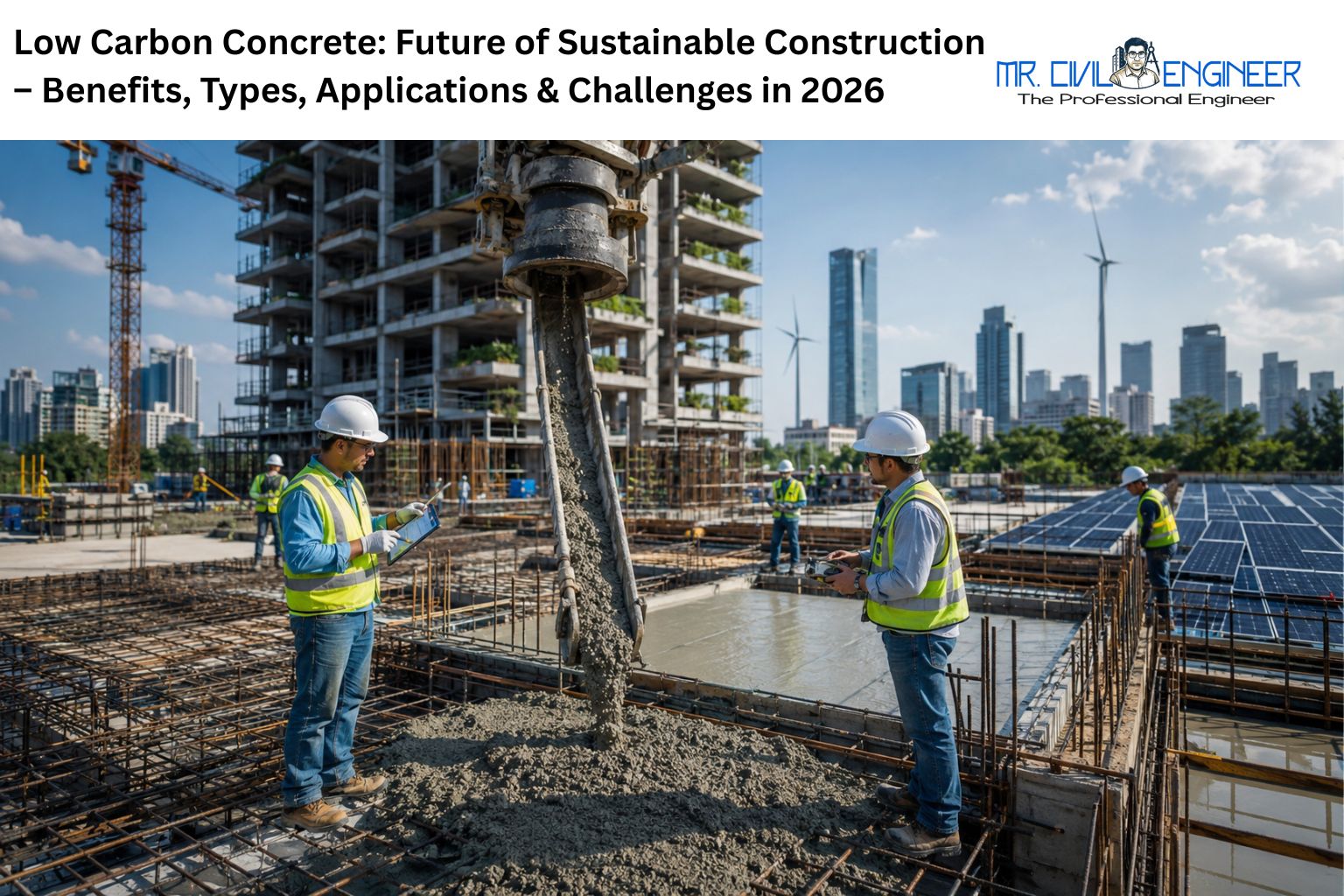
The construction industry is experiencing one of the biggest transformations in its history. For decades, concrete has been the backbone of buildings, bridges, highways, dams, and infrastructure projects worldwide. However, traditional concrete production contributes significantly to global carbon emissions, making sustainability a major concern for engineers and policymakers.
In 2026, the demand for environmentally responsible construction practices is increasing rapidly. Governments, developers, and construction companies are actively searching for solutions that reduce environmental impact without compromising strength and durability.
This is where Low Carbon Concrete emerges as a game-changing innovation.
Low carbon concrete is not simply another construction material. It represents the future of sustainable construction by reducing greenhouse gas emissions, improving resource efficiency, and supporting global net-zero goals.
Whether you are a civil engineering student, site engineer, contractor, builder, or homeowner, understanding low carbon concrete is becoming essential for future projects.
What is Low Carbon Concrete?
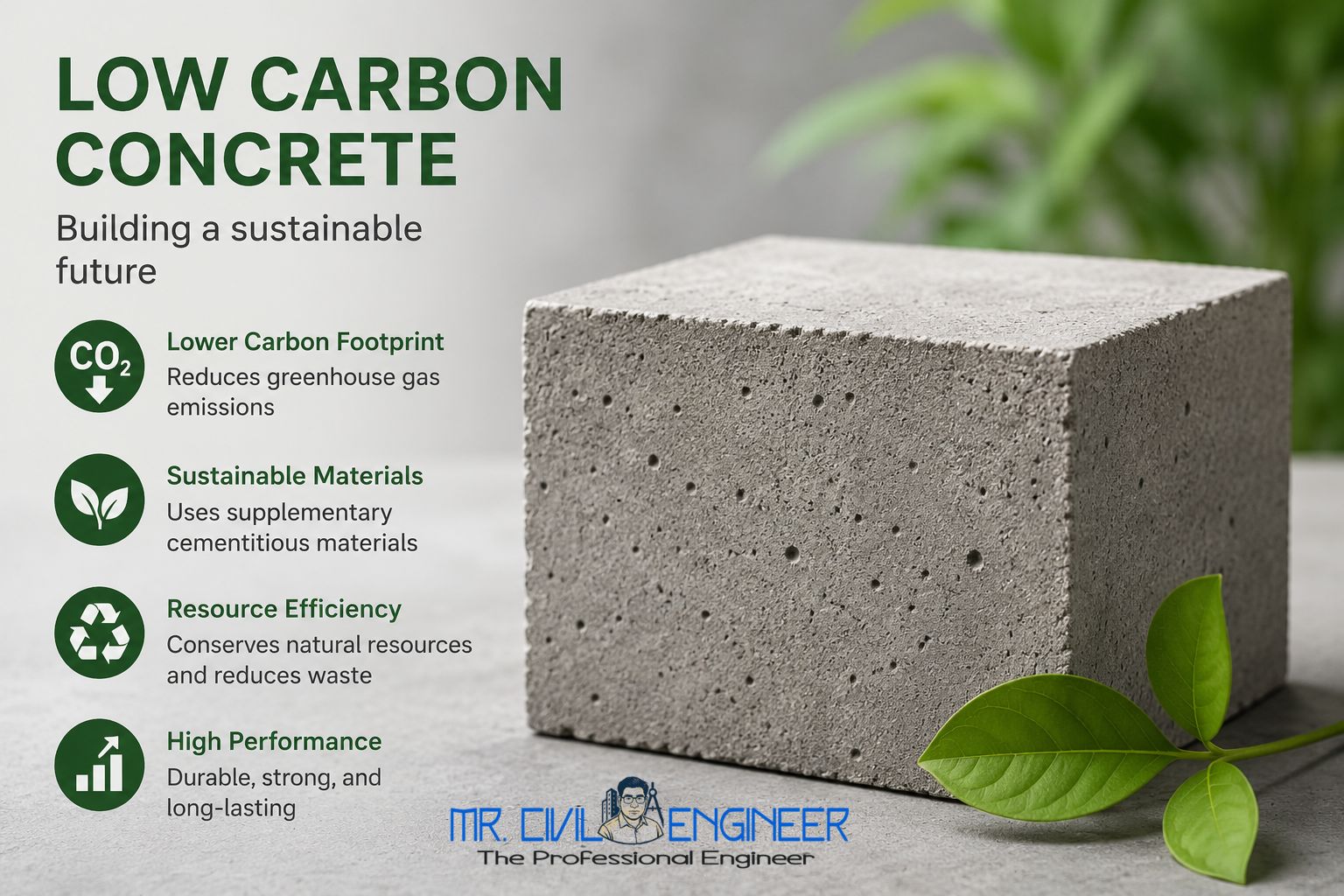
Low carbon concrete is a sustainable concrete mix specifically designed to reduce carbon dioxide emissions associated with traditional concrete production.
The primary objective is to minimize the use of ordinary Portland cement (OPC), which is responsible for the majority of concrete-related carbon emissions. Alternative cementitious materials such as fly ash, Ground Granulated Blast Furnace Slag (GGBS), silica fume, calcined clay, and other industrial by-products are incorporated into the mix.
The result is a durable, strong, and environmentally friendly concrete with significantly lower embodied carbon.
Why Concrete Has a High Carbon Footprint
Concrete itself is not the major problem. The main issue comes from cement production.
Cement Manufacturing Process
During cement production:
- Limestone is heated above 1400°C.
- Large amounts of fuel are consumed.
- Chemical reactions release carbon dioxide.
Globally, cement production contributes approximately 7–8% of total CO₂ emissions.
For every ton of cement produced, nearly one ton of carbon dioxide may be released into the atmosphere.
This makes reducing cement consumption a critical sustainability objective.
Need for Sustainable Construction in 2026
Environmental regulations are becoming stricter worldwide.
Major construction projects are now evaluated based on:
- Carbon emissions
- Resource consumption
- Energy efficiency
- Sustainability certifications
- Environmental impact
Governments and developers increasingly prefer materials that help achieve:
- Net Zero Carbon Targets
- Green Building Certifications
- ESG Compliance
- Sustainable Infrastructure Development
Low carbon concrete directly supports these objectives.
How Low Carbon Concrete Works
The concept is straightforward.
Instead of relying heavily on Portland cement, engineers replace a portion of cement with supplementary cementitious materials (SCMs).
These materials react with calcium hydroxide generated during cement hydration and form additional cementitious compounds.
As a result:
- Cement consumption decreases
- Carbon emissions reduce
- Durability improves
- Long-term strength increases
The overall environmental impact becomes significantly lower.
Types of Low Carbon Concrete
Fly Ash Based Concrete
Fly ash is a by-product of thermal power plants.
It improves:
- Workability
- Durability
- Sulfate resistance
- Long-term strength
Fly ash replacement may range from 15% to 50%.
GGBS Concrete
Ground Granulated Blast Furnace Slag is obtained from steel manufacturing.
Benefits include:
- Reduced heat of hydration
- Improved durability
- Better chloride resistance
- Lower carbon emissions
Many infrastructure projects use GGBS replacement levels between 30% and 70%.
Geopolymer Concrete
Geopolymer concrete completely eliminates Portland cement in some cases.
It utilizes:
- Fly ash
- Alkali activators
- Industrial by-products
This technology can reduce carbon emissions dramatically compared to conventional concrete.
Calcined Clay Concrete
Calcined clay is emerging as a promising sustainable material.
Advantages include:
- Wide availability
- Lower manufacturing emissions
- Reduced clinker requirement
- Excellent performance
Many researchers consider it the future of green cement technology.
Materials Used in Low Carbon Concrete
Cement Alternatives
Common alternatives include:
- Fly Ash
- GGBS
- Silica Fume
- Rice Husk Ash
- Calcined Clay
- Natural Pozzolans
Aggregates
The same aggregates used in traditional concrete can be utilized:
- Coarse Aggregate
- Fine Aggregate
- Recycled Aggregate
Recycled aggregates further enhance sustainability.
Water
Clean potable water should always be used for concrete production.
Proper water-cement ratio remains essential for strength and durability.
Manufacturing Process of Low Carbon Concrete
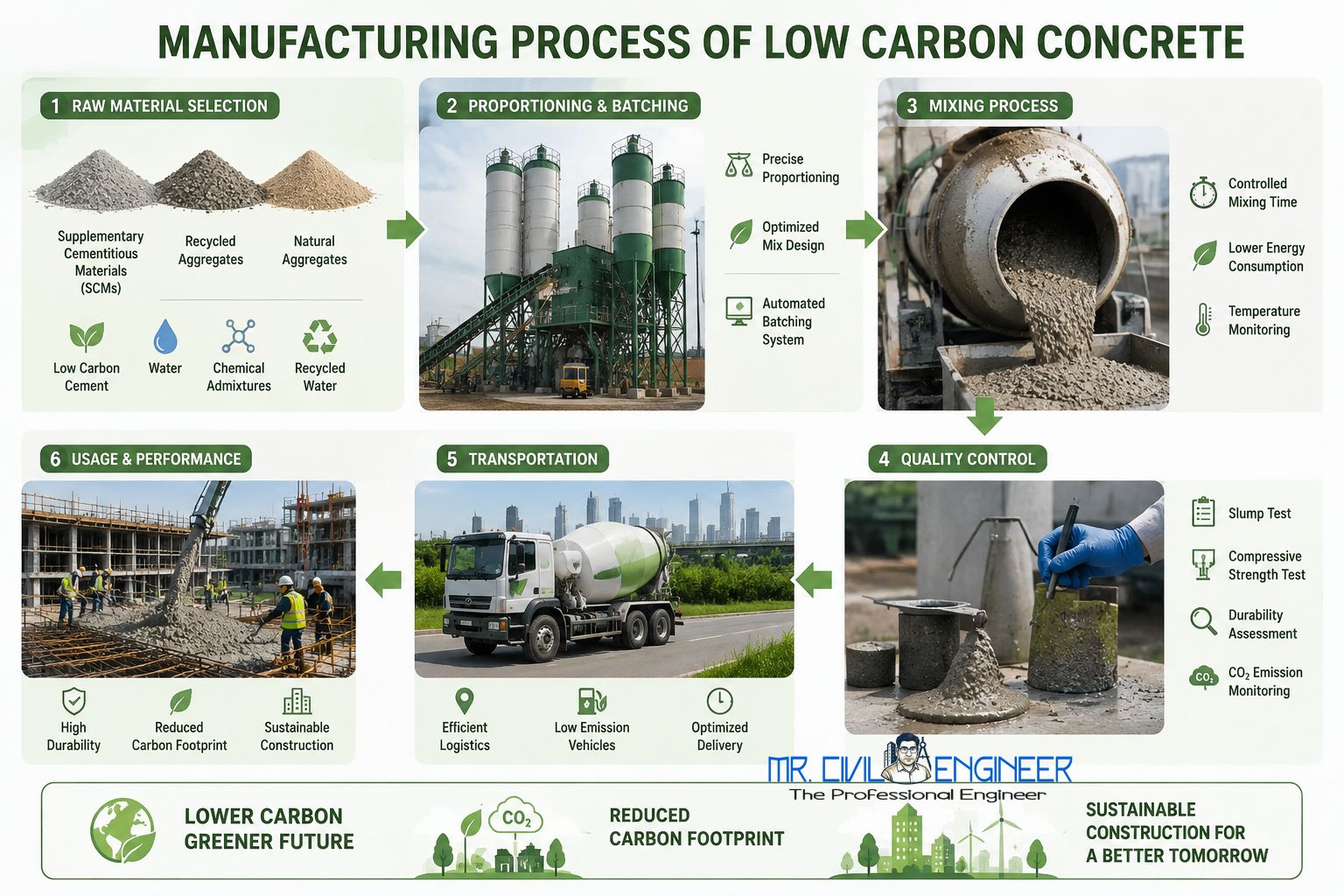
Step 1: Material Selection
Choose appropriate supplementary cementitious materials based on project requirements.
Step 2: Mix Design
Prepare laboratory trial mixes to determine:
- Strength
- Workability
- Durability
- Setting time
Step 3: Batching
Accurately measure materials using calibrated batching equipment.
Step 4: Mixing
Ensure uniform distribution of cement replacements throughout the mix.
Step 5: Placement
Concrete should be placed and compacted properly to avoid voids and honeycombing.
Step 6: Curing
Proper curing remains critical for strength development.
Many low carbon mixes gain strength gradually and require adequate curing.
Advantages of Low Carbon Concrete
Significant Carbon Reduction
The most obvious benefit is reduced carbon emissions.
Projects can achieve substantial sustainability targets.
Improved Durability
Many low carbon concrete mixes exhibit:
- Better sulfate resistance
- Lower permeability
- Improved chloride resistance
This increases service life.
Reduced Heat of Hydration
Useful for:
- Raft foundations
- Dams
- Mass concrete structures
Lower heat generation reduces cracking risk.
Better Long-Term Strength
Some SCMs continue reacting for months, increasing ultimate strength.
Waste Utilization
Industrial by-products are effectively reused, reducing landfill burden.
Disadvantages and Challenges
Slower Early Strength
Certain mixes may develop strength more slowly than OPC concrete.
Construction schedules must account for this factor.
Availability Issues
Some regions may face supply limitations of SCMs.
Quality Control Requirements
Strict testing and monitoring are essential for achieving desired performance.
Skilled Workforce Requirement
Proper understanding of mix design and curing practices is necessary.
Applications of Low Carbon Concrete
Residential Buildings
Suitable for:
- Foundations
- Columns
- Beams
- Slabs
Builders can reduce environmental impact without sacrificing quality.
Commercial Projects
Shopping malls, office complexes, and institutional buildings increasingly adopt sustainable concrete solutions.
Infrastructure Projects
Common applications include:
- Bridges
- Metro stations
- Airports
- Highways
- Tunnels
Industrial Facilities
Factories and warehouses benefit from improved durability and sustainability.
Comparison Table
| Parameter | Conventional Concrete | Low Carbon Concrete |
| Carbon Emissions | High | Low |
| Cement Consumption | High | Reduced |
| Durability | Good | Excellent |
| Long-Term Strength | Good | Better |
| Sustainability | Limited | Excellent |
| Environmental Impact | High | Low |
| Resource Efficiency | Moderate | High |
Practical Site Experience
During several large foundation and commercial building projects, GGBS-based concrete has demonstrated excellent performance.
One common observation is that the concrete remains workable for longer durations, especially in hot weather conditions.
Site engineers often report reduced thermal cracking in raft foundations and mass concrete pours.
Proper curing remains essential because low carbon concrete develops strength differently than traditional concrete.
Contractors who understand these characteristics generally achieve better quality results.
Construction Checklist
Before Concrete Placement
☑ Mix design approved
☑ Material testing completed
☑ Aggregate moisture checked
☑ Batching plant calibrated
☑ Formwork inspected
☑ Reinforcement approved
During Placement
☑ Slump checked
☑ Vibration performed
☑ Segregation avoided
☑ Placement sequence followed
After Placement
☑ Surface finishing completed
☑ Curing started
☑ Temperature monitored
☑ Cube testing conducted
Safety Considerations
Material Handling
Workers should wear PPE during material handling and batching operations.
Dust Protection
Fine cementitious materials may create dust. Proper respiratory protection is recommended.
Concrete Pumping Safety
Concrete placement equipment should be inspected regularly to avoid accidents.
Chemical Admixture Handling
Always follow manufacturer guidelines when handling admixtures and activators.
Common Mistakes to Avoid
- Assuming all low carbon concrete behaves like OPC concrete.
- Ignoring curing requirements.
- Using untested replacement percentages.
- Neglecting quality control testing.
- Selecting unsuitable SCMs for exposure conditions.
- Poor storage of cementitious materials.
- Inadequate supervision during batching.
Pro Tips
Pro Tip 1
Always perform laboratory trial mixes before large-scale production to verify strength, workability, durability, and setting characteristics accurately.
Pro Tip 2
Maintain proper curing for at least seven to fourteen days because many sustainable mixes gain strength gradually.
Pro Tip 3
Use GGBS in mass concrete foundations to reduce thermal cracking and improve long-term durability performance significantly.
Pro Tip 4
Monitor slump regularly during placement because different supplementary materials may influence workability and consistency behavior.
Pro Tip 5
Combine recycled aggregates with low carbon concrete wherever practical to maximize sustainability benefits and resource efficiency.
Future Trends of Low Carbon Concrete
The future of sustainable construction strongly depends on carbon reduction technologies.
Emerging innovations include:
- Carbon Capture Concrete
- Carbon Mineralization
- AI-Based Mix Optimization
- Self-Healing Concrete
- Net Zero Concrete Production
- Carbon-Negative Building Materials
By 2030 and beyond, low carbon concrete is expected to become a standard material rather than an alternative option.
Frequently Asked Questions (FAQs)
Is low carbon concrete stronger than normal concrete?
In many cases, long-term strength can equal or exceed conventional concrete when properly designed and cured.
Can low carbon concrete be used in residential houses?
Yes. It is suitable for foundations, columns, beams, slabs, and other structural elements.
Does low carbon concrete cost more?
Initial costs may sometimes be slightly higher, but lifecycle costs are often lower due to improved durability.
What is the most common low carbon concrete material?
Fly ash and GGBS are among the most widely used supplementary cementitious materials worldwide.
Is low carbon concrete environmentally friendly?
Yes. It significantly reduces carbon emissions and supports sustainable construction objectives.
Conclusion
Low Carbon Concrete is no longer a future concept—it is becoming a practical necessity for modern construction. As the industry moves toward sustainable infrastructure and net-zero carbon targets, reducing cement-related emissions is one of the most effective ways to lower environmental impact.
For civil engineers, contractors, builders, and homeowners, adopting low carbon concrete means building structures that are durable, environmentally responsible, and future-ready. Whether through fly ash, GGBS, geopolymer technology, or emerging cement alternatives, sustainable concrete solutions are transforming how we design and construct buildings.
The future of construction belongs to materials that balance strength, durability, cost-effectiveness, and sustainability. Low carbon concrete is leading that transformation.
Latest Articles
- Earthquake-Resistant Building Techniques: How Modern Buildings Survive Earthquakes
- Importance of Structural Drawings on Site: A Complete Guide for Civil Engineers, Contractors & Homeowners
- How to Design an Underground Bunker: Step-by-Step Guide 2026
- Soil Bearing Capacity Explained Simply (Civil Engineering Guide)
- Common Causes of Wall Cracks & Repairs – Complete Guide