
Earthquakes are among the most destructive natural disasters on Earth. Within a few seconds, a strong earthquake can damage buildings, disrupt infrastructure, and put thousands of lives at risk. While engineers cannot prevent earthquakes, they can design and construct buildings that withstand seismic forces and protect occupants.
This is where earthquake-resistant building techniques become extremely important. Modern structural engineering has made remarkable progress in understanding how buildings behave during earthquakes. Today, engineers use advanced design methods, special construction materials, and innovative structural systems to minimize earthquake damage.
Whether you are a civil engineering student, site engineer, contractor, architect, or property owner, understanding these techniques can help you appreciate how safe buildings are created.
In this comprehensive guide, you will learn:
- What earthquake-resistant construction means
- How earthquakes affect buildings
- Essential earthquake-resistant building techniques
- Structural design principles used by engineers
- Common construction mistakes
- Practical tips for safer buildings
Let’s explore the science behind earthquake-resistant structures.
What Is an Earthquake-Resistant Building?
An earthquake-resistant building is a structure designed and constructed to withstand seismic forces without collapsing.
The primary goal is not necessarily to prevent all damage. Instead, the objective is:
- Protect human life
- Prevent structural collapse
- Minimize repair costs
- Maintain building functionality after moderate earthquakes
A properly designed building can sway, deform, and absorb energy during an earthquake while remaining stable.
Understanding How Earthquakes Affect Buildings
Before learning earthquake-resistant techniques, it is important to understand what happens during an earthquake.
When tectonic plates move, they release energy in the form of seismic waves. These waves travel through the ground and create vibrations.
Buildings experience:
Horizontal Forces
Horizontal ground movement creates the most severe damage because buildings are primarily designed to carry vertical loads.
Vertical Forces
Upward and downward shaking can affect foundations and structural members.
Torsional Forces
If a building has an irregular shape, different parts move differently, causing twisting effects.
Resonance Effects
If the building’s natural vibration frequency matches the earthquake frequency, shaking can become amplified.
This is why proper structural design is essential.
Why Earthquake-Resistant Construction Is Important
Earthquake-resistant buildings offer several advantages:
- Improved life safety
- Reduced structural damage
- Lower maintenance costs
- Better disaster resilience
- Faster post-earthquake recovery
- Increased property value
In earthquake-prone regions, these benefits are critical.
Key Principles of Earthquake-Resistant Design
Successful seismic design is based on several engineering principles.
1. Structural Ductility
Ductility is the ability of a structure to deform without collapsing.
Instead of breaking suddenly, ductile structures bend and absorb energy.
Examples include:
- Reinforced concrete structures
- Structural steel frames
- Composite structures
High ductility significantly improves earthquake performance.
2. Structural Strength
Buildings must have adequate strength to resist seismic forces.
This includes:
- Strong columns
- Properly designed beams
- Adequate shear walls
- Strong foundations
However, strength alone is not enough. A structure must also be flexible.
3. Structural Stiffness
Stiffness controls building deformation.
A balance between stiffness and flexibility is necessary.
Too much flexibility causes excessive movement.
Too much stiffness increases seismic forces.
4. Continuous Load Path
Earthquake forces must travel safely through the structure.
A continuous load path includes:
- Roof
- Floors
- Beams
- Columns
- Foundations
Weak connections can lead to structural failure.
Top Earthquake-Resistant Building Techniques
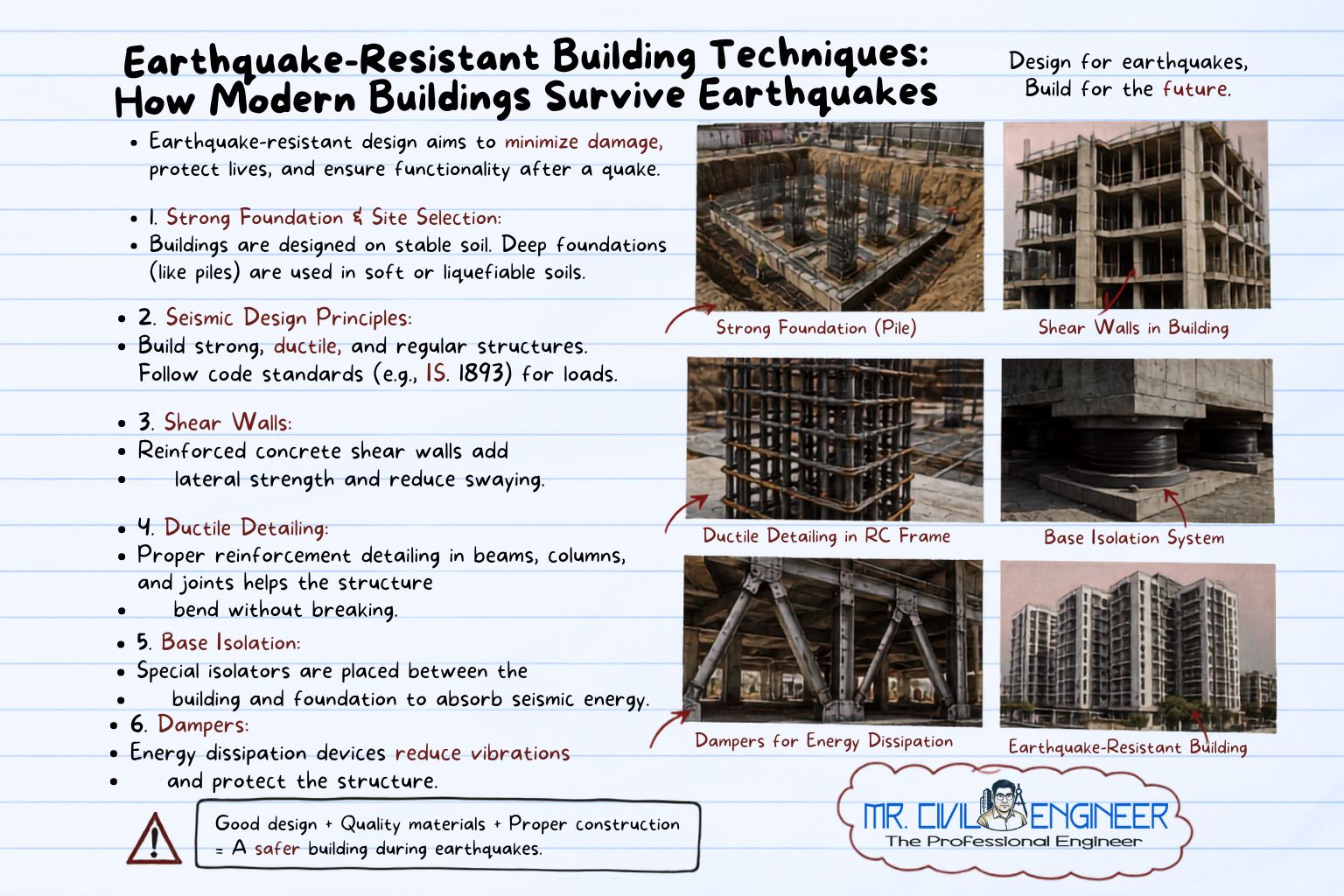
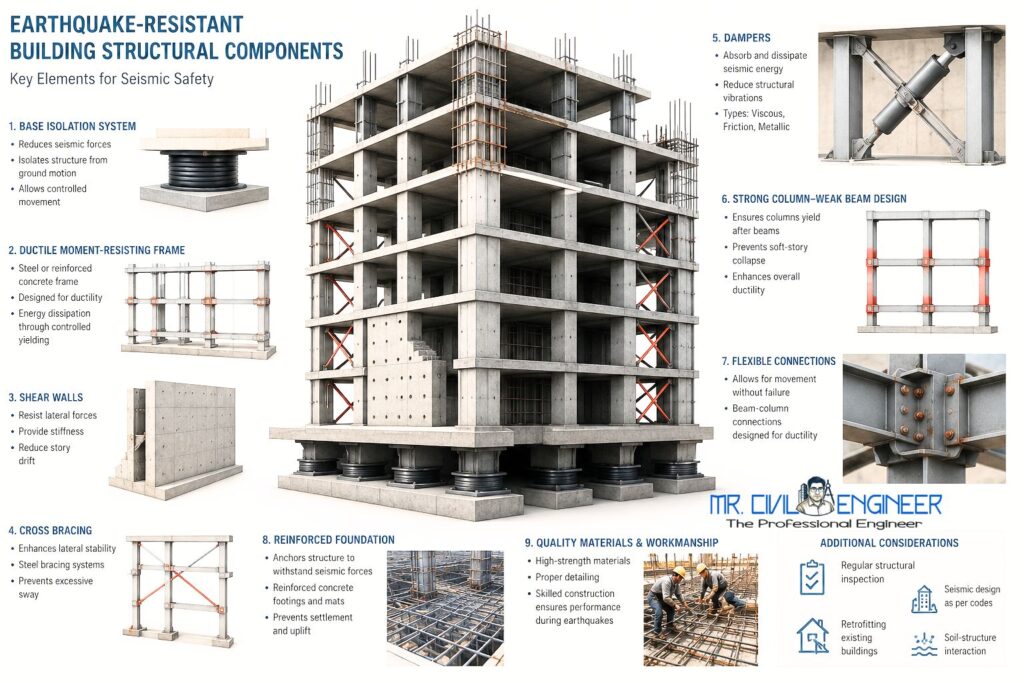
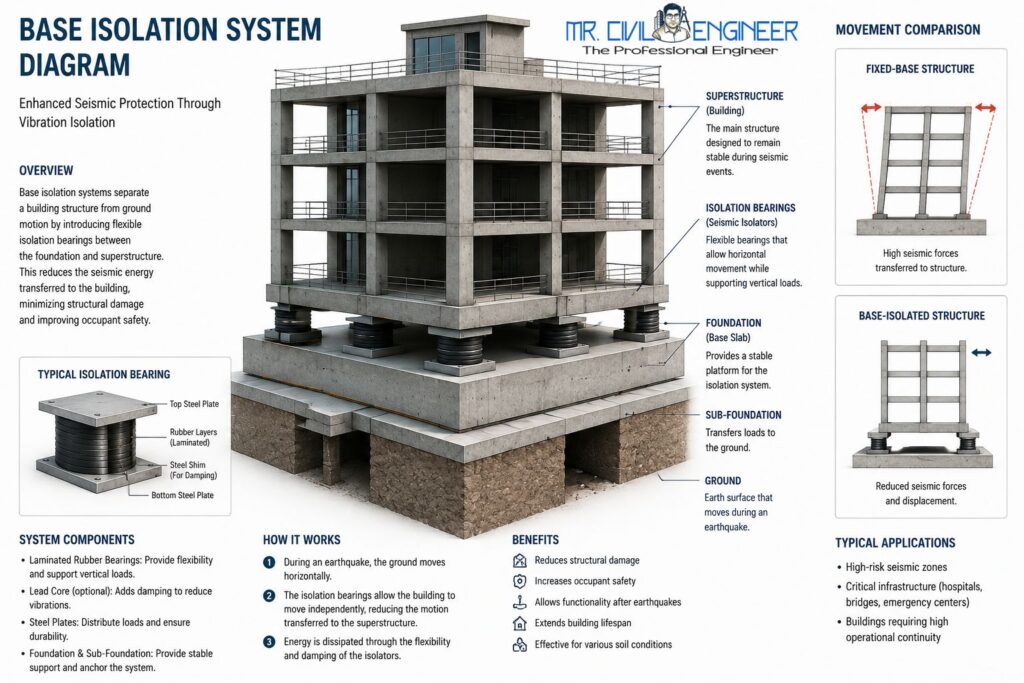
1. Base Isolation System
Base isolation is one of the most effective earthquake-resistant building techniques.
How It Works
Special bearings are installed between the foundation and the building.
These bearings:
- Absorb seismic energy
- Reduce ground motion transfer
- Allow controlled movement
Benefits
- Significant reduction in structural damage
- Improved occupant safety
- Protection of sensitive equipment
Real-World Example
Many hospitals, government buildings, and bridges use base isolation systems in seismic zones.
2. Shear Walls
Shear walls are vertical structural elements that resist horizontal earthquake forces.
Function
They:
- Increase lateral strength
- Reduce building sway
- Improve stability
Common Materials
- Reinforced concrete
- Structural steel
- Reinforced masonry
Best Locations
- Elevator cores
- Staircase areas
- Exterior walls
Shear walls are commonly used in high-rise buildings.
3. Cross Bracing Systems
Cross bracing improves structural stability.
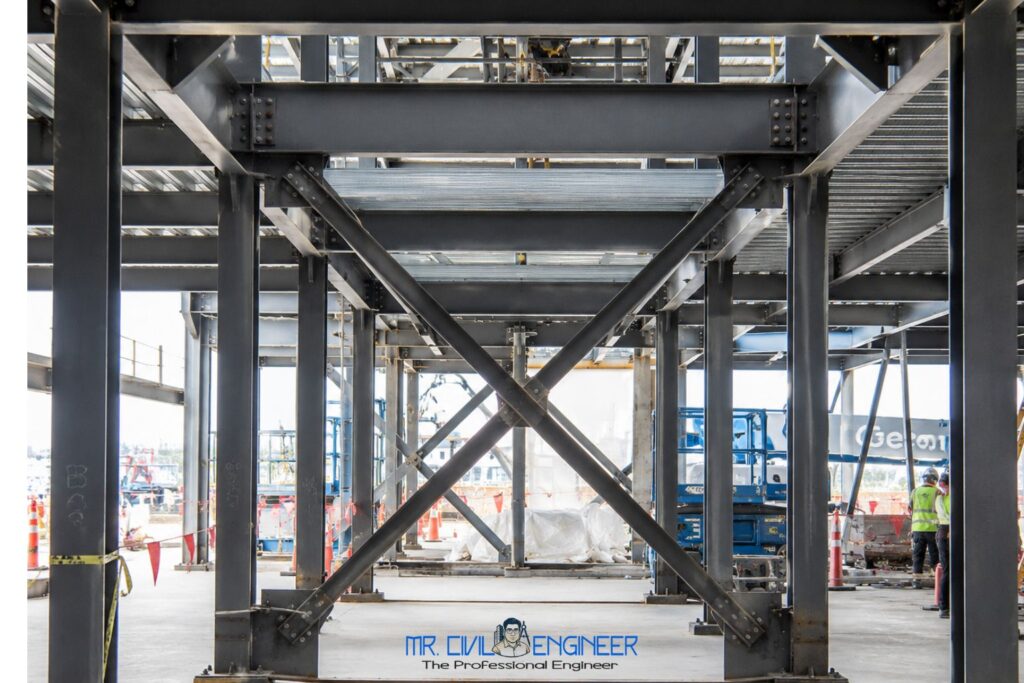
Types
- X-bracing
- K-bracing
- Diagonal bracing
Advantages
- Increased lateral resistance
- Better load distribution
- Cost-effective seismic strengthening
Steel bracing systems are widely used in commercial buildings.
4. Moment-Resisting Frames
Moment-resisting frames use rigid beam-column connections.
These connections:
- Transfer bending moments
- Allow controlled movement
- Dissipate seismic energy
Benefits
- Architectural flexibility
- Open floor layouts
- Excellent seismic performance
Modern steel structures often use moment-resisting frames.
5. Energy Dissipation Devices
These devices absorb earthquake energy before it reaches the structure.
Examples
- Viscous dampers
- Friction dampers
- Metallic dampers
Benefits
- Reduced structural vibration
- Lower damage levels
- Enhanced building safety
Many modern skyscrapers use damping systems.
6. Flexible Foundations
Flexible foundations help buildings move with the ground.
Purpose
- Reduce stress concentration
- Improve seismic performance
- Prevent sudden foundation failure
Foundation design should always consider local soil conditions.
7. Lightweight Construction Materials
Heavier structures experience greater earthquake forces.
Using lightweight materials helps reduce seismic loads.
Common Lightweight Materials
- AAC blocks
- Lightweight concrete
- Steel framing
- Fiber cement boards
Reducing building mass directly reduces earthquake forces.
8. Proper Reinforcement Detailing
Even strong concrete can fail without proper reinforcement.
Important Practices
- Adequate anchorage length
- Proper stirrup spacing
- Strong beam-column joints
- Correct lap splicing
Good detailing improves ductility and energy absorption.
9. Strong Column–Weak Beam Concept
This is a fundamental seismic design philosophy.
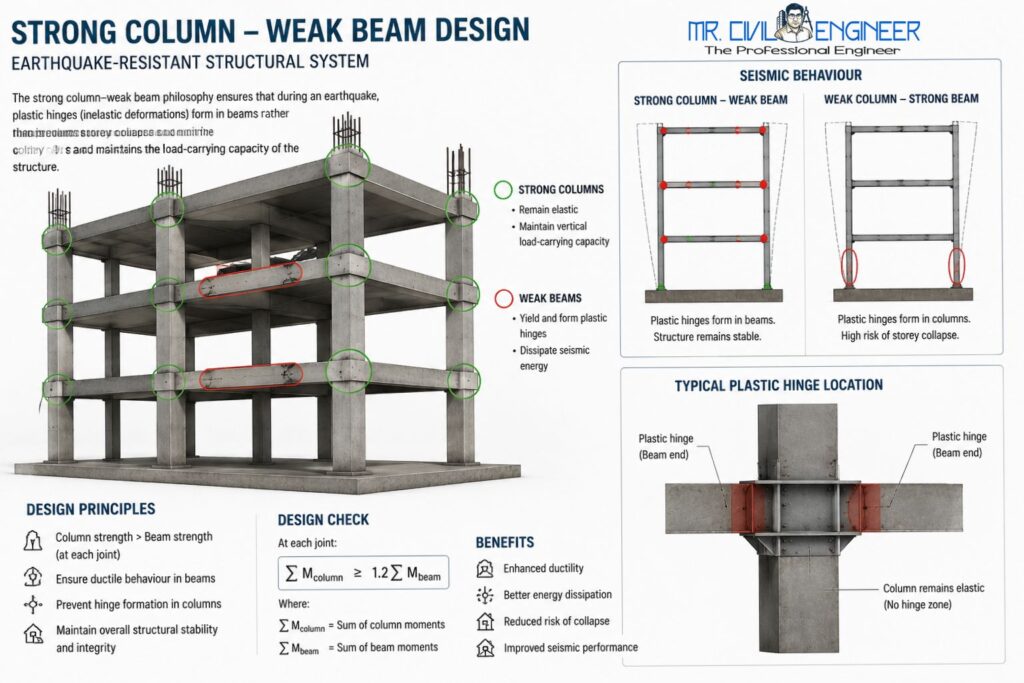
Objective
Columns should remain stronger than beams.
During an earthquake:
- Beams yield first
- Columns remain stable
- Progressive collapse is prevented
This concept is widely used in earthquake-resistant design codes.
10. Seismic Retrofitting of Existing Buildings
Many older buildings were not designed for earthquakes.
Retrofitting improves their seismic performance.
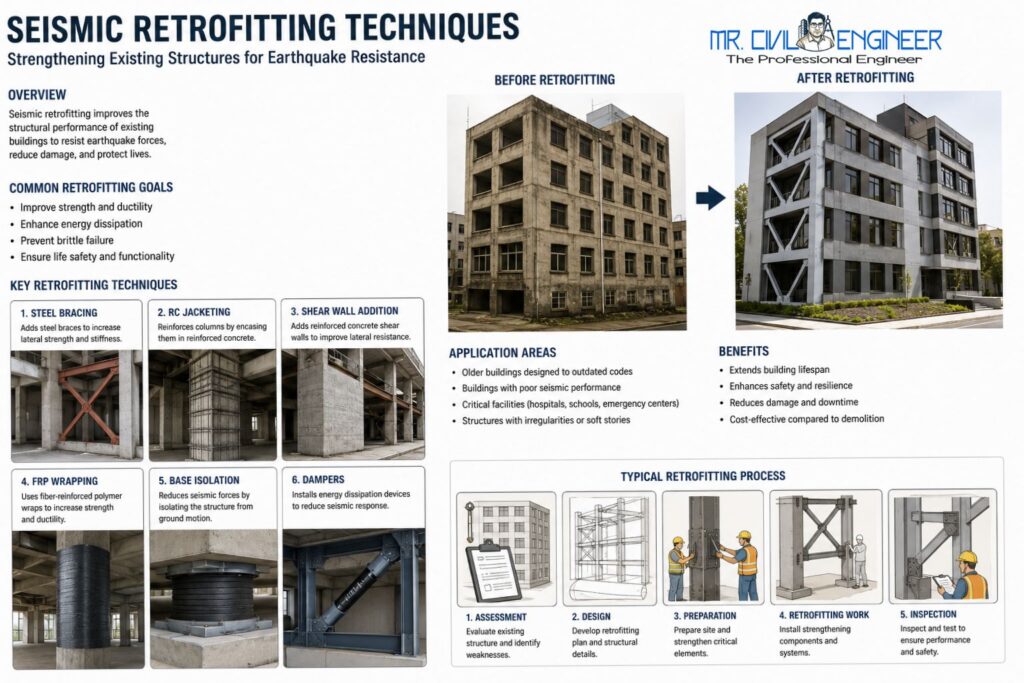
Common Retrofitting Methods
- Steel jacketing
- Concrete jacketing
- FRP wrapping
- Additional shear walls
- Foundation strengthening
Retrofitting is often more economical than rebuilding.
Earthquake-Resistant Construction Materials
Reinforced Concrete
Advantages:
- High compressive strength
- Good durability
- Excellent seismic performance with proper detailing
Structural Steel
Advantages:
- High ductility
- Lightweight
- Fast construction
Steel performs exceptionally well during earthquakes.
Fiber-Reinforced Polymer (FRP)
FRP is used for strengthening structures.
Benefits include:
- Corrosion resistance
- Lightweight nature
- High tensile strength
Engineered Timber
Modern timber systems can perform surprisingly well during earthquakes because of their flexibility and light weight.
Importance of Soil Investigation
Even a well-designed structure can fail on poor soil.
A detailed geotechnical investigation helps determine:
- Soil bearing capacity
- Liquefaction potential
- Groundwater level
- Settlement characteristics
Proper foundation selection depends on accurate soil data.
Earthquake-Resistant Design for Residential Buildings
Homeowners can improve safety by following these practices:
Use Symmetrical Building Layouts
Symmetrical buildings experience less torsion.
Avoid Soft Storeys
Open parking at the ground floor can create weak levels.
Ensure Quality Construction
Use:
- Quality cement
- Proper reinforcement
- Skilled labor
Follow Building Codes
Always comply with local seismic design standards.
Earthquake-Resistant Design for High-Rise Buildings
Tall buildings require advanced seismic systems.
Common solutions include:
- Shear wall cores
- Outrigger systems
- Tuned mass dampers
- Base isolation
- Structural steel framing
These systems control excessive movement during earthquakes.
Step-by-Step Process for Earthquake-Resistant Construction
Step 1: Site Selection
Avoid:
- Fault zones
- Landslide-prone areas
- Liquefaction-prone soils
Step 2: Soil Investigation
Conduct detailed geotechnical studies.
Step 3: Structural Design
Perform seismic analysis according to applicable codes.
Step 4: Material Selection
Choose high-quality materials with proven performance.
Step 5: Reinforcement Detailing
Ensure proper placement and anchorage.
Step 6: Quality Construction
Maintain strict supervision during construction.
Step 7: Inspection and Testing
Verify:
- Concrete quality
- Reinforcement placement
- Structural connections
Common Mistakes in Earthquake-Resistant Construction
Many building failures occur because of avoidable mistakes.
1. Ignoring Soil Investigation
Poor soil conditions can cause severe foundation damage.
2. Poor Reinforcement Detailing
Improper detailing reduces ductility.
3. Weak Beam-Column Joints
Joints are critical seismic zones.
4. Unauthorized Structural Changes
Removing walls or columns weakens the structure.
5. Soft Storey Design
Ground-floor parking without proper strengthening increases risk.
6. Low-Quality Materials
Inferior materials reduce overall structural capacity.
7. Non-Compliance with Building Codes
Ignoring seismic regulations can lead to catastrophic failures.
Pro Tips for Earthquake-Resistant Buildings
Tip 1
Always engage qualified structural engineers during planning.
Tip 2
Follow local seismic design codes without compromise.
Tip 3
Use ductile detailing in reinforced concrete structures.
Tip 4
Perform regular structural inspections.
Tip 5
Retrofit older buildings located in seismic zones.
Tip 6
Pay special attention to beam-column joints.
Tip 7
Invest in quality materials rather than cosmetic upgrades.
Tip 8
Ensure proper supervision throughout construction.
Real-World Lessons from Major Earthquakes
Several earthquakes worldwide have shown that properly designed buildings perform significantly better than poorly constructed ones.
Key lessons include:
- Good detailing saves lives.
- Structural symmetry improves performance.
- Quality construction is as important as design.
- Building codes must be followed strictly.
- Regular maintenance enhances resilience.
Modern engineering continuously improves earthquake-resistant technologies based on these lessons.
Future Trends in Earthquake-Resistant Construction
The construction industry is adopting advanced technologies such as:
- Smart structural monitoring systems
- AI-based structural health assessment
- High-performance concrete
- Shape memory alloys
- Advanced damping systems
- Seismic isolation technologies
These innovations will make future buildings even safer.
Conclusion
Earthquakes cannot be prevented, but their impact on buildings can be dramatically reduced through proper engineering and construction practices. Earthquake-resistant building techniques such as base isolation, shear walls, cross bracing, moment-resisting frames, energy dissipation systems, and proper reinforcement detailing play a crucial role in protecting lives and property.
The success of any earthquake-resistant structure depends on a combination of sound design, quality materials, skilled construction, and strict adherence to building codes. Whether constructing a small residential house or a high-rise tower, incorporating seismic safety measures from the beginning is always more effective and economical than repairing earthquake damage later.
A safer building is not just an engineering achievement—it is an investment in human safety, resilience, and long-term sustainability.
Disclaimer
This article is intended for educational and informational purposes only. Structural design and earthquake-resistant construction should always be performed by qualified civil and structural engineers according to local building codes and regulations.
Frequently Asked Questions (FAQs)
1. What is the most effective earthquake-resistant building technique?
Base isolation is considered one of the most effective techniques because it significantly reduces the transfer of seismic forces from the ground to the structure.
2. Why are shear walls important in earthquake-resistant buildings?
Shear walls resist horizontal seismic forces, reduce building sway, and improve overall structural stability during earthquakes.
3. Can existing buildings be made earthquake-resistant?
Yes. Existing buildings can be strengthened through seismic retrofitting methods such as steel jacketing, FRP wrapping, additional shear walls, and foundation improvements.
4. Which material performs best during earthquakes?
Structural steel generally performs very well due to its high ductility and ability to absorb seismic energy without sudden failure.
5. Why is soil investigation important for earthquake-resistant construction?
Soil conditions greatly influence foundation behavior during earthquakes. Proper investigation helps engineers select suitable foundations and identify risks such as liquefaction and settlement.
Latest Article
- Importance of Structural Drawings on Site: A Complete Guide for Civil Engineers, Contractors & Homeowners
- How to Design an Underground Bunker: Step-by-Step Guide 2026
- Soil Bearing Capacity Explained Simply (Civil Engineering Guide)
- Common Causes of Wall Cracks & Repairs – Complete Guide
- Bathroom Waterproofing – Step-by-Step Complete Guide