
A new bungalow in Bangalore tilts just months after completion—black cotton soil swelled with monsoon rains, unchecked by basic tests. Stories like this highlight why skipping soil investigation risks everything from cracks to collapse.
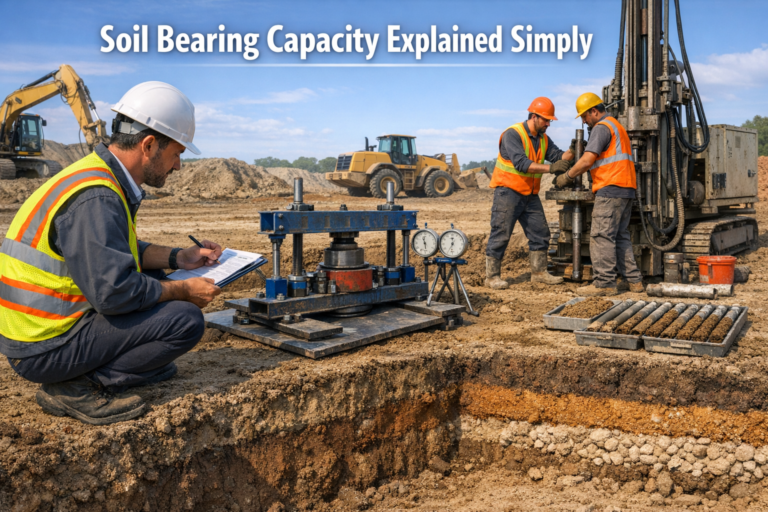
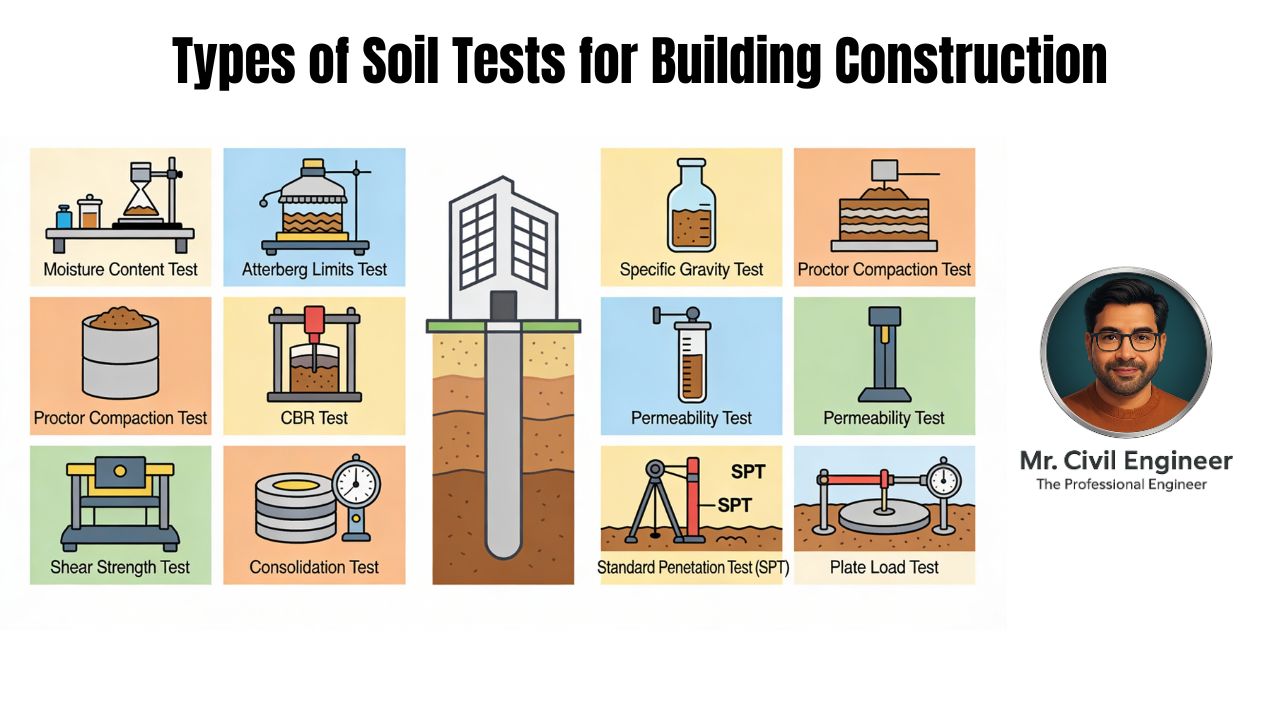
Soil tests reveal bearing capacity, compressibility, and type (sandy/clayey), guiding foundation choices like isolated footings or piles. This guide covers the top 12 types of soil tests for building construction—lab and field—with methods, uses, and Indian context per IS 2720.
Why Soil Testing is Non-Negotiable
Before breaking ground:
- Determines safe load (e.g., 100–200 kN/m² for sands).
- Predicts settlement (critical for clays).
- Classifies soil (SPT N-value >10 safe for shallow foundations).
- Saves 20–30% on overdesign; mandatory for high-rises per NBC.
Typical cost: ₹10,000–50,000 for small sites (2–3 days).
Laboratory Soil Tests
Samples go to lab for precise analysis.
Moisture Content Test
Measures water % by oven-drying (105°C).
- Use: Affects strength (high moisture = weak clay).
- Method: Weigh wet/dry soil.
Atterberg Limits Test
Defines fine soil behavior: liquid limit (LL, Casagrande cup), plastic limit (PL, roll thread), shrinkage limit (SL).
- Use: Classify clays/silts; plasticity index (PI=LL-PL) predicts swelling.
- Example: PI>20 = expansive soil, needs deep piles.
Specific Gravity Test
Ratio of soil solid weight to water (pycnometer method, 2.6–2.7 typical).
- Use: Void ratio, porosity calc for compaction.
Proctor Compaction Test
Finds optimum moisture content (OMC) for max dry density (MDD).
- Use: Embankments/fill compaction (Standard/Modified Proctor).
- Field tip: Compact at OMC ±2%.
Shear Strength & Consolidation Tests
- Direct Shear/Triaxial: Friction angle/cohesion (φ, c).
- Consolidation: Settlement rate under load (oedometer).
- Use: Slopes, retaining walls, clay foundations.
Field/In-Situ Soil Tests
Direct site testing for real conditions.
Dry Density Test
In-place density excluding moisture.
- Core Cutter: Hammer cylinder, excavate, weigh (fine soils).
- Sand Replacement: Pour calibrated sand into pit (coarse).
- Use: Compaction check (>95% Proctor MDD).
Standard Penetration Test (SPT)
Drive 63.5kg hammer 75cm, count blows for 30cm penetration (N-value).
- Use: Bearing capacity (N>10 safe); every 1.5m borehole.
- Example: Mumbai high-rises use SPT for piles.
Plate Load Test
Load 45cm plate, measure settlement.
- Use: Shallow foundations (ultimate capacity = load/settlement curve).
- Limitation: Shallow only (1–2m).
California Bearing Ratio (CBR) Test
Penetrate piston into soaked soil, compare to standard.
- Use: Roads/pavements but key for subgrade under footings.
Permeability Test
Constant/falling head in borehole.
- Use: Drainage (k>10^-5 cm/s sandy).
Auger Boring/Core Drilling
Extract samples/profiles to 10–30m.
- Use: Soil strata mapping for high-rises.
| Test | Lab/Field | Key Output | Best For |
|---|---|---|---|
| Moisture Content | Lab | Water % | All soils |
| Atterberg Limits | Lab | PI, LL | Clays |
| SPT | Field | N-value | Bearing capacity |
| Plate Load | Field | Ultimate load | Shallow foundations |
| Proctor | Lab | OMC/MDD | Compaction |
| Dry Density | Field | Density % | Quality control |
How to Choose Soil Tests for Your Project
- G+1 House: Moisture, dry density, SPT, plate load (₹15k).
- High-rise: Full suite + triaxial/consolidation (₹50k+).
- Roads: CBR + Proctor.
Timeline: Field 1–2 days, lab 3–7 days.
Pro tip: Bore 1 hole/500m²; undisturbed samples via Shelby tube.
Common Mistakes and Best Practices
- Mistake: Surface tests only (miss soft layers).
- Fix: 1.5x foundation depth.
- India-specific: Test for expansive soils (Montmorillonite clays); follow IS 2720.
Hire NABL-accredited labs for reports.
FAQs
Most important soil test for foundations?
SPT and plate load for bearing capacity.
Soil test cost in India?
₹10k–50k depending on boreholes/depth.
How many types of soil tests?
12+ common; select 4–6 per project.
Core cutter or sand replacement?
Core cutter for fines; sand for gravels.
Conclusion
Mastering types of soil tests for building construction ensures your foundations stand firm against settlement, swelling, or shear. From simple moisture checks to advanced SPT, each reveals soil secrets guiding safe, economical designs.
Never skip—invest ₹20k upfront to save lakhs later. Consult a geotech engineer, follow IS codes, and build confidently.
Read This Also
Latest Building Materials in Construction (2026 Update)
How to Estimate Brickwork and Rate Analysis with Example
Artificial Intelligence in Civil Engineering: How Smart Infrastructure is Being Built
Advanced Materials for Civil Engineering: Trends & Applications