
Introduction
Before constructing any building, bridge, or structure, engineers must answer one important question:
Can the soil safely support the weight of the structure?
The ground beneath a building plays a crucial role in its stability. If the soil is weak and unable to carry the structural load, the building may experience cracks, settlement, or even collapse.
This ability of soil to safely support loads is known as soil bearing capacity.
Understanding soil bearing capacity is essential for civil engineers, architects, and construction professionals. It helps determine the type of foundation required and ensures the long-term safety of the structure.
In this article, we will explain soil bearing capacity in the simplest possible way, including types, factors affecting it, testing methods, and practical examples from construction projects.
What is Soil Bearing Capacity?
Soil bearing capacity refers to the maximum load per unit area that soil can safely support without failure or excessive settlement.
In simple terms:
It is the strength of soil to carry the weight of a structure.
If the applied load exceeds the soil bearing capacity, the soil may fail and cause foundation problems.
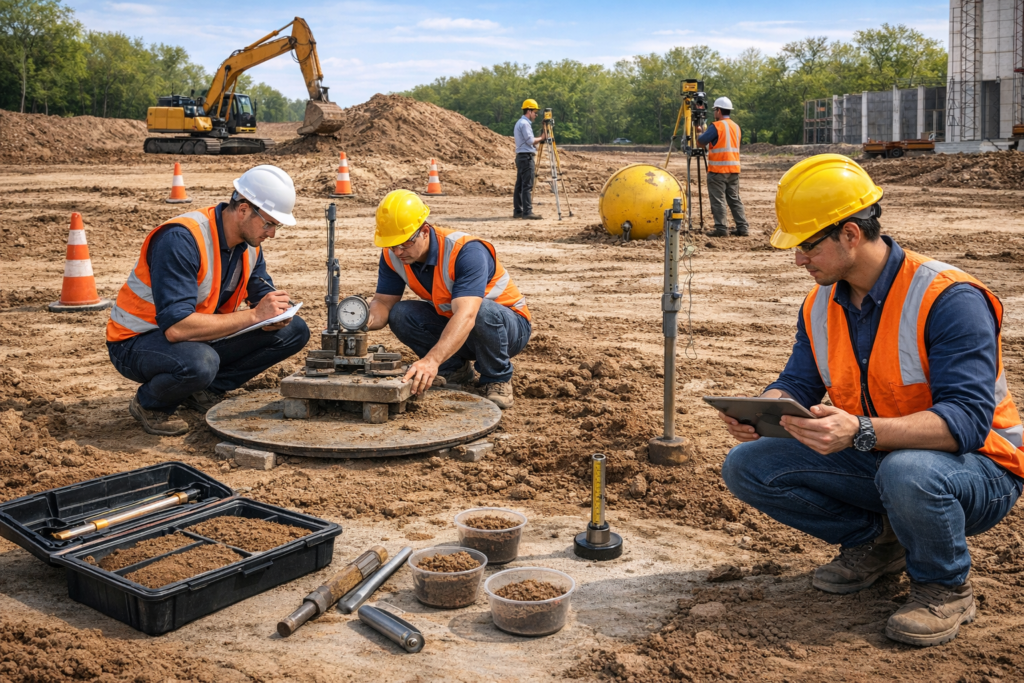
Simple Example
Imagine placing a heavy object on sand.
If the object is too heavy, it will sink into the sand.
But if the soil is strong and compact, it can support the load without sinking.
This concept represents soil bearing capacity.
Why Soil Bearing Capacity is Important
Soil bearing capacity plays a major role in foundation design.
Understanding soil capacity helps engineers:
- Select suitable foundation type
- Prevent foundation settlement
- Avoid structural damage
- Ensure building safety
Without proper soil investigation, construction projects may face serious structural issues.
Types of Soil Bearing Capacity
Soil bearing capacity is generally classified into three types.
1. Ultimate Bearing Capacity
Ultimate bearing capacity is the maximum pressure soil can withstand before failure occurs.
At this stage, the soil experiences shear failure and cannot support additional load.
However, structures are never designed using ultimate bearing capacity because it does not include safety factors.
2. Safe Bearing Capacity (SBC)
Safe bearing capacity is the maximum load that soil can safely support without risk of failure.
It is calculated by applying a factor of safety to the ultimate bearing capacity.
Example:
If ultimate bearing capacity = 300 kN/m²
Factor of safety = 3
Safe bearing capacity = 100 kN/m²
3. Allowable Bearing Capacity
Allowable bearing capacity considers both:
- Soil strength
- Settlement limits
This value ensures that the structure remains stable without excessive settlement.
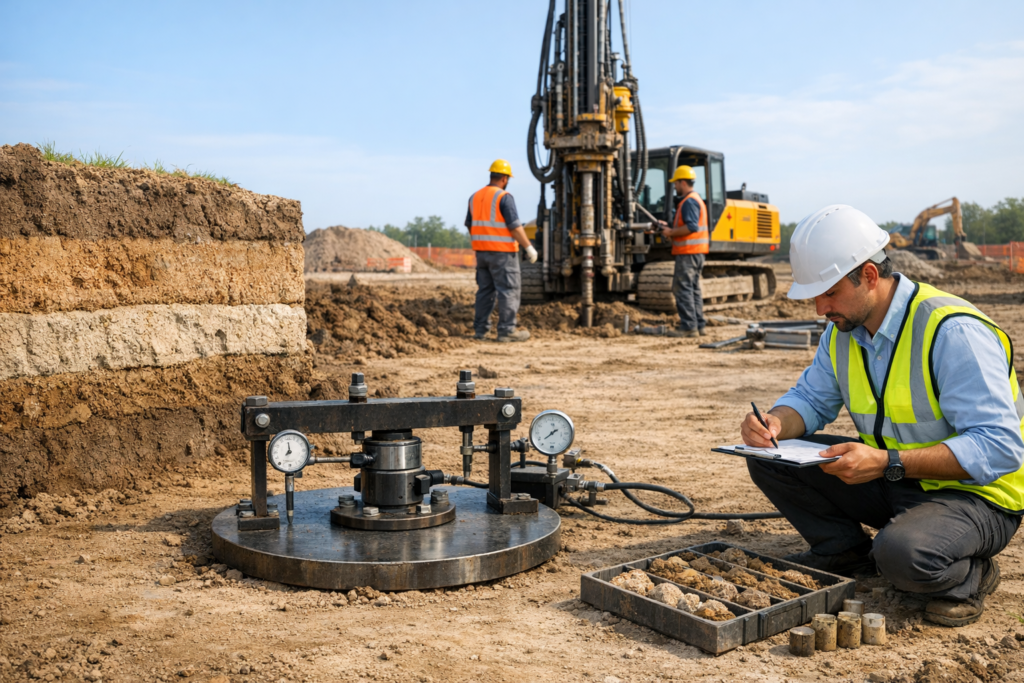
Typical Bearing Capacity of Different Soils
Different soil types have different load-bearing capacities.
| Soil Type | Bearing Capacity (kN/m²) |
|---|---|
| Hard Rock | 1000+ |
| Gravel | 300–600 |
| Dense Sand | 200–400 |
| Clay | 100–200 |
| Soft Clay | 50–100 |
These values are approximate and vary depending on site conditions.
Factors Affecting Soil Bearing Capacity
Several factors influence soil bearing capacity.
1. Soil Type
Different soils have different strengths.
For example:
- Rock → very strong
- Sand → moderate strength
- Clay → weaker strength
2. Soil Density
Dense soils provide higher bearing capacity compared to loose soils.
3. Moisture Conten
Excess water reduces soil strength and bearing capacity.
4. Depth of Foundation
Deeper foundations usually have higher bearing capacity.
5. Groundwater Level
High groundwater levels reduce soil strength.
Methods to Determine Soil Bearing Capacity
Engineers use several tests to determine soil capacity.
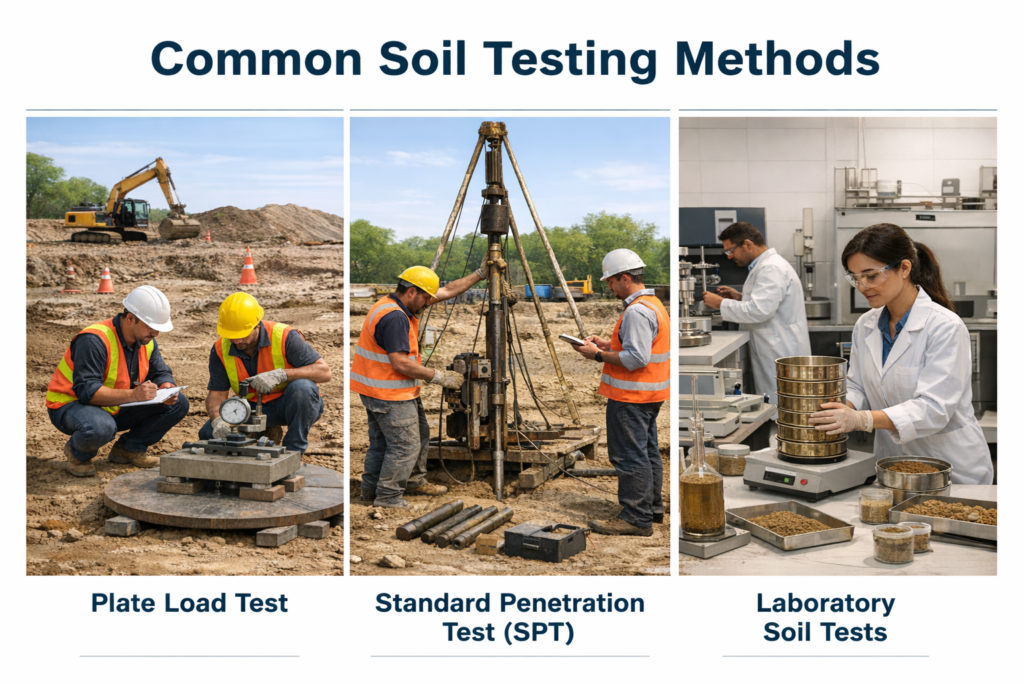
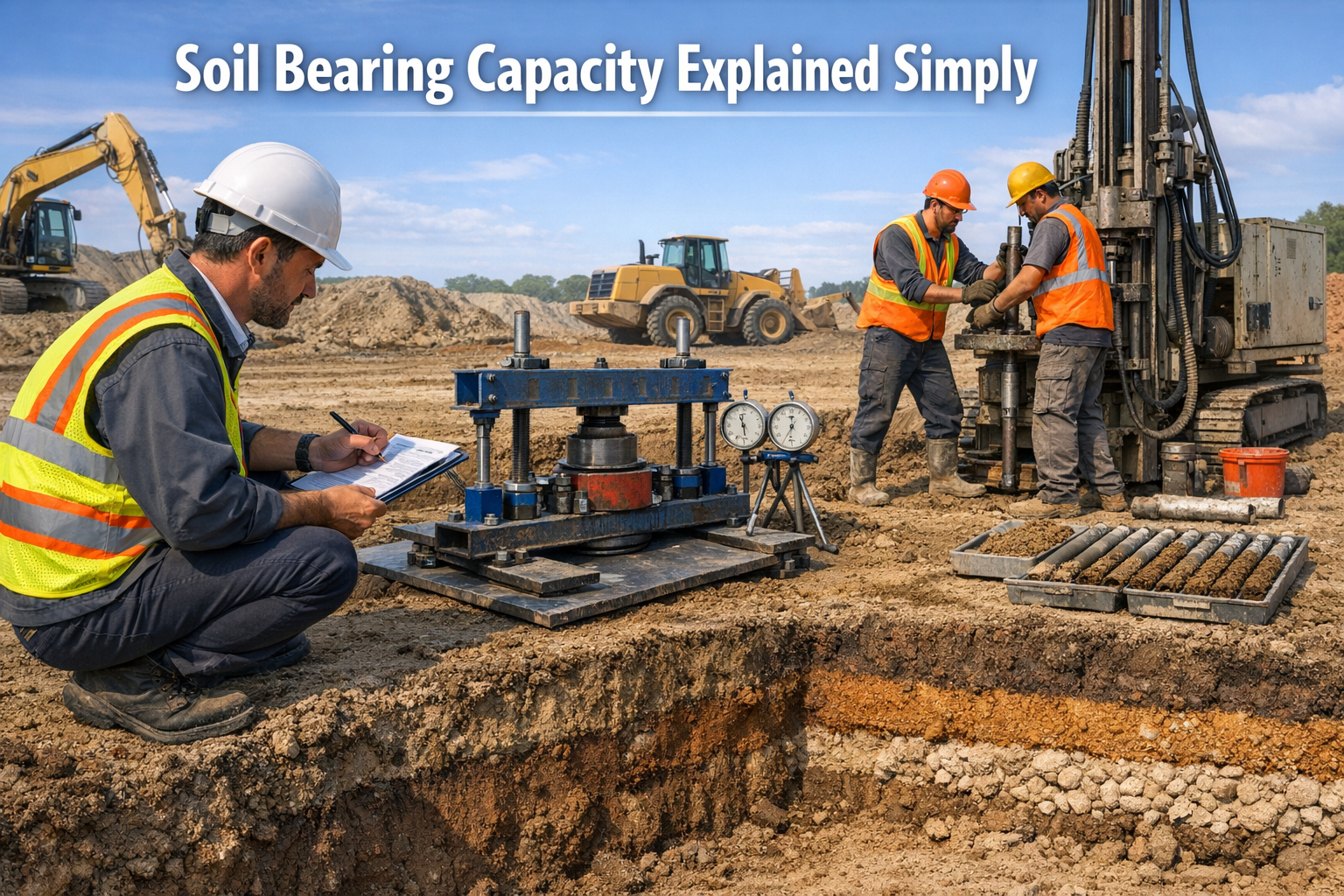
Plate Load Test
Plate load test is a field test used to determine soil bearing capacity directly at the construction site.
A steel plate is placed on the soil and gradually loaded to observe settlement.
Standard Penetration Test (SPT)
SPT measures soil resistance using a hammer-driven sampler.
The number of blows required to penetrate soil indicates soil strength.
Laboratory Soil Tests
Some laboratory tests include:
- Triaxial test
- Direct shear test
- Consolidation test
These tests help determine soil strength parameters.
Soil Bearing Capacity Formula
One of the most famous formulas used in geotechnical engineering is Terzaghi’s Bearing Capacity Equation.
It is used to calculate ultimate bearing capacity considering soil properties.
The equation considers factors such as:
- Soil cohesion
- Soil friction angle
- Foundation depth
- Soil density
Signs of Poor Soil Bearing Capacity
Weak soil may cause several structural problems.
Common warning signs include:
- Cracks in walls
- Uneven floors
- Foundation settlement
- Tilting structures
- Doors and windows not closing properly
How to Improve Soil Bearing Capacity
Engineers can improve soil capacity using various methods.
Soil Compaction
Compaction increases soil density and strength.
Soil Stabilization
Materials such as cement, lime, or chemicals are added to improve soil strength.
Grouting
Grouting fills soil voids with cement slurry to increase stability.
Deep Foundations
Pile foundations transfer loads to deeper, stronger soil layers.
Soil Bearing Capacity for Residential Buildings
For small residential buildings, soil bearing capacity is typically between:
100 kN/m² to 200 kN/m²
However, soil tests are always recommended before construction.
Real-Life Example of Soil Failure
Many buildings have experienced structural damage due to poor soil investigation.
In some cases, buildings constructed on soft clay soils experienced severe settlement, leading to cracks and structural instability.
This is why geotechnical investigation is a critical step before construction.
FAQs
What is safe bearing capacity of soil?
Safe bearing capacity is the maximum load soil can safely support considering safety factors.
How is soil bearing capacity calculated?
It is determined through soil testing methods such as plate load test, SPT, and laboratory tests.
What is SBC for residential buildings?
Typically between 100–200 kN/m², depending on soil type.
Which soil has highest bearing capacity?
Hard rock and dense gravel soils have the highest bearing capacity.
Conclusion
Soil bearing capacity is one of the most important concepts in foundation engineering.
Before constructing any structure, engineers must carefully evaluate the soil’s ability to carry structural loads.
Proper soil investigation ensures:
- Safe foundation design
- Reduced settlement risk
- Long-term structural stability
Understanding soil bearing capacity helps engineers build strong, durable, and safe structures.