

Introduction: Why Slab Thickness Is Not “Just a Number”
One of the most common questions in house construction is:
“How thick should my slab be?”
Many people assume slab thickness is decided randomly—100 mm here, 125 mm there. In reality, slab thickness is a structural decision that directly affects safety, deflection, cracks, and long-term durability.
Whether you are a civil engineering student, site engineer, or homeowner, understanding slab thickness calculation for one-way and two-way slabs will help you avoid costly mistakes.
Let’s break it down—simply, practically, and visually.
What Is an RCC Slab?
An RCC slab is a horizontal structural element that:
- Carries dead load (self-weight)
- Carries live load (people, furniture)
- Transfers load safely to beams, columns, and walls
The slab mainly resists bending and deflection, which is why thickness matters.
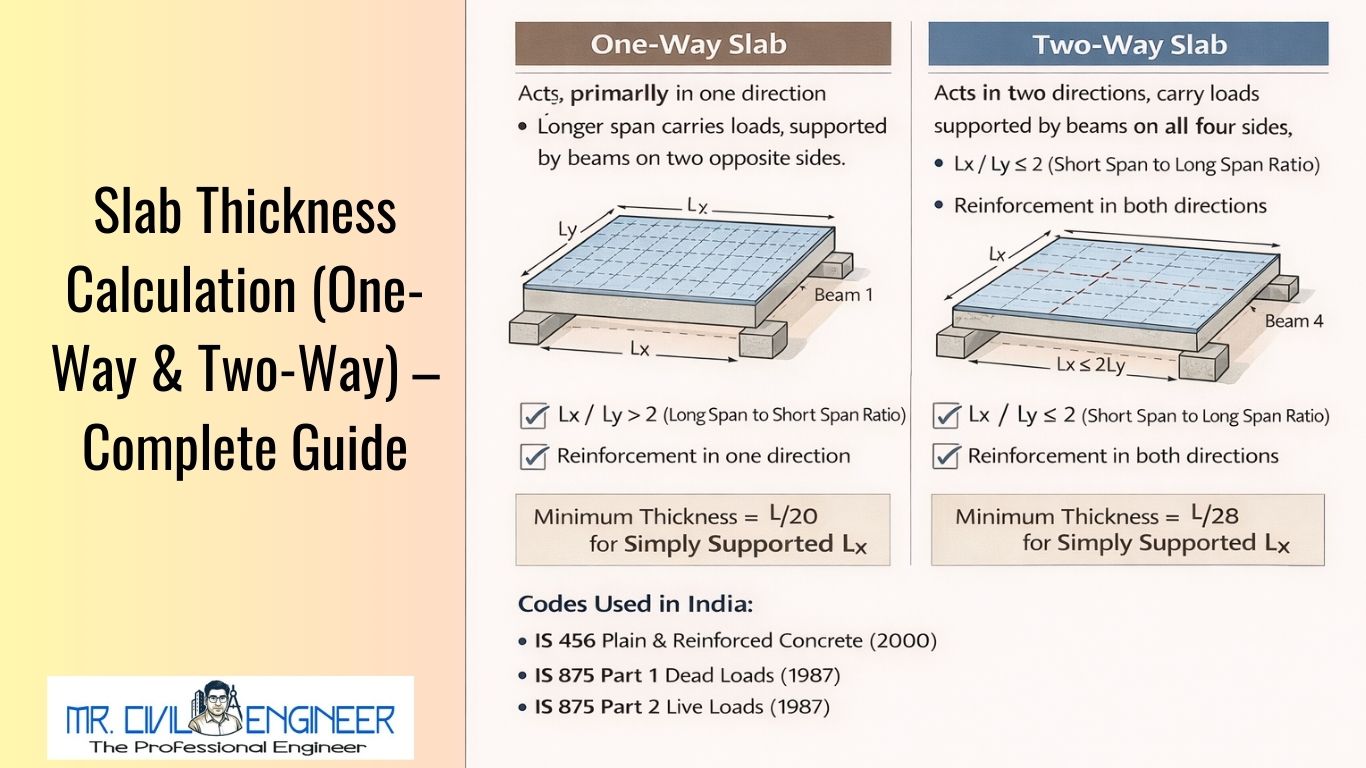
One-Way Slab Explained
What Is a One-Way Slab?
A slab is called one-way when:
- The longer span / shorter span ≥ 2
- Load is transferred mainly in one direction
Where One-Way Slabs Are Used
- Narrow rooms
- Corridors
- Verandahs
- Typical residential layouts with rectangular rooms
Structural Behavior
- Bending mainly occurs along the shorter span
- Main reinforcement is placed along the shorter span
Two-Way Slab Explained
What Is a Two-Way Slab?
A slab is two-way when:
- Longer span / shorter span < 2
- Load is distributed in both directions
Common Applications
- Square or near-square rooms
- Living rooms
- Bedrooms
- Office floors
Structural Behavior
- Bending occurs in both directions
- Reinforcement is provided in both spans
Key Difference: One-Way vs Two-Way Slab
| Aspect | One-Way Slab | Two-Way Slab |
|---|---|---|
| Span Ratio | ≥ 2 | < 2 |
| Load Transfer | One direction | Two directions |
| Reinforcement | Mainly one direction | Both directions |
| Thickness | Slightly higher | Slightly lower |
Slab Thickness Calculation – Core Principle
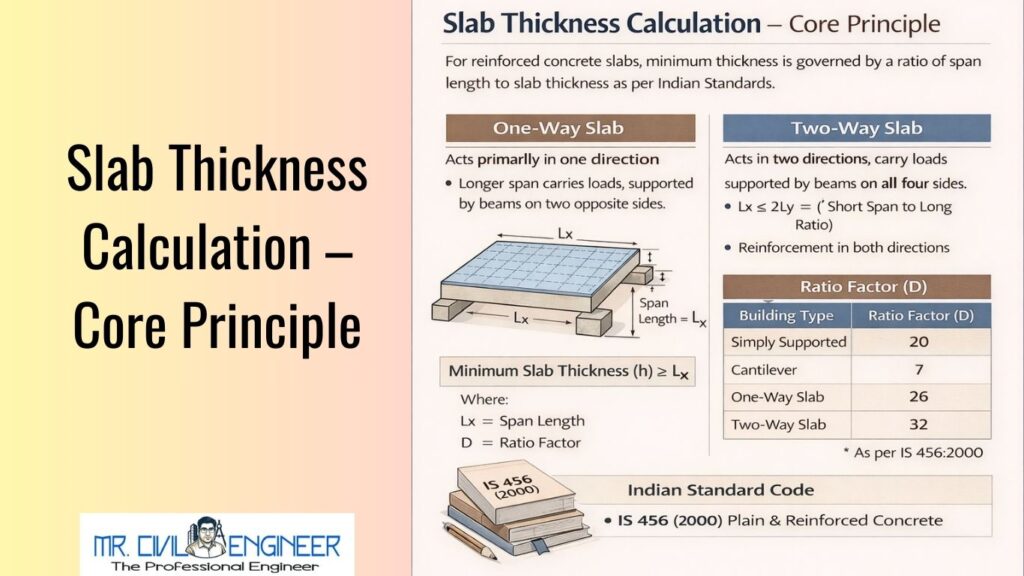
The main controlling factor for slab thickness is:
Deflection control
Instead of complex formulas, structural design often starts with span-to-depth ratios (thumb rules derived from IS code practice).
One-Way Slab Thickness Calculation
Thumb Rule (Common Practice)
Effective depth ≈ Span / 20
Practical Residential Example
- Shorter span = 4.0 m
- Effective depth = 4000 / 20 = 200 mm
- Add cover + bar diameter (~25–30 mm)
👉 Overall slab thickness ≈ 125–150 mm
Commonly Used Thickness
- Residential buildings: 120–150 mm
- Light loads: 110–120 mm
- Heavy loads: 150 mm and above
Two-Way Slab Thickness Calculation
Thumb Rule (Simplified)
Effective depth ≈ Shorter span / 25 to 30
Example
- Shorter span = 3.6 m
- Effective depth = 3600 / 28 ≈ 130 mm
- Including cover → 110–130 mm slab thickness
Commonly Adopted Thickness
- Residential houses: 110–125 mm
- Commercial floors: 130–160 mm
Minimum Slab Thickness (Good Practice)
| Location | Minimum Thickness |
|---|---|
| Residential slab | 110 mm |
| Commercial slab | 130 mm |
| Cantilever slab | 125–150 mm |
| Staircase slab | 150 mm |
⚠️ Never use less than 100 mm slab thickness, even for small spans.
Common Mistakes to Avoid
❌ Copy-pasting slab thickness from nearby buildings
❌ Ignoring span length
❌ Reducing thickness to save cement
❌ Not considering future load changes
Remember:
A thin slab saves money today but costs repairs tomorrow.
Frequently Asked Questions (FAQs)
Is 100 mm slab thickness safe?
Only for very small spans and light loads. Not recommended for standard rooms.
Can slab thickness be reduced?
Yes, but only after structural design and deflection checks.
Which slab is stronger: one-way or two-way?
Both are safe when designed properly. Two-way slabs distribute load more efficiently.
Conclusion: The Smart Way to Decide Slab Thickness
Slab thickness is not guesswork. It depends on:
- Span length
- Slab type
- Load
- Deflection control
While thumb rules help in understanding, final slab thickness should always be confirmed by a structural engineer.
If you understand the basics, you’ll:
✅ Ask better questions
✅ Avoid site-level mistakes
✅ Build safer, longer-lasting structures


its superb as your other posts : D, thankyou for putting up.
Perfectly pent articles, Really enjoyed looking through.