

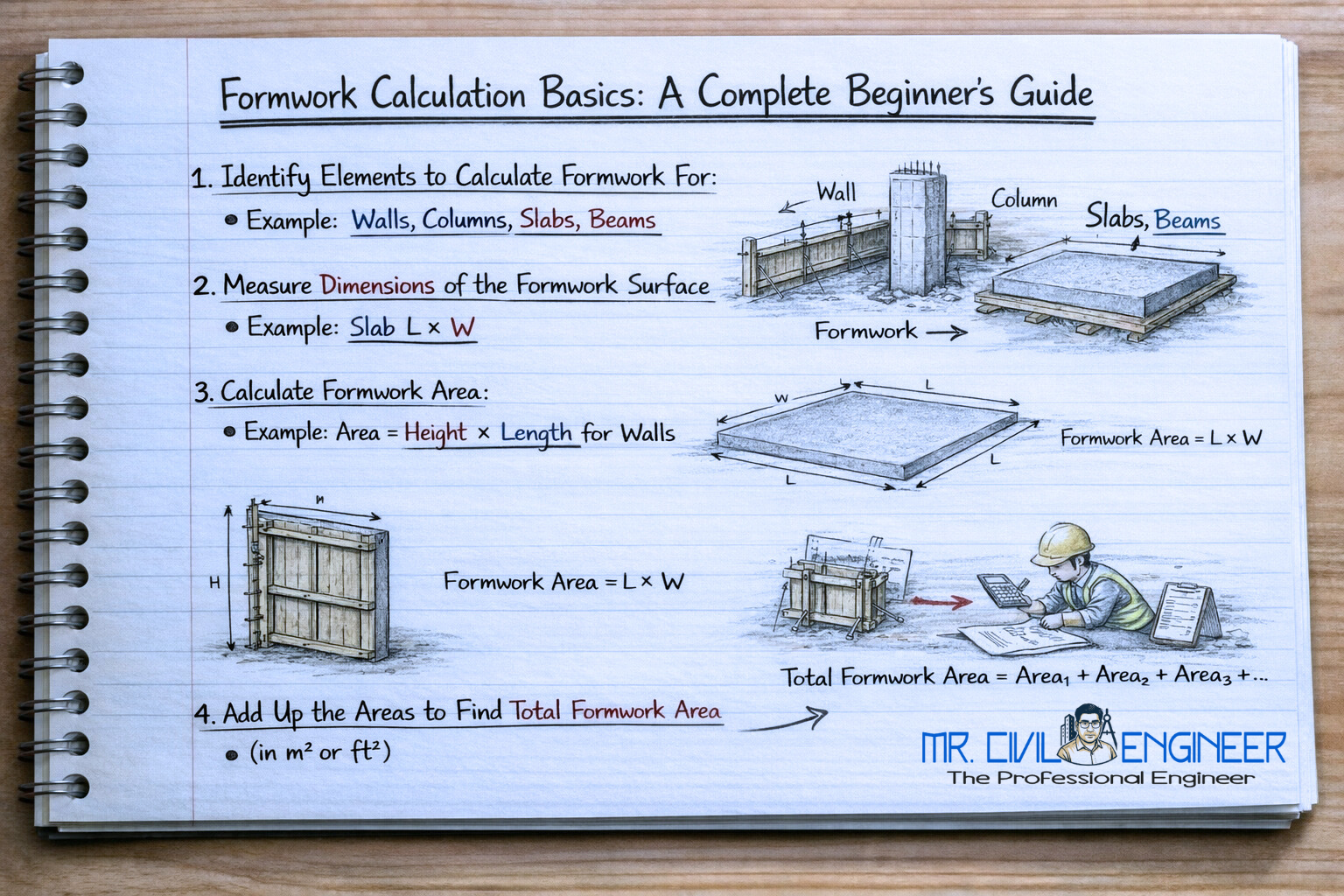
Have you ever stood on a construction site and wondered how much shuttering material is actually required before pouring concrete? Or maybe you’re a civil engineering student trying to understand why formwork is measured in square meters and not cubic meters?
You’re not alone.
Formwork calculation is one of the most confusing topics for beginners in construction — yet it plays a huge role in cost control, safety, and project planning. A small mistake in shuttering estimation can increase project cost by thousands.
In this guide, we’ll explain formwork calculation basics in a simple, practical, and site-friendly way.
What is Formwork?
Formwork is the temporary structure used to support freshly placed concrete until it gains enough strength to stand on its own.
It acts like a mould that gives shape to:
- Slabs
- Beams
- Columns
- Footings
- Walls
Formwork is usually made of:
- Plywood
- Steel plates
- Timber
- Aluminium systems
Why Formwork Calculation is Important
Accurate formwork estimation helps in:
✅ Controlling project cost
✅ Planning material quantity
✅ Deciding labor requirements
✅ Scheduling construction work
✅ Avoiding material wastage
✅ Ensuring safety and quality
In RCC works, formwork cost can be 20–25% of total concrete cost, which makes its calculation extremely important.
Unit of Measurement for Formwork
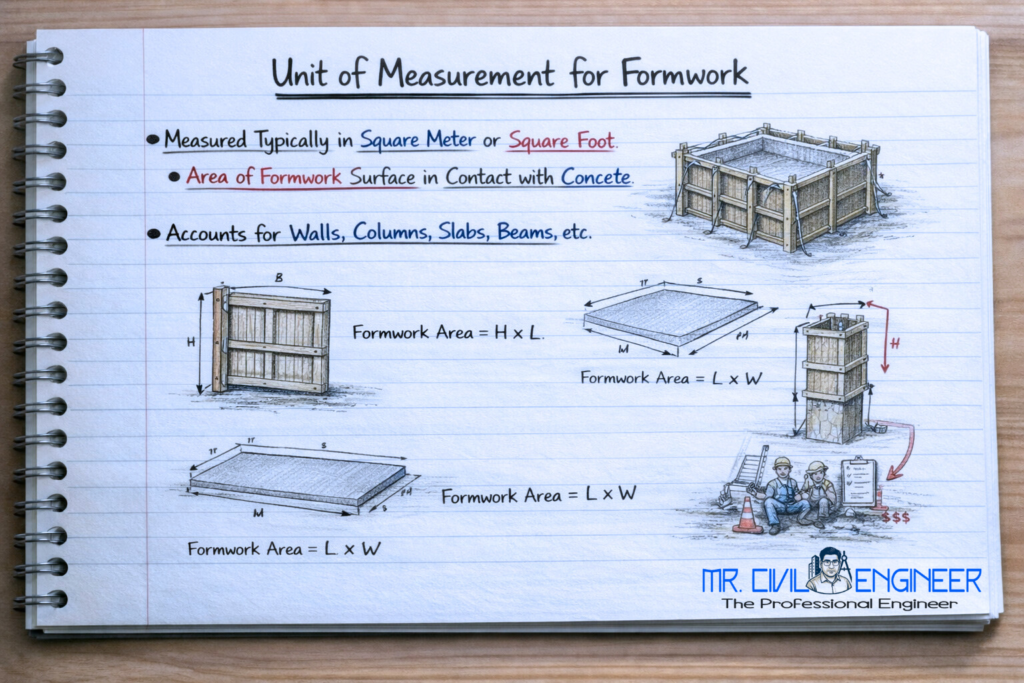
Formwork is measured in Square Meter (m²).
Why?
Because we calculate the surface area of concrete that comes in contact with shuttering, not the volume of concrete.
📌 Concrete = measured in m³
📌 Formwork = measured in m²
Example:
If a slab is 4 m × 5 m, the concrete volume depends on thickness, but the formwork depends on area in contact with shuttering.
Basic Formula for Formwork Calculation
Formwork Area = Surface area of concrete in contact with formwork
In simple terms:
Measure the length and height (or width) of every surface where shuttering is required and calculate the area.
Formwork Calculation for Different Structural Elements
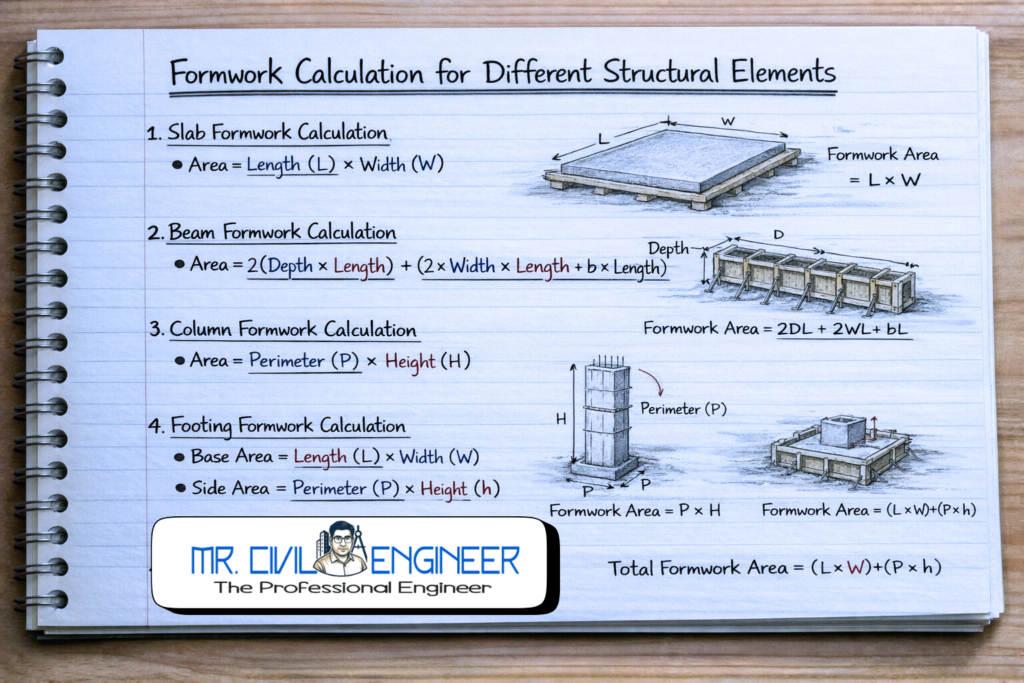
1. Slab Formwork Calculation
For slab, shuttering is required only at the bottom surface.
Formula:
Slab formwork area = Length × Width
Example:
Slab size = 5 m × 4 m
Formwork = 5 × 4 = 20 m²
👉 No shuttering on top side because concrete is poured there.
2. Beam Formwork Calculation
Beam has:
- Bottom surface
- Two side surfaces
Formula:
Beam formwork =
Bottom area + Side areas
= (Length × width) + 2 × (Length × depth)
Example:
Beam size = 4 m long, 0.3 m wide, 0.45 m deep
Bottom = 4 × 0.3 = 1.2 m²
Sides = 2 × (4 × 0.45) = 3.6 m²
Total = 4.8 m²
3. Column Formwork Calculation
Column requires shuttering on all four sides.
Formula:
Column formwork = Perimeter × Height
= 2 × (Length + Breadth) × Height
Example:
Column size = 0.4 m × 0.4 m
Height = 3 m
Area = 2 × (0.4 + 0.4) × 3
= 4.8 m²
4. Footing Formwork Calculation
For footing, shuttering is required on:
- Vertical sides only
Example:
Footing size = 1.5 m × 1.5 m
Depth = 0.4 m
Area = Perimeter × depth
= 2 × (1.5 + 1.5) × 0.4
= 2.4 m²
Step-by-Step Example (Residential Slab)
Room size = 4 m × 5 m
Beam size = 0.3 m × 0.45 m
Column size = 0.3 m × 0.3 m
Height = 3 m
Slab shuttering = 4 × 5 = 20 m²
Beam shuttering:
Bottom = 5 × 0.3 = 1.5 m²
Sides = 2 × (5 × 0.45) = 4.5 m²
Total beam = 6 m²
Column shuttering:
2 × (0.3 + 0.3) × 3 = 3.6 m²
Total formwork =
20 + 6 + 3.6 = 29.6 m²
Factors Affecting Formwork Quantity
- Shape of structure (rectangular vs circular)
- Height of floor
- Type of beam layout
- Number of repetitions
- Formwork material (plywood, steel, aluminium)
- Complexity of design
Common Mistakes in Formwork Calculation
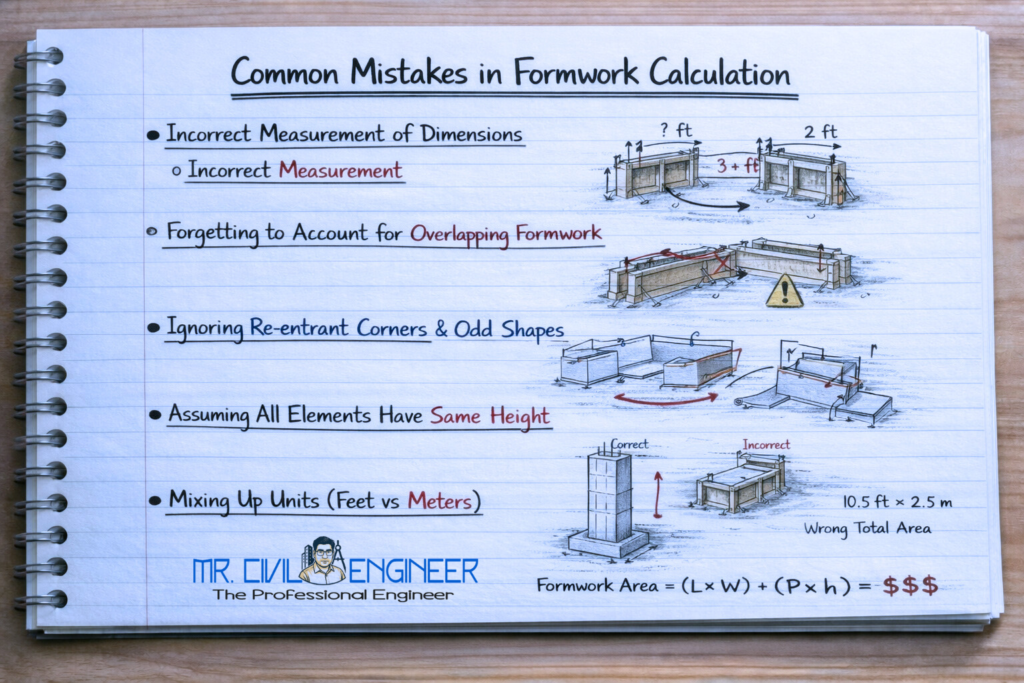
❌ Calculating concrete volume instead of surface area
❌ Forgetting beam sides
❌ Deducting openings unnecessarily
❌ Ignoring column faces
❌ Mixing up slab and beam shuttering
❌ Not checking drawing properly
Tips for Accurate Formwork Estimation
✔ Read drawings carefully
✔ Break structure into slab, beam, column & footing
✔ Use square meters consistently
✔ Prepare a small calculation table
✔ Keep 5–10% margin for site wastage
✔ Verify with site dimensions
FAQs
Q1. Is formwork calculated in cubic meters?
No. Formwork is calculated in square meters (m²).
Q2. Should we deduct openings in slab formwork?
Usually small openings are not deducted. Large openings like lift shafts can be deducted.
Q3. How much formwork is required for 1 sqm slab?
For a plain slab, formwork = 1 sqm per sqm of slab area.
Q4. Which is costlier – concrete or formwork?
In RCC work, formwork cost is often higher than concrete cost.
Conclusion
Formwork calculation is not complicated once you understand one simple idea:
Calculate the surface area of concrete in contact with shuttering.
By learning the basic formulas for slab, beam, column, and footing, you can:
- Estimate shuttering quantity
- Control project cost
- Plan materials better
- Avoid site confusion
Whether you are a student or a site engineer, mastering formwork calculation basics will make you more confident in construction estimation and execution.
Latest Articles
- How to Reduce Construction Cost Without Quality Loss
- Curing Methods in Concrete: Types, Importance & Best Practices
- Safety Measures on Construction Site: What Every Engineer Must Know
- Construction Joints – Types & Location (Complete RCC Guide)
- Concrete Pouring Checklist for Hot Weather (Site-Practical Guide)


[…] Formwork Calculation Basics: A Complete Beginner’s Guide […]