
Have you ever wondered why some buildings develop cracks at the base, even when the columns and beams look perfectly fine?
In most cases, the real issue lies below ground level—in the footing.
Footing design is not just a structural formality; it is the foundation of structural safety. In this guide, we’ll break down isolated and combined footing design basics in a simple, site-oriented, and beginner-friendly way.
What Is a Footing in Building Construction?
A footing is the lowest structural element of a building that directly rests on soil.
Its main job is simple but critical:
Safely transfer the load of the building to the soil without causing excessive settlement.
Load Transfer Path:
Slab → Beam → Column → Footing → Soil
If any part of this chain fails, the structure is at risk.
Types of Footings Used in Buildings
Common footings include:

- Isolated footing
- Combined footing
- Strip footing
- Raft (mat) foundation
In residential and low-rise buildings, isolated and combined footings are the most widely used.
Isolated Footing – Basics Explained
What Is an Isolated Footing?
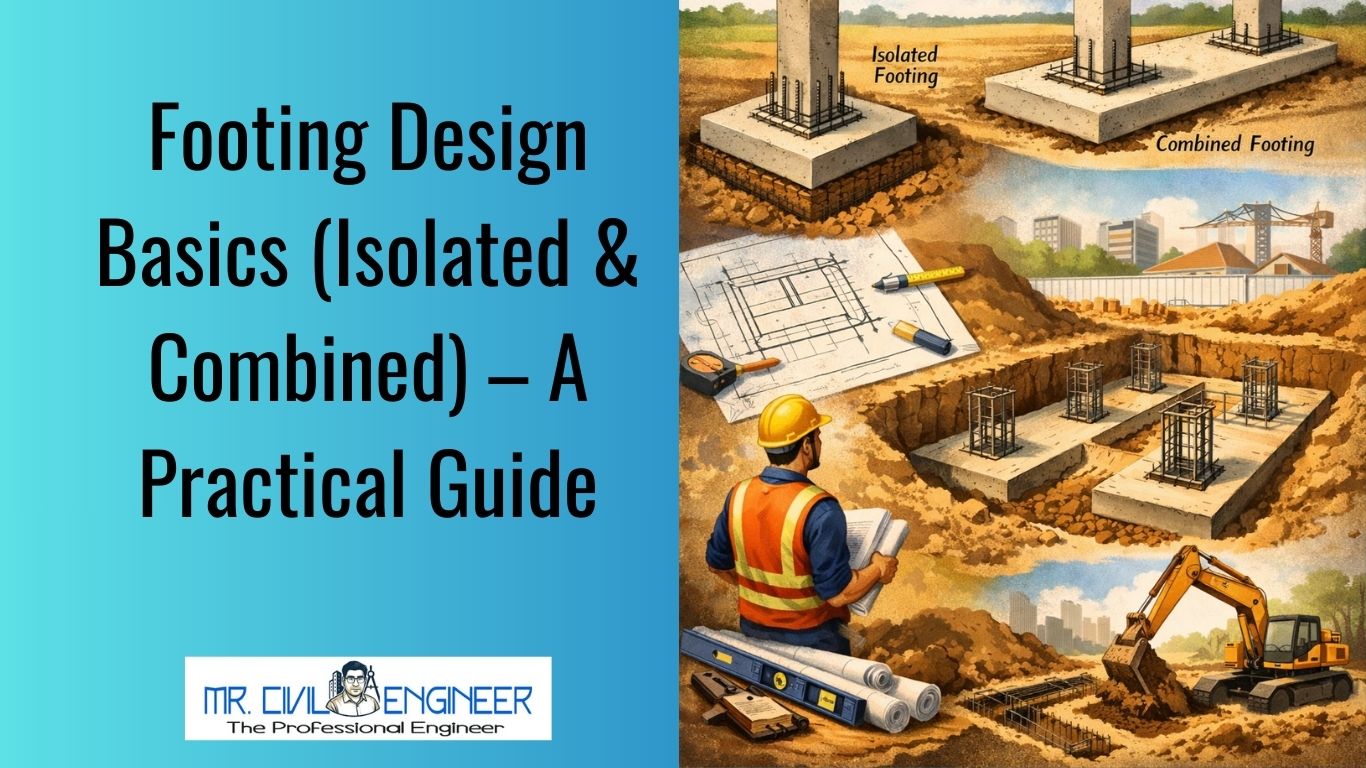
An isolated footing supports a single column and spreads its load over a safe area of soil.
When Is It Used?
- Columns are well spaced
- Soil has good bearing capacity
- Loads are moderate
Common Shapes
- Square (most common)
- Rectangular
- Circular (rare in buildings)
How It Works (Simple Logic)
If a column carries 300 kN load and soil can safely carry 150 kN/m²:
Required footing area = 300 / 150 = 2.0 m²
This area is adjusted practically to suit reinforcement and formwork.
Combined Footing – Basics Explained
What Is a Combined Footing?
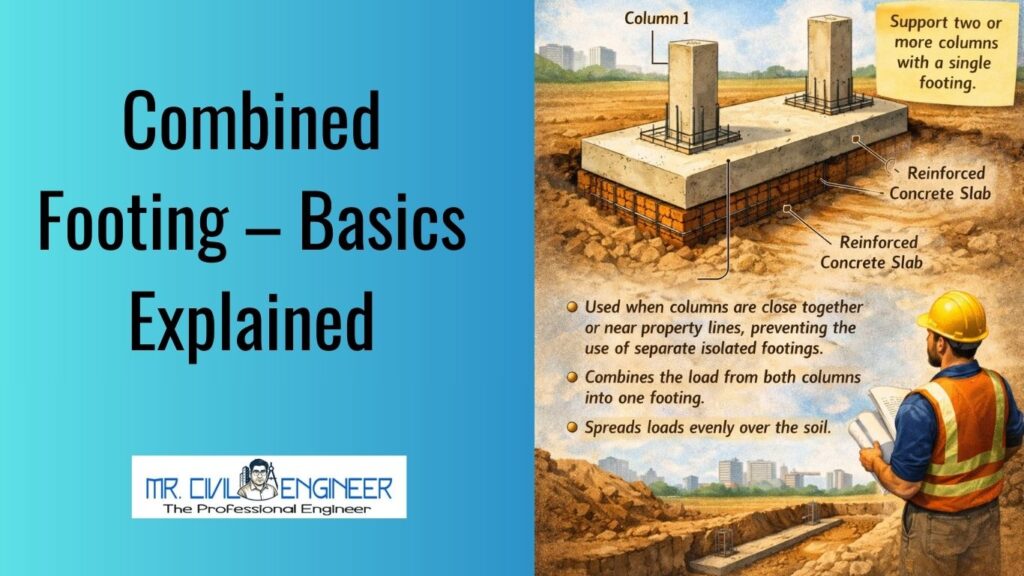
A combined footing supports two or more columns using a single foundation slab.
Why Is It Needed?
- Columns are very close
- One column is near property boundary
- Individual footings would overlap
Types of Combined Footing
- Rectangular combined footing – when column loads are similar
- Trapezoidal combined footing – when column loads differ
Key Design Principle
The center of gravity of loads must coincide with the center of footing area to ensure uniform soil pressure.
Key Design Parameters for Footings
Before designing any footing, engineers consider:
1. Column Load
- Dead load
- Live load
- Self-weight of footing
2. Safe Bearing Capacity (SBC)
- Obtained from soil investigation report
- Expressed in kN/m²
3. Soil Type
- Clay, sand, silt, or mixed soil
- Affects settlement behavior
4. Depth of Foundation
- Below topsoil
- Below seasonal moisture variation
Basic Footing Design Steps (Conceptual)
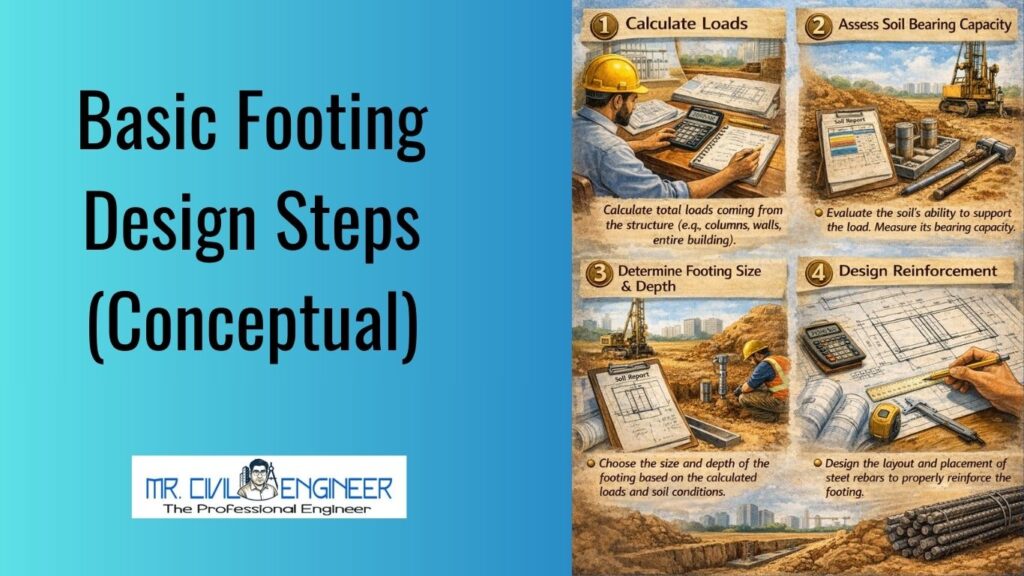
This is not software design, but core understanding every engineer must have.
- Calculate total column load
- Determine required footing area
- Check soil pressure
- Decide footing thickness
- Design reinforcement for:
- Bending moment
- One-way shear
- Punching shear
Common Site Mistakes in Footing Construction
🚫 Excessive excavation without approval
🚫 Uneven PCC surface
🚫 Incorrect reinforcement cover
🚫 Ignoring soil test report
These mistakes often lead to unequal settlement and cracks.
Isolated vs Combined Footing – Quick Comparison
| Aspect | Isolated Footing | Combined Footing |
|---|---|---|
| Columns supported | One | Two or more |
| Cost | Economical | Slightly higher |
| Design complexity | Simple | Moderate |
| Use case | Open space | Boundary / close columns |
FAQs – Footing Design Basics
Q1. Which footing is cheaper?
👉 Isolated footing, when soil and spacing permit.
Q2. Can combined footing be used in houses?
👉 Yes, especially near plot boundaries.
Q3. Is soil test mandatory?
👉 Absolutely. SBC without soil test is guesswork.
Conclusion
Footing design is where engineering judgment meets ground reality.
Whether you choose an isolated footing or a combined footing, the goal remains the same:
Safe load transfer + controlled settlement + long-term durability
Understanding these basics will not only help you design better but also execute smarter on site.
Read Now
- Column Size for G+1 & G+2 Buildings (Residential Guide)
- Slab Thickness Calculation (One-Way & Two-Way) – Complete Guide
- Load Calculation for Residential Buildings: A Practical Guide for Slabs, Beams, and Columns
- 12 Common Mistakes in House Planning (And Smart Fixes)
- Bar Bending Schedule (BBS) – Basics with Example for Civil Engineers