

Your first day as a site engineer: helmet on, safety shoes muddy, clipboard ready—but the RCC pour starts in 30 minutes and the contractor argues about mix proportions. Sound familiar? Site engineers are the unsung heroes keeping million-rupee projects on track, and mastering their duties & responsibilities separates good engineers from great ones. Whether you’re a fresher prepping for interviews or a homeowner verifying your contractor’s engineer, this guide covers every key responsibility with checklists and real-site examples.
Why Site Engineers Matter (And What Companies Expect)
India constructs 200,000+ km highways and millions of homes yearly, but 30–40% face delays due to poor site execution. Site engineers bridge design office and field reality—spotting issues architects miss, enforcing safety amid 50 workers, and delivering quality under deadline pressure. Expect 10–12 hour days, weekend site visits, and decisions worth lakhs daily.
1. Pre-Construction Planning Duties
Before concrete pours, site engineers prepare the battlefield:
- Review drawings & specifications: Cross-check architect/structural drawings vs site conditions (soil report, levels). Mark clashes (duct vs beam).
- Material approvals: Inspect cement (IS 1489 PPC), steel (Fe500), bricks before unloading. Reject damaged batches.
- Team setup: Allocate masons, bar benders, carpenters per BOQ quantities.
- Site mobilization: Verify tower crane positioning, water/electricity setup.
Checklist: Soil test report? Approved drawings on site? Vendor lab tests?
2. Daily Site Management Responsibilities
Site engineers run the show from 8 AM whistle:
- Worker attendance: Mark muster roll (200 workers? Track by gangs).
- Material receipt & storage: Weigh sand (1.5 CUM per M20 batch), stack steel off-ground.
- Progress tracking: Measure completed work daily (100m³ excavation?). Update MS Project/Gantt charts.
- Weather planning: Monsoon? Prioritize plinth protection, stock tarps.
Real example: Spotting 10% extra sand billing saved ₹2 lakhs on a 50-crore project.
3. Quality Control Duties (Your Core Responsibility)
Quality starts at site engineer’s desk:
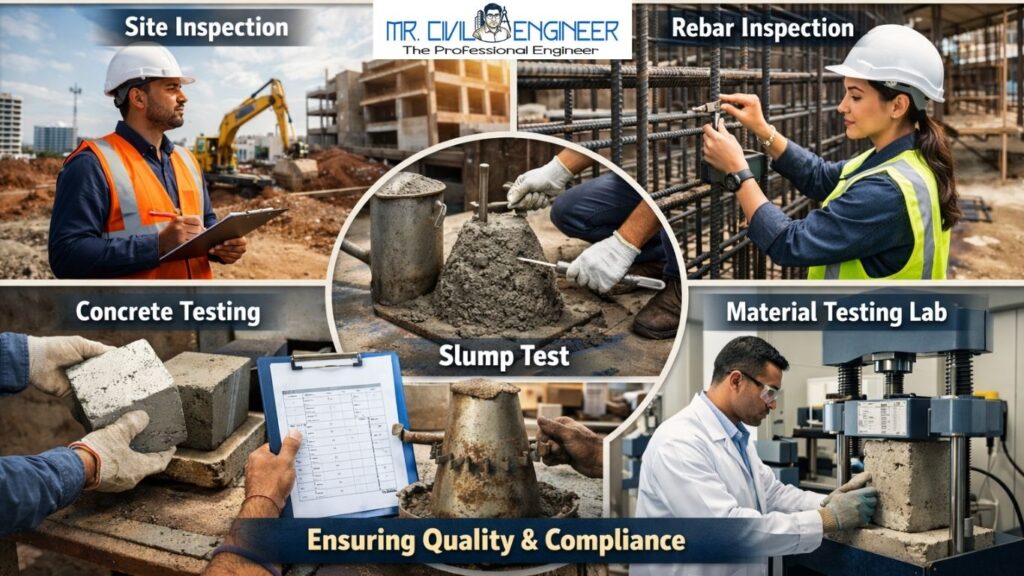
- Concrete verification: Slump test (75–100mm), cube casting (6 cubes/300CUM), grade check (M20 vs M25).
- Formwork inspection: Check alignment, props (steel preferred), bracing before pour.
- Steel verification: Count bars per BBS, check laps (50D), clean rust, chairs placed.
- Stage sign-off: Foundation complete? No cracks, proper curing? Sign for next stage.
Pro tip: Reject work twice—rework costs 3x original.
| Check Item | Acceptance Criteria | Frequency |
|---|---|---|
| Rebar dia/cleanliness | As per BBS, rust-free | Pre-pour |
| Concrete slump | 75–125mm | Per truck |
| Cube test | 7-day >65% fck | Every 50CUM |
| Formwork plumb | <1:400 deviation | Daily |
4. Safety Responsibilities (Non-Negotiable)
One accident delays projects months and costs crores:
- PPE enforcement: 100% helmets, shoes, harnesses at height (>2m).
- Hazard identification: Mark deep excavations (>1.5m need shoring), electrical risks.
- Toolbox talks: 10-min daily safety briefing (hand injuries 40% accidents).
- Emergency prep: First aid stocked, fire extinguishers checked monthly.
Duty: Stop unsafe work immediately. Example: Halting pour during thunder saved lives.
5. RCC & Structural Supervision Duties
Peak responsibility during skeleton phase (40% project time):
- Rebar checking: Verify hook angles (135° columns), stirrup spacing (≤300mm), development length.
- Pour supervision: Sequence (columns → beams → slab), vibration (25–50mm/sec), no cold joints.
- Curing monitoring: Water cure 14 days slabs, cover with bags.
- De-shuttering: 16hrs sides, 21 days slabs (M20).
Scenario: Noticed 10% less steel in beams—demanded recount, avoided collapse risk.
6. Finishing Stage Responsibilities
Structure up, focus shifts to details:
- MEP coordination: Plumbing chases <1/3 wall thickness, electrical conduits sleeved.
- Masonry/plaster: Walls plumb (<5mm/3m), uniform joints, 12mm plaster.
- Finishing quality: Tiles level (<2mm lippage), paint holidays absent.
- Handover prep: As-built drawings, test certificates ready.
7. Documentation & Reporting Duties
Paperwork proves your work:
- Daily report: Weather, progress (50m³ concrete cast), issues, photos.
- Measurement book (MB): Abstract measurements for running bills (100m beam @ ₹200/m).
- Material registers: Cement bags in/out, steel MT received.
- QA/QC records: Test results, NDT reports.
Digital shift: Apps like PlanGrid auto-sync reports to HO.
8. Contractor Coordination & Client Reporting
Balance act daily:
- Work allocation: “Gang A: Column casting, Gang B: Formwork.”
- Payment certification: Verify 90% completion for RA bills.
- Variation orders: Extra work? Get written approval first.
- Client updates: Weekly photos, milestone achievements.
Pitfall: Verbal instructions = disputes. Always document.
9. Common Mistakes Site Engineers Make (And Fixes)
- Rushing RCC pour: Wait for full props. Fix: Checklist sign-off.
- Ignoring curing: 30% strength loss. Fix: Dedicated curing supervisor.
- Poor documentation: Payment delays. Fix: Digital MB app.
- Safety complacency: “Only today.” Fix: Zero-tolerance policy.
10. Career Growth for Site Engineers
Master these duties → Project Engineer (₹8–12LPA) → PM (₹20L+).
Must-have skills: Primavera/MS Project, BIM basics, negotiation.
Certifications: ACP-I (L&T), OSHA safety, NDT Level II.
Interview prep: “Explain your last site’s biggest challenge?”
Average salary: Freshers ₹3.5–5LPA, 5yrs ₹8–12LPA (metros higher).
FAQs: Site Engineer Duties Answered
What is daily routine of site engineer?
8AM muster, material check, progress measurement, 4PM report, evening client call.
What are 5 main duties of site engineer?
Quality control, safety enforcement, progress tracking, documentation, contractor coordination.
Site engineer salary in India 2025?
₹4–6LPA freshers, ₹10–15LPA experienced (varies by city/firm).
How to prepare for site engineer interview?
Know IS456 concrete code, BBS reading, safety checklists, last project metrics.
Conclusion: Own Your Site, Build Your Career
Site engineers don’t just supervise—they deliver dreams safely and on time. Master these duties & responsibilities through daily checklists, site visits, and continuous learning, and you’ll rise from mud-stained boots to corner office. Whether chasing L&T postings or freelance consulting, start with strong site fundamentals. Download the checklist, hit the field, and engineer excellence.