
Almost every construction professional has faced this situation at least once:
The project started within budget, calculations looked perfect on paper—but halfway through construction, costs started rising unexpectedly.
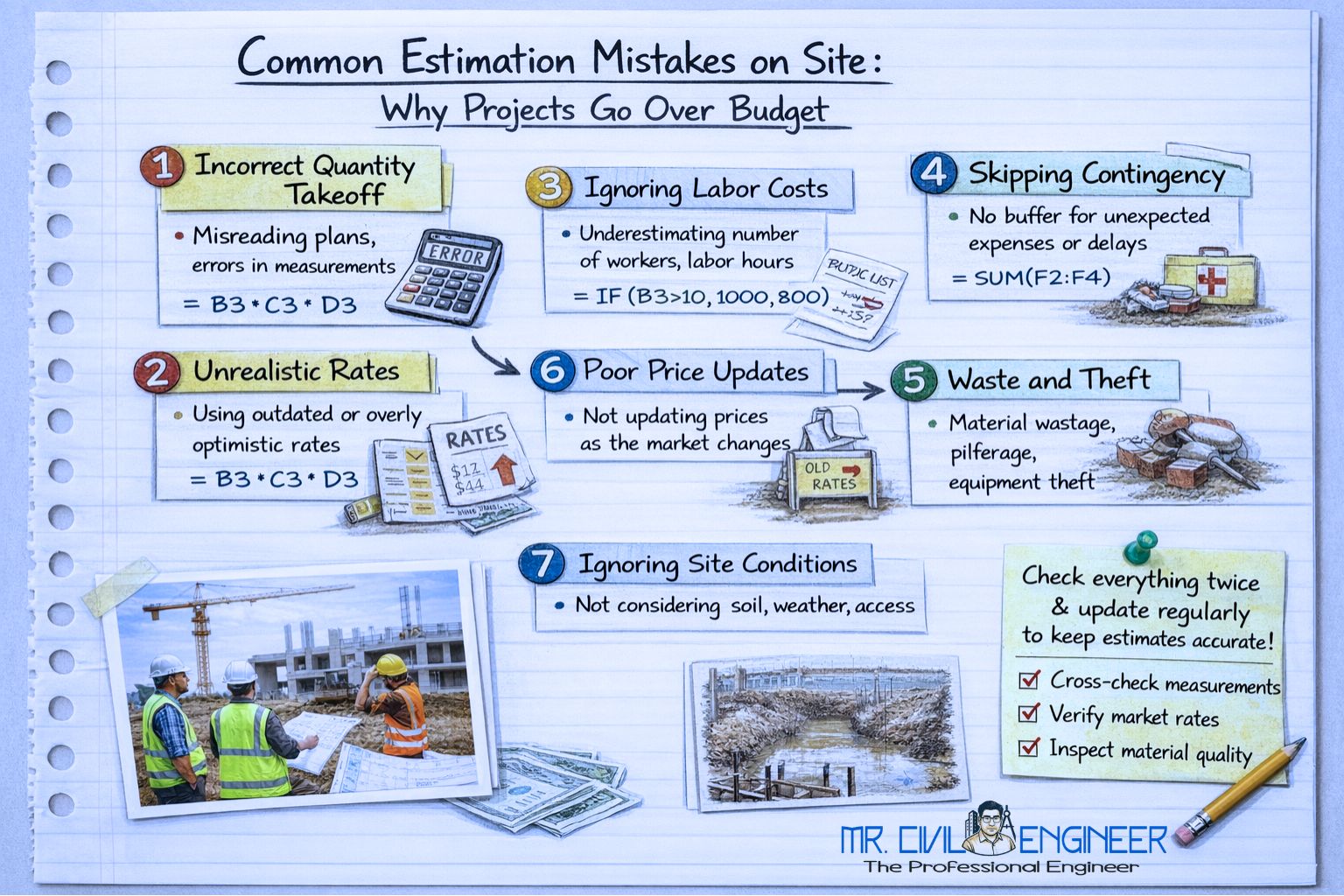
In most cases, this doesn’t happen because of luxury upgrades or client demands. It happens because of common estimation mistakes on site.
The truth is, estimation errors are rarely dramatic. They are small, silent mistakes that accumulate over time—until the budget collapses.
This article explains the most common estimation mistakes on construction sites, why they occur, and how they can be avoided.
What Is Construction Estimation?
Construction estimation is the process of:
- Calculating quantities of materials
- Estimating labour and equipment requirements
- Predicting the total project cost before execution
A good estimate acts like a financial map. If the map is wrong, even the best execution cannot prevent cost overruns.
Why Estimation Mistakes Are So Common on Site
Estimation mistakes happen because:
- Site conditions differ from assumptions
- Drawings change frequently
- Time pressure leads to shortcuts
- Estimation is often treated as paperwork, not engineering
Let’s look at the most frequent and costly mistakes seen on real construction sites.
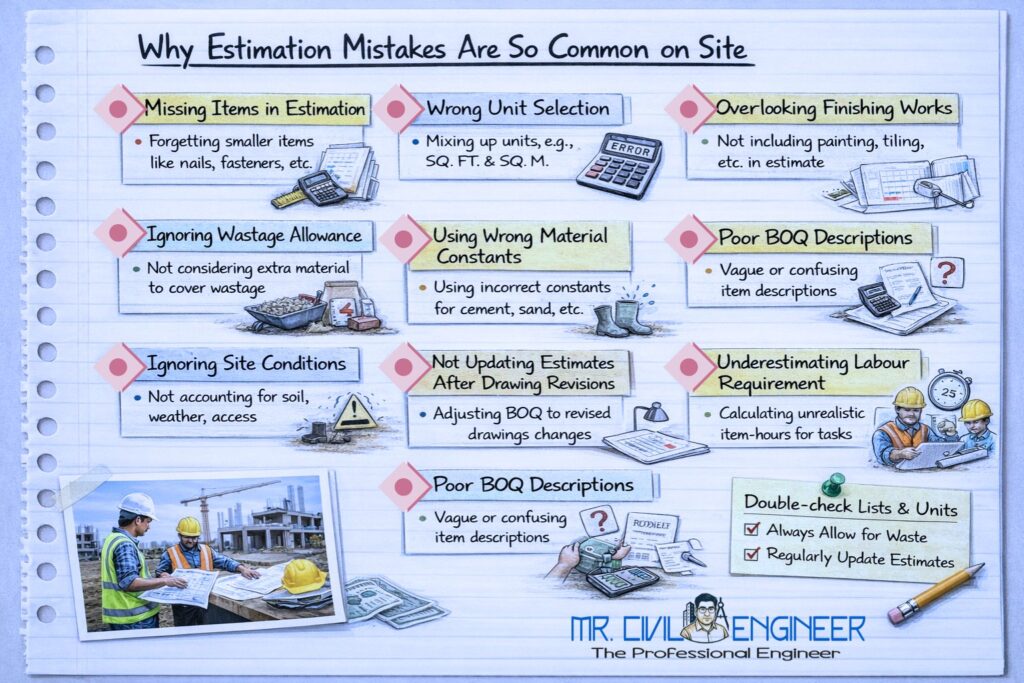
1. Missing Items in Estimation
This is the number one estimation mistake.
Many estimates focus on major works like RCC and masonry but forget:
- Scaffolding
- Curing and protection
- Small concrete works
- Cutting, hacking, and repair work
- Temporary arrangements
Each missing item may seem small, but together they can increase costs by 10–20%.
If it is executed on site, it must appear in the estimate.
2. Wrong Unit Selection
Using the wrong unit creates serious cost distortion.
Common examples:
- Measuring plaster in cubic meters instead of square meters
- Mixing running meters and square meters
- Using “numbers” instead of area-based measurement
Wrong units lead to:
- Incorrect rates
- Confusing bills
- Disputes during payment
Unit selection must always follow standard measurement rules.
3. Ignoring Wastage Allowance
Materials are never used with 100% efficiency on site.
Common wastage sources:
- Cutting and breakage
- Handling losses
- Improper storage
- Rework
Ignoring wastage leads to repeated material orders and higher transport cost.
Typical wastage allowances:
- Cement: 3–5%
- Steel: 2–3%
- Bricks: 5%
- Sand & aggregate: 5–7%
Zero-wastage estimation is unrealistic.
4. Using Wrong Material Constants
Material constants are standard values used in estimation.
Examples:
- Bricks per m³
- Cement bags per m³ concrete
- Steel kg per m³ RCC
Using incorrect constants results in systematic error throughout the estimate.
For example:
- Using 480 bricks instead of 500 bricks per m³
- Assuming low steel percentage without checking drawings
Small constant errors multiply into large quantity differences.
5. Ignoring Site Conditions
Office estimates often ignore real site conditions such as:
- Restricted access
- Manual handling instead of machinery
- Extra labour due to congestion
- Height and lifting requirements
A rate that works on open ground may fail in:
- Urban sites
- Renovation projects
- High-rise construction
Site conditions must always be factored into estimation.
6. Not Updating Estimates After Drawing Revisions
Drawings rarely remain unchanged.
Common mistakes include:
- Using old drawings for estimation
- Ignoring revised structural details
- Missing additional walls or thickness changes
Each revision affects:
- Quantity
- Cost
- Construction method
An estimate that is not updated is already wrong.
7. Overlooking Finishing Works
Many estimates underestimate finishing costs.
Often ignored items:
- Edge detailing
- Skirting
- Grooves and cornices
- Hardware and accessories
- Sealants and minor fittings
Finishing works may look small individually, but together they consume a large portion of the budget.
8. Underestimating Labour Requirement
Labour productivity varies greatly.
Mistakes happen when:
- Standard labour outputs are blindly used
- Weather conditions are ignored
- Skill level of workers is overestimated
Result:
- Delays
- Increased labour cost
- Reduced productivity
Labour estimation must be realistic, not optimistic.
9. Poor BOQ Descriptions
A BOQ item with vague description leads to disputes.
Example of poor description:
RCC work in slab
Better description:
RCC work M20 grade in slab including centering, shuttering, vibration, curing but excluding reinforcement
Poor descriptions create:
- Extra item claims
- Ambiguity in scope
- Payment conflicts
10. Depending Blindly on Contractor Estimates
Contractor estimates may:
- Underquote to secure work
- Exclude certain items intentionally
- Assume lower quality execution
Relying only on contractor estimates without verification is risky.
Independent estimation protects both budget and quality.
11. Mixing Units and Measurement Systems
Mixing:
- Feet with meters
- Inches with millimeters
is a silent but dangerous mistake.
One wrong conversion can distort the entire estimate.
Standardize:
- Units
- Measurement system
- Decimal precision
Consistency prevents errors.
FAQs
Q1. What is the most common estimation mistake on site?
Missing items and ignoring wastage.
Q2. Can estimation mistakes be completely avoided?
No, but they can be significantly reduced with systematic checks.
Q3. Are estimation mistakes more common on small projects?
Yes, because small projects often skip detailed estimation.
Q4. Who is responsible for estimation accuracy?
Primarily the engineer or estimator, supported by site feedback.
Conclusion
Common estimation mistakes on site are rarely caused by lack of knowledge. They are caused by assumptions, shortcuts, and lack of attention to detail.
Good estimation is not about speed—it is about:
- Understanding drawings
- Respecting site realities
- Using correct standards
- Reviewing work carefully
In construction, a small estimation mistake today becomes a big financial problem tomorrow.
The best engineers are not those who build fast—but those who estimate accurately and execute confidently.
Related Articles
- Excel Sheet for Civil Engineering Estimation: A Complete Practical Guide
- BOQ Preparation Step-by-Step: A Practical Guide for Construction Projects
- Rate Analysis of RCC Work: Step-by-Step Guide with Example
- Plaster Quantity Calculation (Area-Wise): Step-by-Step Guide
- Brickwork Quantity Calculation (With Formula): Step-by-Step Guide