
Introduction: Why Column Size Decides Your Building’s Future
When people plan a house, they often focus on floor plans, elevation, and interiors.
But the real strength of a building lies in something you rarely see—columns.
A wrongly sized column can lead to:
- Excessive cracks
- Uneven settlement
- Structural failure in extreme cases
So if you’re planning a G+1 or G+2 residential building, understanding column size is not optional—it’s essential.
Let’s explain it clearly, practically, and without confusing formulas.
What Is an RCC Column?
An RCC column is a vertical structural member that:
- Collects load from slabs and beams
- Transfers it safely to the foundation and soil
Think of columns as the legs of a building.
Thin legs + heavy body = instability.
That’s why column size directly affects safety.
Factors That Affect Column Size
Before jumping to numbers, understand what controls column size:
1. Number of Floors
- More floors = more load
- G+2 columns carry almost double load compared to G+1
2. Load on Building
- Residential vs commercial
- Future floor provision
- Water tanks, staircases
3. Column Spacing
- Larger distance between columns = higher load per column
4. Soil Bearing Capacity
- Weak soil needs stronger columns and foundations
5. Concrete & Steel Grade
- M20 vs M25 concrete
- Fe415 vs Fe500 steel
👉 This is why there is no single “standard” column size.
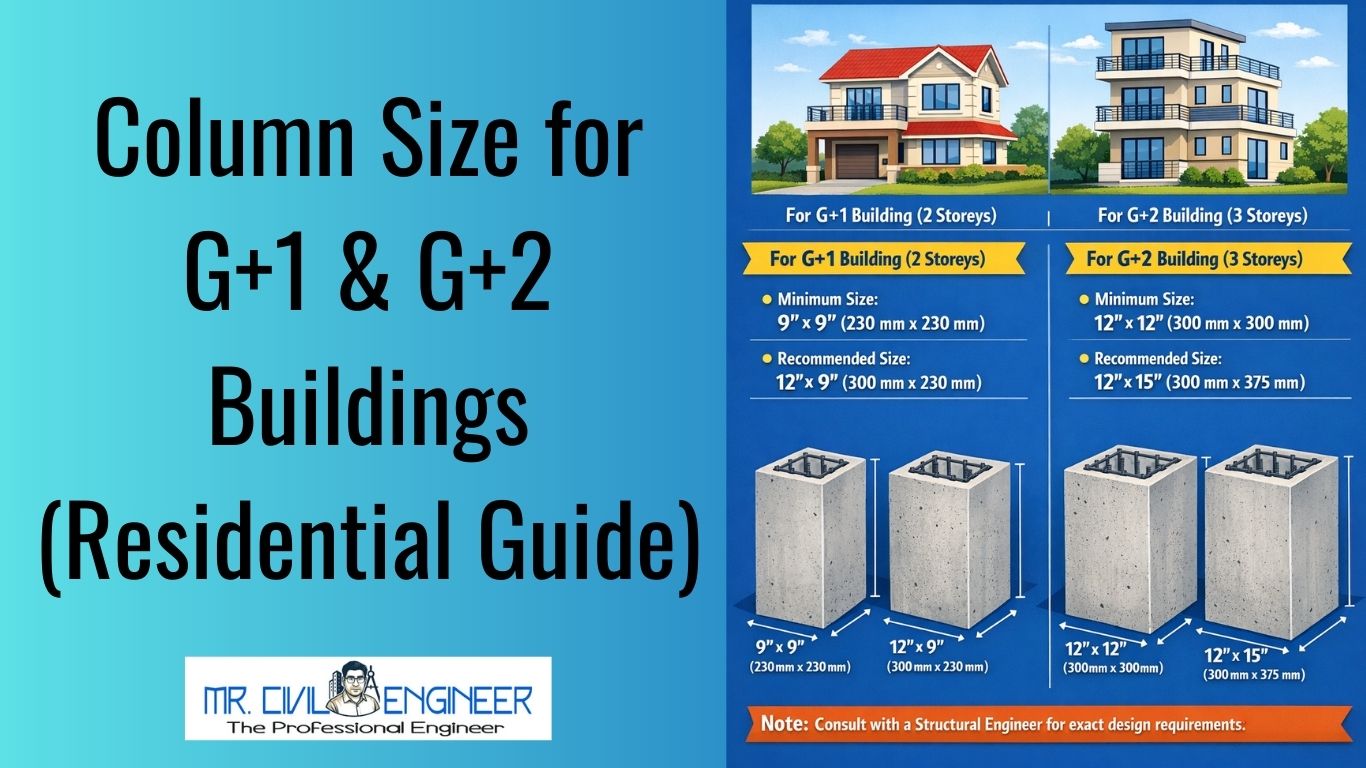
Column Size for G+1 Building
Commonly Used Column Sizes (Residential)
| Column Size | Usage |
|---|---|
| 230 × 230 mm (9”×9”) | Very small spans, light load |
| 230 × 300 mm (9”×12”) | Most common & safe |
| 300 × 300 mm (12”×12”) | Preferred for durability |
Thumb Rule (G+1)
Minimum column size: 9”×12” (230×300 mm)
Practical Example
A typical G+1 house:
- Room spans: 3.5–4.0 m
- Load: Residential
- Soil: Medium
✅ 230×300 mm column works safely
Column Size for G+2 Building
Why G+2 Needs Bigger Columns
Each additional floor increases:
- Axial load
- Bending effects
- Long-term stress
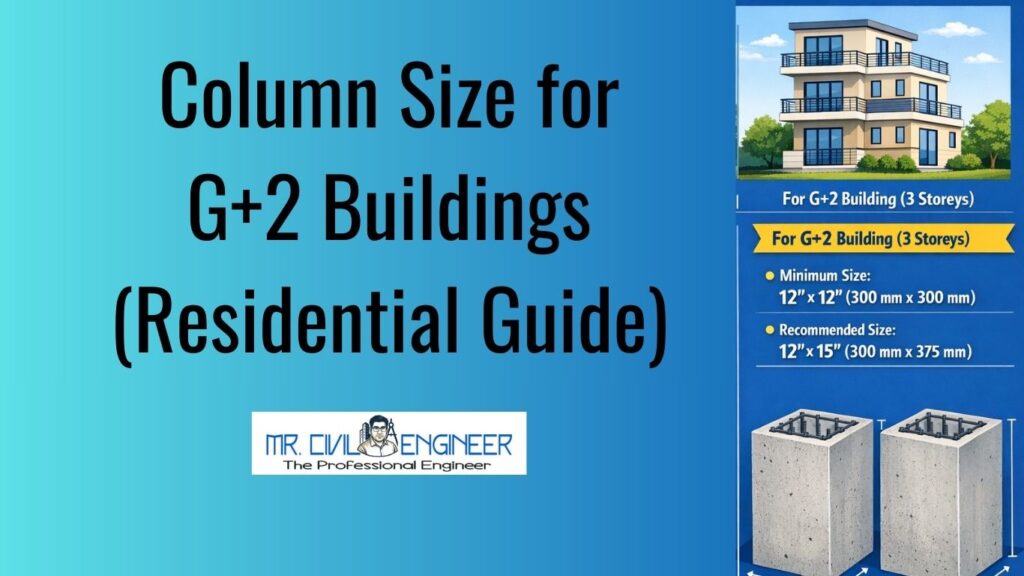
Recommended Column Sizes (G+2)
| Column Size | Application |
|---|---|
| 230 × 300 mm (9”×12”) | Borderline (only with design) |
| 300 × 300 mm (12”×12”) | Safe & commonly used |
| 300 × 450 mm (12”×18”) | Heavy load / longer spans |
Thumb Rule (G+2)
Adopt minimum 12”×12” (300×300 mm) column
This provides:
- Better load capacity
- Easier reinforcement detailing
- Future safety margin
Typical Column Size Reference Table
| Building Type | Recommended Column Size |
|---|---|
| Ground floor only | 9”×9” (minimum) |
| G+1 residential | 9”×12” or 12”×12” |
| G+2 residential | 12”×12” or 12”×18” |
| Staircase / lift area | Larger than regular |
Column Size vs Reinforcement: The Hidden Truth
Many people ask:
“Can I use a smaller column with more steel?”
Technically yes—but practically dangerous.
Why?
- Congested steel causes poor concreting
- Reduces durability
- Increases cracking risk
👉 Balanced design = proper column size + correct steel %
Minimum Column Size (Good Practice)
Even for small houses:
🚫 Avoid columns smaller than 230 mm (9”) width
Why?
- Difficult to place steel properly
- Low fire resistance
- Poor long-term performance
Common Mistakes to Avoid
❌ Copying column size from neighbor’s house
❌ Relying only on masons’ experience
❌ Reducing size to save cement
❌ Ignoring future floor provision
Remember:
Columns cannot be changed later—but interiors can.
Frequently Asked Questions (FAQs)
Is 9”×9” column safe for G+1?
Only for very small houses with short spans. Not recommended generally.
Can column size be same for G+1 and G+2?
No. G+2 requires larger or stronger columns due to extra load.
Bigger column or more steel—what’s better?
Bigger column with balanced steel is always safer and more durable.
Conclusion: Build Smart, Not Just Big
Column size is not about rules—it’s about responsibility.
For G+1 & G+2 residential buildings:
- Follow practical thumb rules
- Understand load behavior
- Always get structural design approval
A well-designed column:
✅ Keeps your house crack-free
✅ Increases lifespan
✅ Gives peace of mind
TRENDING BLOG
- Slab Thickness Calculation (One-Way & Two-Way) – Complete Guide
- Load Calculation for Residential Buildings: A Practical Guide for Slabs, Beams, and Columns
- 12 Common Mistakes in House Planning (And Smart Fixes)
- Bar Bending Schedule (BBS) – Basics with Example for Civil Engineers
- Cement Grades Explained: OPC vs PPC vs PSC (Complete Guide for House Construction)