
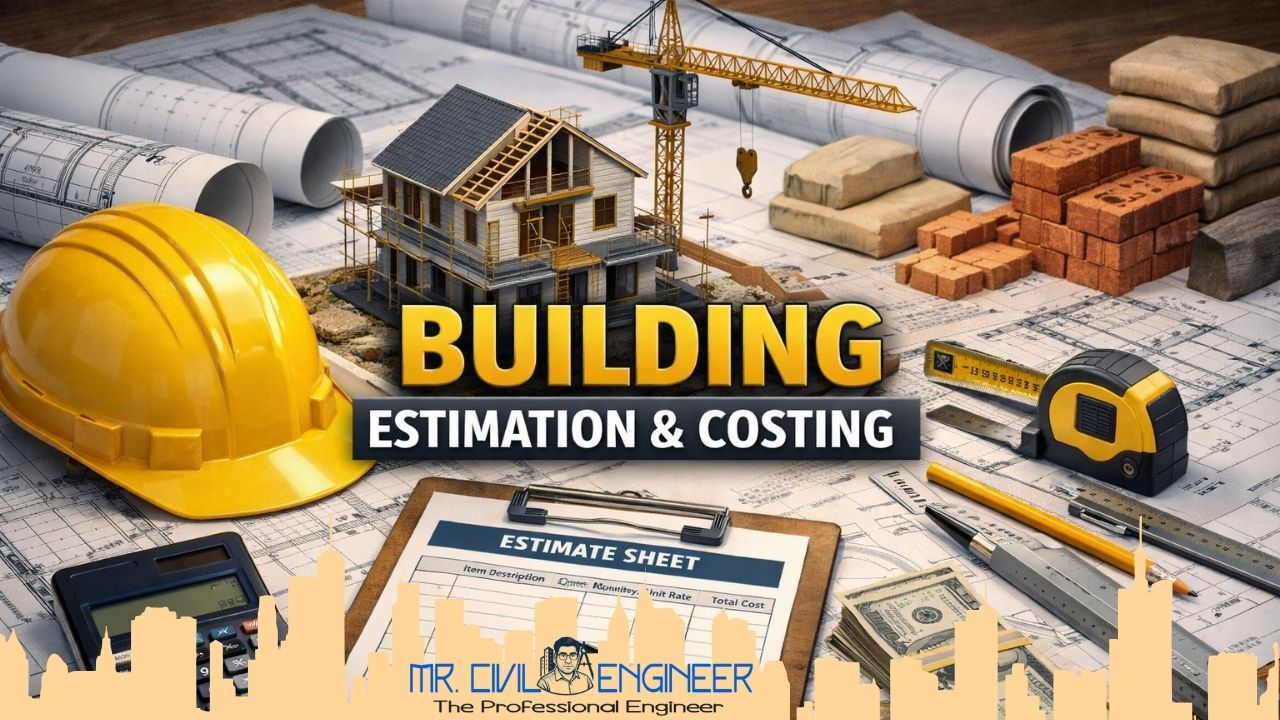
One of the most common reasons construction projects fail is poor cost planning. A house that starts within budget often ends up costing far more than expected—not because of luxury finishes, but because estimation was weak from the beginning.
This is where building estimation and costing plays a crucial role. It acts as the financial backbone of any construction project, helping engineers, contractors, and homeowners plan, control, and complete work without unpleasant surprises.
What Is Building Estimation & Costing?
Building Estimation
Building estimation is the process of calculating the quantities of materials required for a construction project and predicting the approximate cost before work begins.
Costing
Costing is the process of assigning rates to those quantities—including material, labour, equipment, and overheads—to arrive at the total project cost.
In simple terms:
- Estimation = How much quantity is required
- Costing = How much money it will take
Importance of Estimation & Costing in Construction
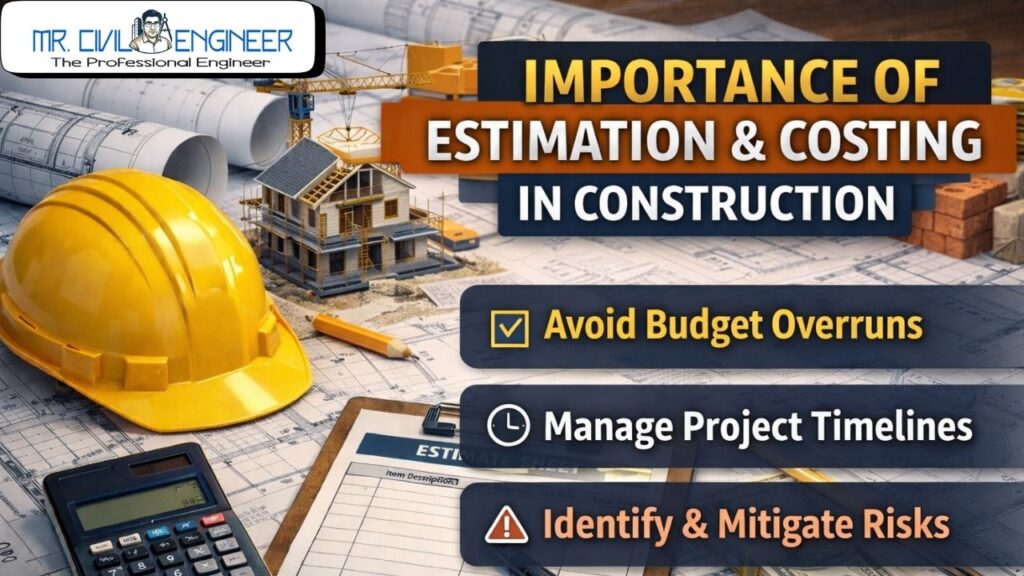
Accurate estimation and costing help to:
- Plan project budget realistically
- Avoid cost overruns
- Arrange funds and loans
- Compare contractor quotations
- Control material procurement
- Monitor project progress financially
According to construction industry studies, projects with proper cost estimation are up to 30% more likely to finish within budget.
Types of Estimates in Building Construction
1. Preliminary (Rough) Estimate
- Prepared at planning stage
- Based on plinth area or floor area
- Used for budget approval and feasibility
2. Detailed Estimate
- Prepared using working drawings
- Includes item-wise quantities and rates
- Most accurate and widely used estimate
3. Revised Estimate
- Prepared when original cost exceeds limits
- Due to rate changes or design modifications
4. Supplementary Estimate
- For additional works not included earlier
- Example: extra room, staircase, or boundary wall
Data Required for Building Estimation
Accurate estimation depends on correct input data:
- Architectural drawings
- Structural drawings
- Detailed specifications
- Schedule of rates (SOR)
- Market material rates
- Site location and conditions
Without proper drawings, estimation becomes guesswork.
Methods of Building Estimation
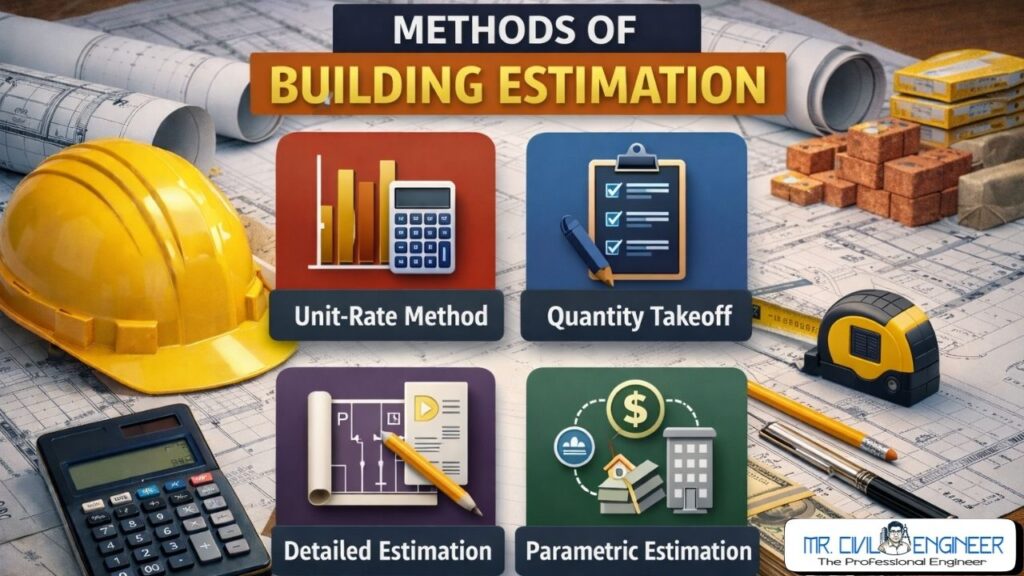
1. Plinth Area Method
- Cost calculated based on built-up area
- Suitable for preliminary estimates
Formula:
Plinth Area × Rate per sq.m = Estimated Cost
2. Floor Area Method
- Excludes wall thickness
- Slightly more accurate than plinth area method
3. Cubic Content Method
- Based on building volume
- Used for multi-storey or complex structures
4. Detailed Quantity Method (Most Accurate)
- Item-wise quantity calculation
- Used for tendering and execution
This is the standard method used in civil engineering practice.
Step-by-Step Building Estimation Process
Step 1: Quantity Take-Off
Calculate quantities of:
- Earthwork
- Concrete
- Brickwork
- Plastering
- Flooring
- Doors and windows
All quantities are measured using standard measurement rules.
Step 2: Preparation of BOQ (Bill of Quantities)
BOQ lists:
- Description of work
- Unit of measurement
- Quantity
It acts as a reference document for contractors and billing.
Step 3: Rate Analysis
Each item rate includes:
- Material cost
- Labour cost
- Equipment cost
- Wastage
- Contractor profit
Accurate rate analysis prevents hidden costs.
Step 4: Abstract of Cost
All item costs are added together to get:
- Total building cost
- Including contingencies (usually 3–5%)
This final figure represents the project budget.
Major Components of Building Costing
Material Cost
- Cement, steel, bricks, sand, aggregates
- Finishing materials
Labour Cost
- Skilled and unskilled labour
- Varies by region and season
Equipment & Machinery
- Mixers, vibrators, scaffolding
Overheads & Profit
- Site supervision
- Office expenses
- Contractor margin
Common Mistakes in Building Estimation & Costing
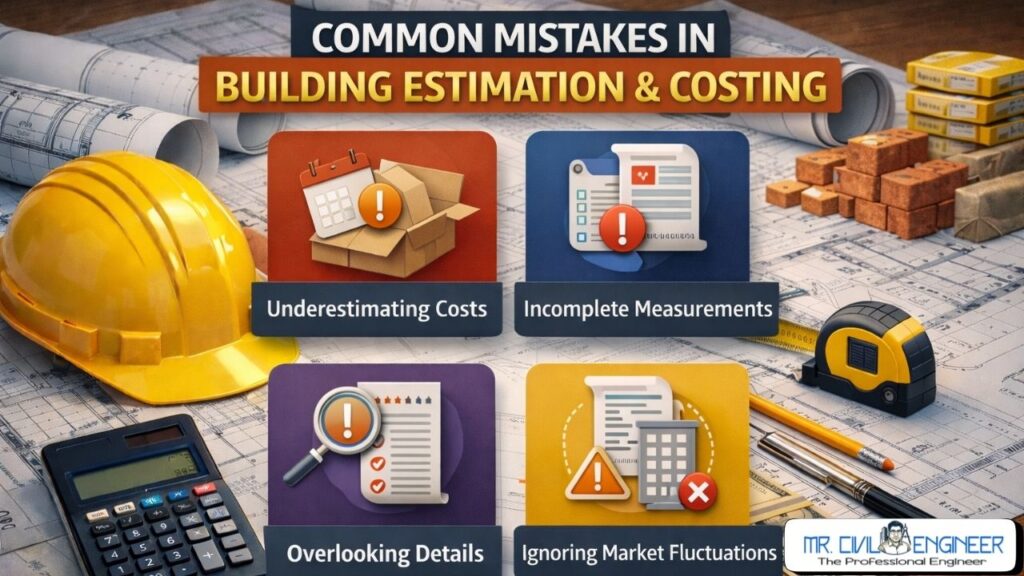
- Ignoring wastage factors
- Using outdated material rates
- Not including contingencies
- Overlooking finishing items
- Underestimating labour cost
These mistakes are the main cause of budget escalation.
FAQs
Q1. Can homeowners do building estimation themselves?
Yes, with basic guidance, but detailed estimates should be verified by professionals.
Q2. Which is the most accurate estimation method?
Detailed quantity estimation method.
Q3. How often should cost estimates be updated?
Whenever material rates or scope changes.
Q4. Is estimation different for RCC and load-bearing buildings?
Yes, item quantities and cost distribution differ.
Conclusion
Building estimation and costing is not just an academic subject—it is a practical decision-making tool. A well-prepared estimate protects you from cost overruns, disputes, and project delays.
Whether you are a student learning the basics, an engineer managing a site, or a homeowner building your dream house, mastering building estimation & costing ensures your project remains financially controlled and professionally executed.
In construction, accuracy in estimation today saves money tomorrow
Latest Articles