

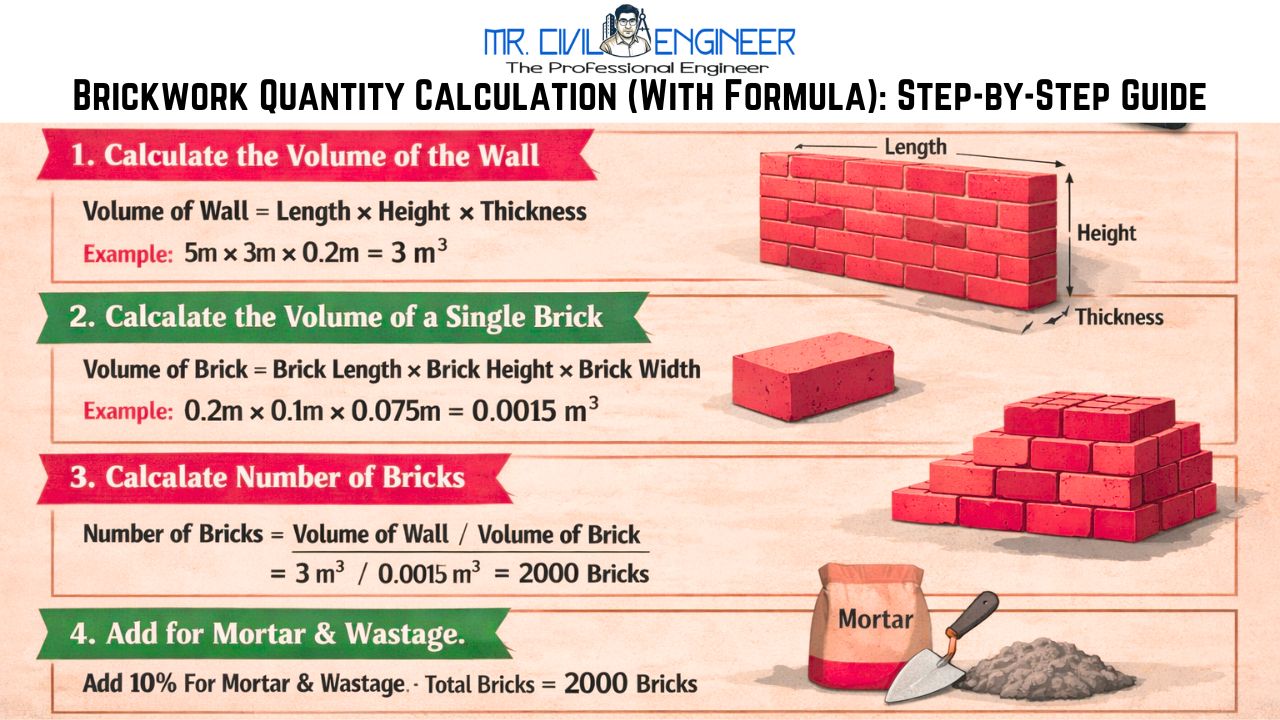
Brickwork looks simple—stack bricks with mortar and build walls. But behind every well-built wall is a proper quantity calculation. When brickwork quantity is calculated incorrectly, construction sites face material shortages, excess stock, increased costs, and delays.
Whether you are a student, site engineer, contractor, or homeowner, understanding brickwork quantity calculation with formula helps you plan better and control construction costs effectively.
Basics of Brickwork in Construction
Brickwork is one of the most commonly used masonry works in residential buildings. It is used for:
- Load-bearing walls
- Partition walls
- Boundary walls
The quantity of brickwork depends on:
- Brick size
- Wall thickness
- Mortar joint thickness
Before jumping into formulas, let’s understand these basics.
Standard Brick Dimensions & Mortar Thickness
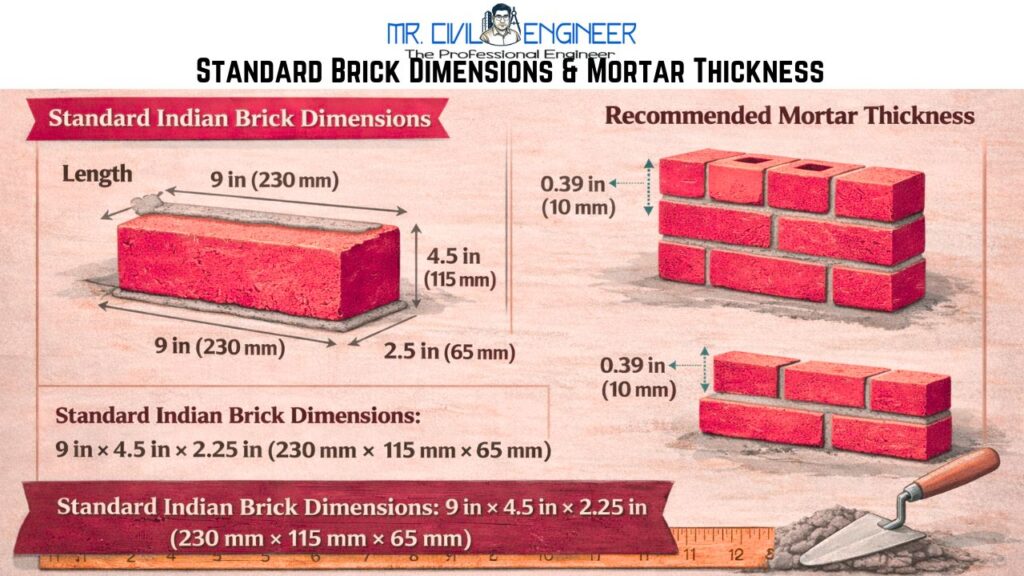
Standard Brick Size (India – Modular Brick)
- Brick size (without mortar):
230 mm × 115 mm × 75 mm - Brick size (with mortar):
230 mm × 125 mm × 85 mm
Mortar thickness is usually 10 mm, which is already included in the standard “with mortar” size.
This standard size is the foundation of all brickwork quantity calculations.
Key Concepts Before Brickwork Calculation
1. Brickwork Volume
Brickwork quantity is usually calculated in:
- Cubic meters (m³) for estimation
- Square meters (m²) for billing
2. Number of Bricks per Cubic Meter
Using standard brick size with mortar: Volume of 1 brick=0.23×0.115×0.075=0.002m3 Number of bricks in 1 m3=0.0021=500bricks
👉 Standard value:
1 m³ brickwork = 500 bricks
3. Mortar Percentage
In brick masonry:
- Mortar occupies about 23–25% of brickwork volume
- Bricks occupy about 75–77%
This helps calculate cement and sand quantity.
Brickwork Quantity Calculation Formula
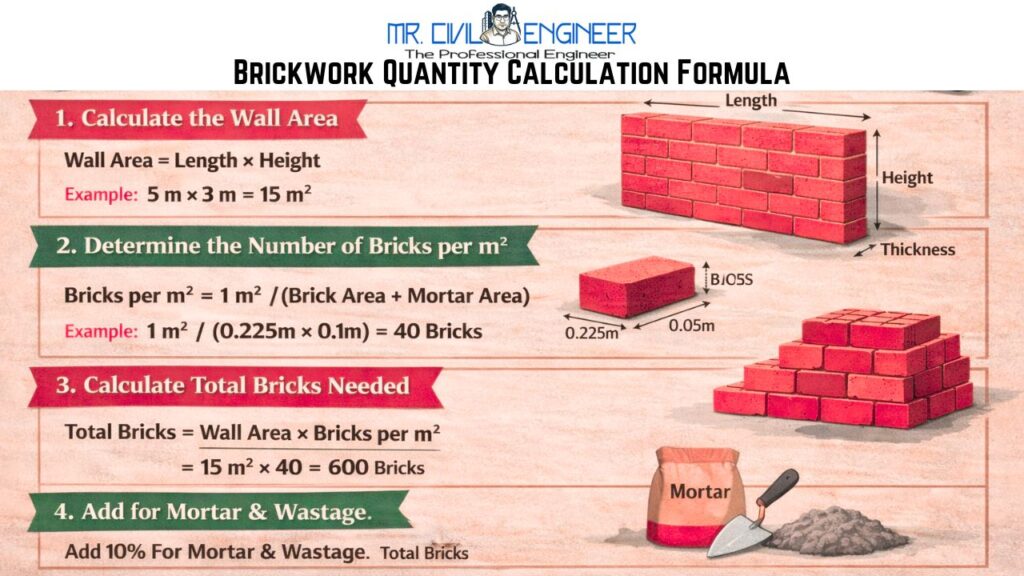
Formula 1: Brick Quantity
Number of bricks=Brickwork volume×500
Formula 2: Mortar Quantity
Mortar volume=Brickwork volume×0.25
(Dry volume of mortar = Wet volume × 1.33)
Step-by-Step Brickwork Calculation (1 m³ Example)
Let’s calculate brickwork materials for 1 cubic meter of brick masonry.
Step 1: Calculate Number of Bricks
1m3×500=500 bricks
Step 2: Calculate Mortar Volume
Wet mortar volume =1×0.25=0.25m3
Dry mortar volume =0.25×1.33=0.3325m3
Step 3: Cement & Sand Calculation (Mortar 1:6)
Total parts = 1 + 6 = 7
Cement Quantity
71×0.3325=0.0475m3
Cement bags:0.0350.0475≈1.35 bags
Sand Quantity
76×0.3325=0.285m3
Final Quantity for 1 m³ Brickwork
- Bricks: 500 nos
- Cement: 1.35 bags
- Sand: 0.28–0.30 m³
Brickwork Calculation Using Wall Area (m² Method)
This method is commonly used for site measurements.
Example:
- Wall length = 5 m
- Wall height = 3 m
- Wall thickness = 230 mm (0.23 m)
Step 1: Calculate Volume
5×3×0.23=3.45m3
Step 2: Calculate Bricks
3.45×500=1725 bricks
Mortar quantities can be calculated using the same method explained earlier.
Brickwork Calculation for Different Wall Thicknesses
| Wall Thickness | Bricks per m² (Approx.) |
|---|---|
| 115 mm (Half brick) | 60 bricks |
| 230 mm (1 brick) | 120 bricks |
| 350mm (1.5 brick) | 180 bricks |
These values are useful for quick site estimation.
Common Mistakes to Avoid in Brickwork Calculation
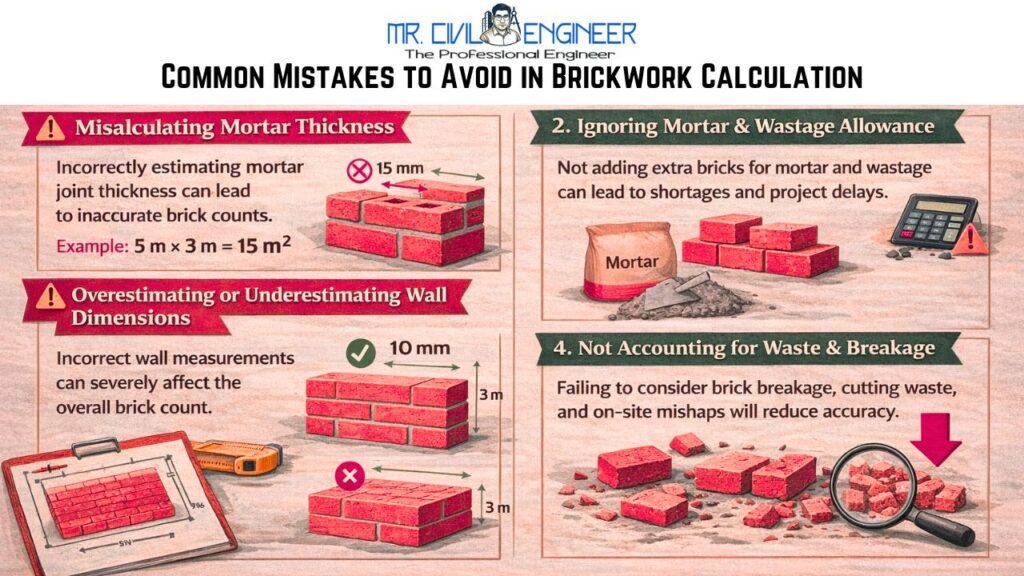
- Ignoring mortar thickness
- Using non-standard brick sizes
- Forgetting mortar dry volume factor
- Not adding wastage (3–5%)
- Mixing cubic meter and square meter units
Such mistakes can increase brickwork cost by 10–15%.
FAQs
Q1. How many bricks are required for 1 m³ brickwork?
About 500 bricks, using standard size with mortar.
Q2. How much cement is needed for 1 m³ brick masonry?
Around 1.3–1.4 bags, depending on mortar ratio.
Q3. Which mortar ratio is commonly used for brickwork?
1:6 for general brick masonry, 1:4 for load-bearing walls.
Q4. Should extra bricks be added to the estimate?
Yes, add 3–5% for breakage and wastage.
Conclusion
Accurate brickwork quantity calculation with formula is essential for cost-effective and smooth construction. A simple mistake in brick or mortar estimation can lead to delays, excess material, and unnecessary expenses.
By understanding standard brick sizes, mortar ratios, and applying the correct formulas, anyone—from a student to a homeowner—can confidently calculate brickwork quantities.
In construction, strong walls begin with correct calculations.



Hi there, constantly i used to check blog posts here early in the break of day, because i enjoy to learn more and more.
Herre is my sute … boyarka