
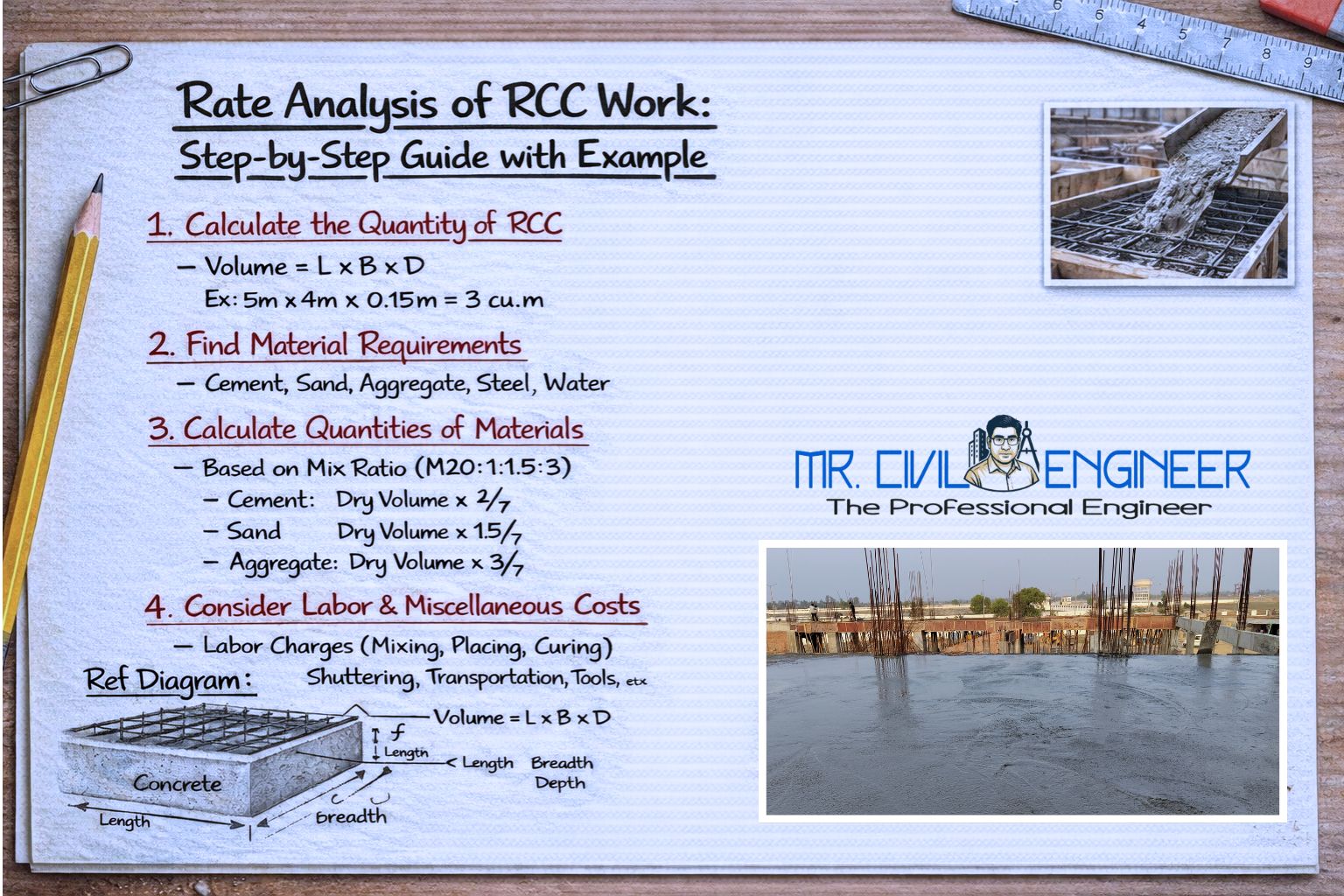

Reinforced Cement Concrete (RCC) is the backbone of modern construction. Slabs, beams, columns, footings—almost every structural element depends on RCC. But one of the most confusing aspects for engineers and contractors is how the RCC rate is actually calculated.
Why does the RCC rate differ from site to site?
Why does one contractor quote ₹6,500/m³ while another quotes ₹8,000/m³?
The answer lies in proper rate analysis of RCC work.
This guide explains RCC rate analysis in a clear, practical, and step-by-step manner, exactly the way it is understood on real construction sites.
What Is Rate Analysis of RCC Work?
Rate analysis of RCC work is the process of determining the unit cost (per m³) of reinforced cement concrete by calculating:
- Material cost
- Labour cost
- Shuttering / formwork cost
- Equipment, overheads, and contractor profit
Estimation vs Rate Analysis
- Estimation: Calculates quantities
- Rate analysis: Calculates cost per unit
Rate analysis answers one key question:
👉 How much does 1 cubic meter of RCC actually cost?
Components of RCC Work
RCC work is not just concrete. It is a combination of four major components:
- Concrete (cement, sand, aggregate)
- Reinforcement steel
- Shuttering / formwork
- Labour and equipment
Ignoring any one of these leads to an incorrect RCC rate.
Data Required for RCC Rate Analysis
Before starting calculations, the following data is required:
- Grade of concrete (M20, M25, etc.)
- Mix ratio or design mix
- Steel percentage (typically 1–2%)
- Labour rates (local)
- Shuttering rate per m²
- Material market rates
For this example, we’ll use standard assumptions commonly used in residential buildings.
Material Requirement for 1 m³ RCC
Assumptions
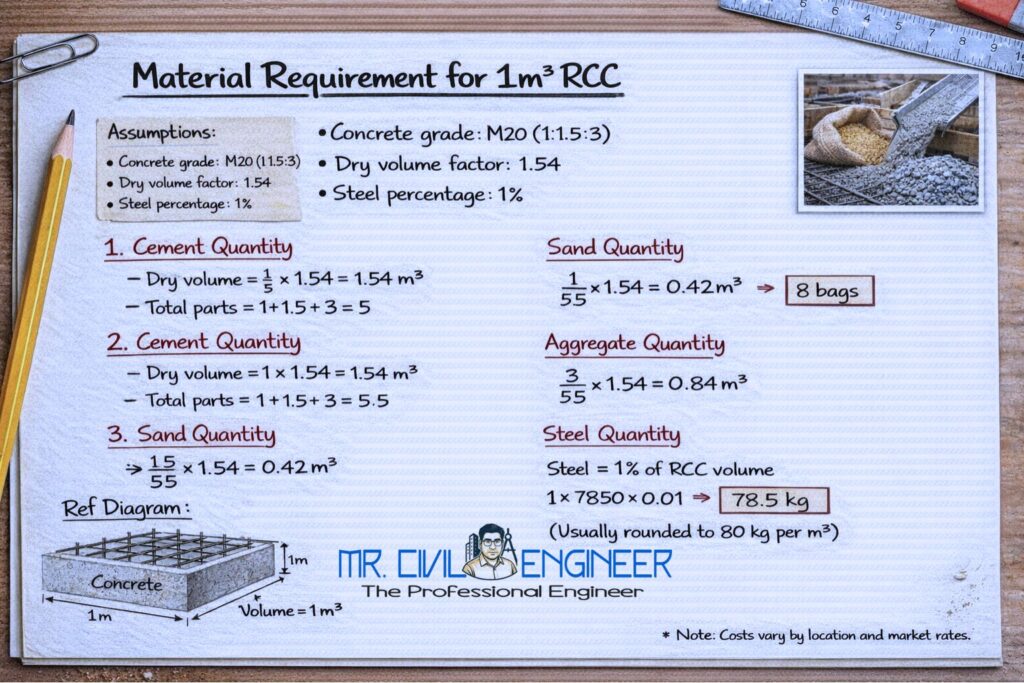
- Concrete grade: M20 (1:1.5:3)
- Dry volume factor: 1.54
- Steel percentage: 1%
Cement Quantity
Dry volume = 1 × 1.54 = 1.54 m³
Total parts = 1 + 1.5 + 3 = 5.5Cement=5.51×1.54=0.28m3
Cement bags:0.28÷0.035≈8 bags
Sand Quantity
5.51.5×1.54=0.42m3
Aggregate Quantity
5.53×1.54=0.84m3
Steel Quantity
Steel = 1% of RCC volume1×7850×0.01≈78.5 kg
(Usually rounded to 80 kg per m³)
Step-by-Step Rate Analysis of RCC Work (1 m³)
Let’s assume indicative market rates (rates vary by location):
| Item | Rate |
|---|---|
| Cement | ₹400 / bag |
| Sand | ₹1,200 / m³ |
| Aggregate | ₹1,100 / m³ |
| Steel | ₹65 / kg |
| Shuttering | ₹500 / m² |
| Labour | As per standard |
1. Material Cost
Cement:
8 bags × ₹400 = ₹3,200
Sand:
0.42 m³ × ₹1,200 = ₹504
Aggregate:
0.84 m³ × ₹1,100 = ₹924
Steel:
80 kg × ₹65 = ₹5,200
Total Material Cost = ₹9,828
2. Labour Cost (Approximate)
| Labour Type | Cost (₹) |
|---|---|
| Mason & helpers | 900 |
| Bar bending | 700 |
| Mixing, placing, curing | 600 |
Total Labour Cost = ₹2,200
3. Shuttering / Formwork Cost
Average shuttering area per m³ RCC ≈ 6 m²
6 m² × ₹500 = ₹3,000
4. Equipment & Miscellaneous
- Concrete mixer, vibrator, tools
- Water, electricity, curing
Approximate = ₹400
Total RCC Rate (Before Profit)
| Component | Cost (₹) |
|---|---|
| Materials | 9,828 |
| Labour | 2,200 |
| Shuttering | 3,000 |
| Equipment | 400 |
Sub Total = ₹15,428
Contractor Profit & Overheads
Add 10–15% contractor margin.
15% of ₹15,428 ≈ ₹2,300
Final RCC Rate
RCC Rate≈₹17,500 per m3
This is a realistic site-level RCC rate for residential buildings.
Factors Affecting RCC Rate
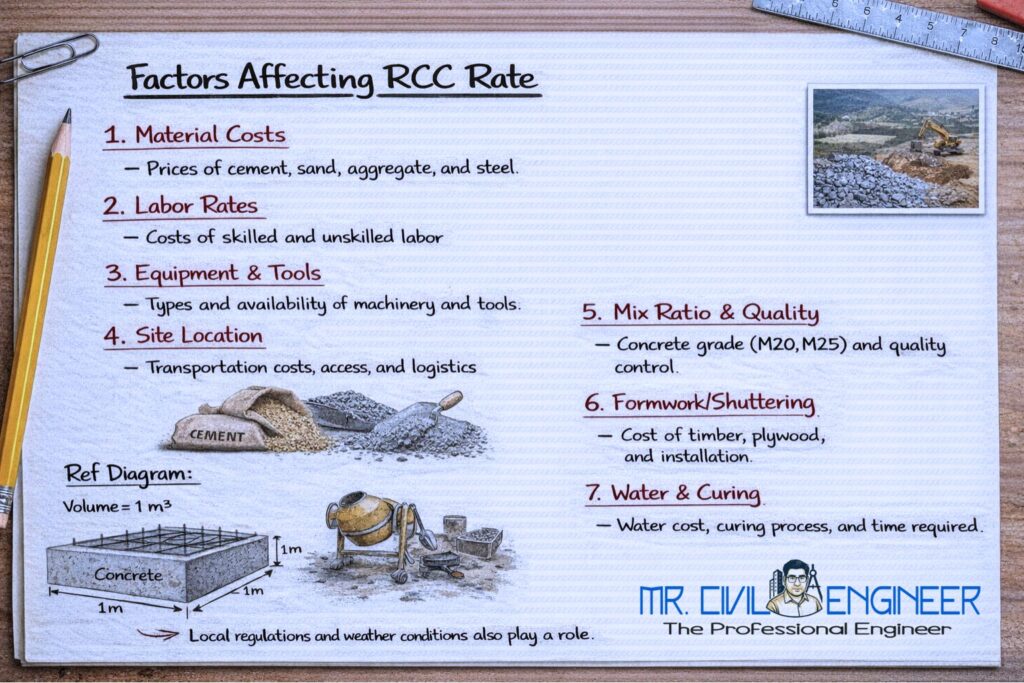
RCC rate is not fixed. It varies due to:
- Location and material availability
- Height of building (lifting cost)
- Congestion of reinforcement
- Type of shuttering (steel / plywood)
- Market fluctuations in steel and cement
This is why RCC rates differ from project to project.
FAQs
Q1. What is the average rate of RCC work per m³?
Usually between ₹6,500 to ₹8,000 for labour-only and ₹15,000 to ₹18,000 including material.
Q2. How much steel is required per m³ RCC?
Typically 80–120 kg, depending on structural design.
Q3. Is shuttering included in RCC rate?
Yes, in complete RCC rate analysis.
Q4. Does RCC rate change for slabs, beams, and columns?
Yes. Columns usually cost more due to higher shuttering and steel congestion.
Conclusion
The rate analysis of RCC work is not just a textbook exercise—it is a practical financial tool. It helps engineers prepare accurate estimates, contractors quote realistic prices, and clients understand where their money is going.
By breaking RCC into materials, labour, shuttering, and overheads, you gain full cost transparency and avoid disputes, underquoting, or losses.
In construction, strong structures begin with strong calculations.
Latest Articles
- Plaster Quantity Calculation (Area-Wise): Step-by-Step Guide
- Brickwork Quantity Calculation (With Formula): Step-by-Step Guide
- Cement, Sand & Aggregate Calculation for House: Step-by-Step Guide
- Building Estimation & Costing: A Complete Guide for Accurate Construction Planning
- RCC Work Checklist for Site Engineers 2026