

If you’re involved in house construction—whether as an engineer, contractor, or homeowner—steel quantity calculation for slab is one of the most important skills you must understand. Steel alone can account for 20–25% of the total RCC cost, and even small mistakes can lead to big financial losses or structural risks.
So how do you calculate slab steel correctly—without confusion or guesswork?
Let’s break it down step by step, using simple language, real examples, and site-proven methods.
Why Steel Is Critical in RCC Slabs
Concrete is strong in compression but weak in tension. Steel reinforcement takes care of tensile stresses, temperature effects, and shrinkage cracks. As per Bureau of Indian Standards (IS 456:2000), proper reinforcement is mandatory to ensure safety and durability.
In slabs, steel is provided mainly as:
- Main reinforcement (load-carrying)
- Distribution reinforcement (crack control & load sharing)
Factors Affecting Steel Quantity in Slab
Steel quantity is not fixed. It varies based on:
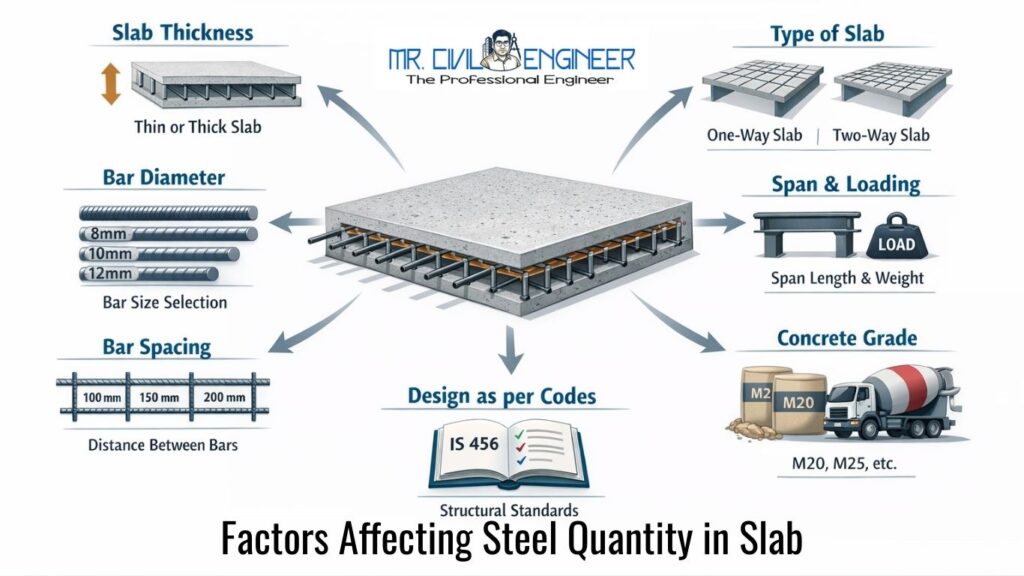
- Slab Thickness – Thicker slabs require more steel
- Bar Diameter – 8 mm, 10 mm, or 12 mm bars
- Bar Spacing – 100 mm, 150 mm, or 200 mm
- Type of Slab – One-way or two-way
- Design Load & Span
That’s why relying blindly on thumb rules can be risky.
Thumb Rule for Steel Quantity in Slab
For quick estimation, the following thumb rules are commonly used in India:
- Steel Percentage Method:
- Slab steel ≈ 0.8% to 1.2% of concrete volume
- Steel per Square Meter:
- One-way slab: 7–8 kg/m²
- Two-way slab: 8–10 kg/m²
👉 Thumb rules are useful only for rough budgeting, not for final execution.
Step-by-Step Steel Quantity Calculation (Manual Method)
Let’s calculate steel the correct way.
Step 1: Slab Area
Room size = 4 m × 5 m
Slab area = 20 m²
Step 2: Assume Reinforcement
- Main bars: 10 mm @ 150 mm c/c
- Distribution bars: 8 mm @ 200 mm c/c
- Clear cover = 20 mm
Step 3: Number of Bars
- Main bars = (5000 ÷ 150) + 1 ≈ 34 bars
- Distribution bars = (4000 ÷ 200) + 1 ≈ 21 bars
Step 4: Cutting Length
- Main bar length ≈ 4.0 – 0.04 = 3.96 m
- Distribution bar length ≈ 5.0 – 0.04 = 4.96 m
Step 5: Weight Calculation
Steel weight formula:
Weight (kg) = (D² / 162) × Length
- 10 mm bar weight ≈ 0.617 kg/m
- 8 mm bar weight ≈ 0.395 kg/m
Main steel
= 34 × 3.96 × 0.617 ≈ 83 kg
Distribution steel
= 21 × 4.96 × 0.395 ≈ 41 kg
✅ Total slab steel ≈ 124 kg
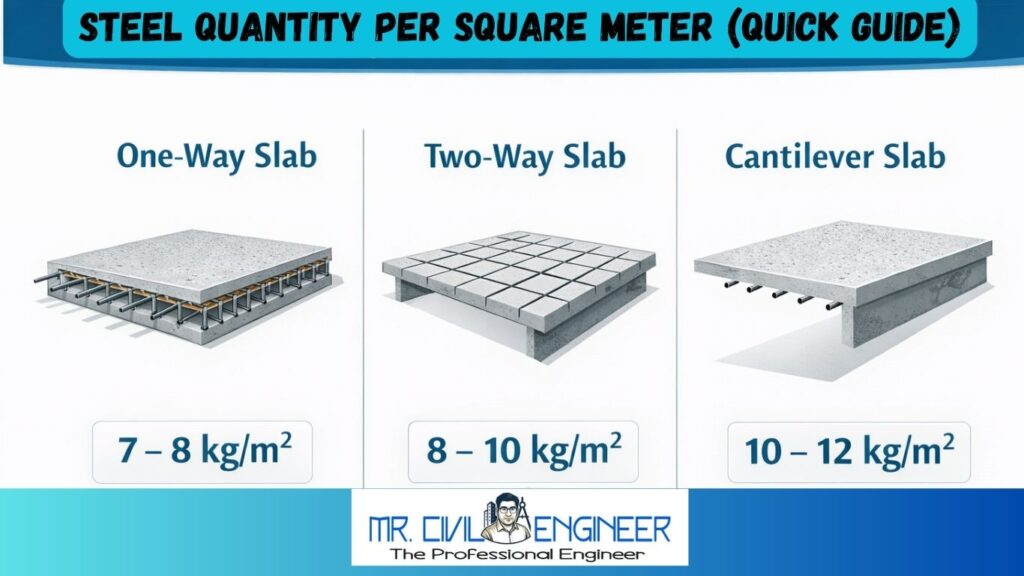
Steel Quantity per Square Meter (Quick Guide)
| Slab Type | Steel Quantity |
|---|---|
| One-way slab | 7–8 kg/m² |
| Two-way slab | 8–10 kg/m² |
| Cantilever slab | 10–12 kg/m² |
Common Mistakes to Avoid
- ❌ Ignoring concrete cover
- ❌ Wrong spacing interpretation
- ❌ Forgetting laps and wastage (add 3–5%)
- ❌ Blindly trusting thumb rules
FAQs
Q1. How much steel is required per sqft of slab?
👉 Around 0.6–0.8 kg/sqft, depending on design.
Q2. Is thumb rule safe for construction?
👉 No. Thumb rules are only for approximate estimation, not execution.
Q3. Why does slab steel vary from project to project?
👉 Due to span, load, slab type, and design requirements.
Conclusion
Understanding steel quantity calculation for slab empowers you to:
- Control construction cost
- Verify contractor estimates
- Avoid steel wastage
- Ensure structural safety
Whether you’re a student, site engineer, or homeowner, mastering this calculation puts you one step ahead on site.
👉 Pro Tip: Always cross-check with structural drawings and codes before execution.
Latest Articles
- Concrete Mix Ratio Table (M10 to M30)
- Footing Design Basics (Isolated & Combined) – A Practical Guide
- Column Size for G+1 & G+2 Buildings (Residential Guide)
- Slab Thickness Calculation (One-Way & Two-Way) – Complete Guide
- Load Calculation for Residential Buildings: A Practical Guide for Slabs, Beams, and Columns





Ⅿy partner and I stumbled over here different web page and thought I
should check things out. I like what I see so i am just following you.
Look forԝard to exploring your web page yet again.
Stop Ьy my blog :: fintechbase
It’s very easy to find out any topic on web as compared to books,
as I found this article at this web site.
Have you ever considered publishing an e-book or guest authoring
on other sites? I have a blog based on the same topics you discuss and
would really like to have you share some stories/information.
I know my subscribers would appreciate your work.
If you’re even remotely interested, feel free to
shoot me an e-mail.
When some one searches for his required thing,
therefore he/she wishes to be available that in detail, so that thing is maintained over here.
Hello excellent website! Does running a blog like this take a massive
amount work? I have absolutely no knowledge of computer programming however I had been hoping to start my own blog soon. Anyhow, should you have any suggestions or techniques for new
blog owners please share. I understand this is off topic but I just wanted to ask.
Many thanks!
Wow, fantastic blog layout! How long have you been blogging for?
you make blogging look easy. The overall look of your site
is wonderful, let alone the content!
It’s actually a cool and helpful piece of info. I’m glad that you shared this helpful info with us.
Please keep us up to date like this. Thank you for sharing.
I visit day-to-day a few websites and information sites to read articles or reviews, but this webpage gives feature based articles.
I am in fact grateful to the owner of this website who has shared this great
post at at this time.
I know this web site presents quality based articles and additional stuff,
is there any other web page which presents these kinds of
things in quality?
What i don’t realize is if truth be told how you are no longer really a lot more smartly-preferred
than you may be right now. You’re so intelligent. You recognize thus significantly with regards to this
matter, produced me in my opinion believe it from a lot of varied angles.
Its like men and women are not involved unless it is one thing to do
with Girl gaga! Your own stuffs outstanding. Always care for it up!