
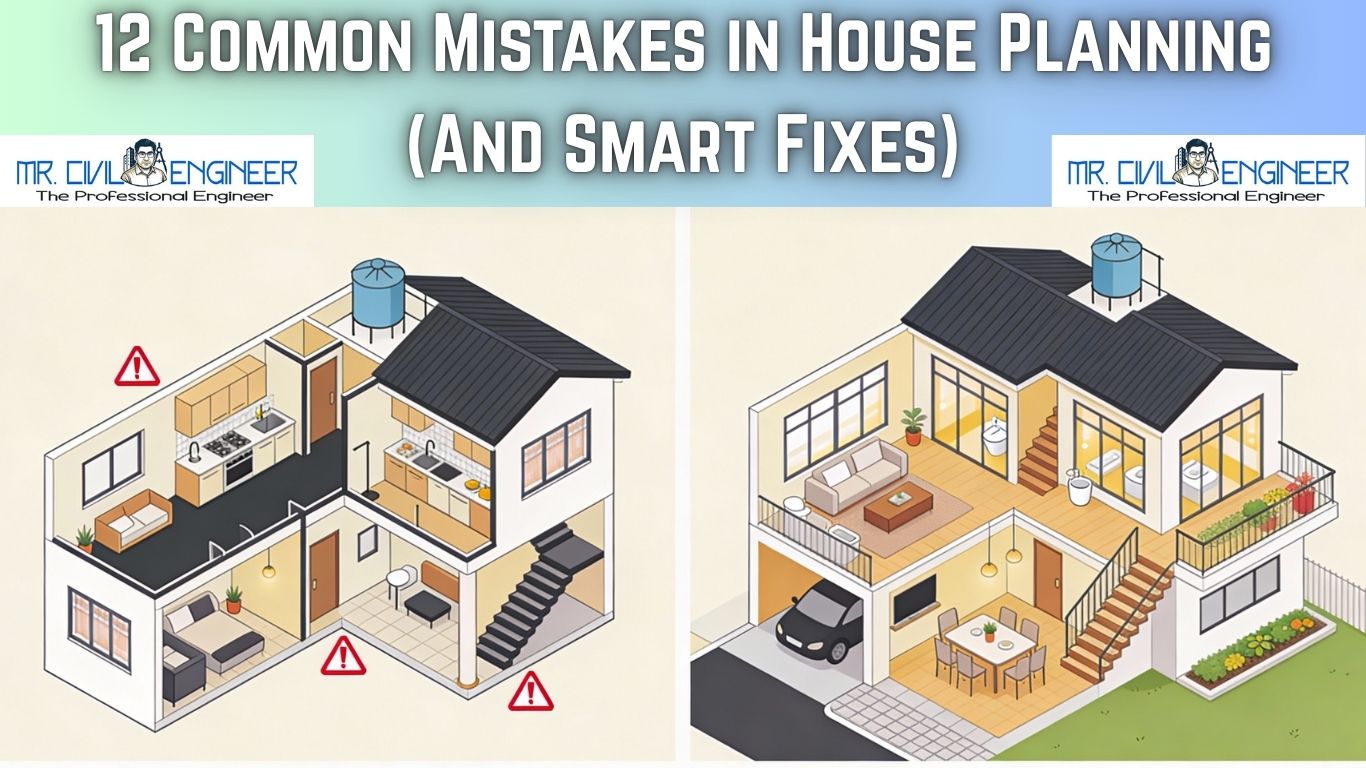

You finally sketch your dream 3BHK—massive living room, Instagram-worthy kitchen island, corner balconies everywhere. Architect nods, contractor starts… then reality hits: bedrooms feel like caves, kitchen workflow frustrates daily, AC bills skyrocket. Common mistakes in house planning plague 70% first-time Indian builders, wasting ₹5–15 lakhs in rework. This guide exposes 12 critical errors with real fixes, checklists, and sizing rules so your plan works for decades, not just photos.
Mistake 1: Ignoring Site Orientation (The Heat Trap)
Problem: West/south-facing living rooms bake in afternoon sun. Bedrooms get zero morning light.
Why common: “Main door northeast Vastu” overrides climate logic.
Fix:
- Living/dining: North/east openings (80% daylight)
- Bedrooms: East/north (morning sun)
- Kitchen/utility: West/south (heat ok)
- Rule: 60% openings north/east facing
Example: Pune home rotated living 90° east—AC usage dropped 40%.
Mistake 2: Oversized Living Room (40% Space Waste)
Problem: 400–500 sq ft living vs practical 250–300 sq ft. Eats bedroom/kitchen space.
Why: “Guests entertain” fantasy rarely used.
Fix:
- Ideal room ratios (3BHK 1500 sq ft):
- – Living: 250–300 sq ft (15–20%)
- – Master bedroom: 150–180 sq ft
- – Kids: 120 sq ft each
- – Kitchen: 100–120 sq ft
Real fix: Compact L-shaped living + family lounge combo saves 100 sq ft.
Mistake 3: Wrong Room Proportions (The Tunnel Effect)
Problem: Long thin bedrooms (20×8 ft) feel claustrophobic. Square better.
Why: Plot shape forces bad layouts.
Fix:
- Bedrooms: 12×14 or 14×12 (square/near-square)
- Living: Max 1:1.5 ratio
- Rule: No dimension >1.5× shorter side
Visual: 14×12 feels spacious vs 20×8 tunnel.
Mistake 4: Poor Kitchen Workflow (Cooking Nightmare)
Problem: Sink-stove-fridge triangle broken. No counter space near utilities.
Why: “Western island” copied without workflow.
Fix: Kitchen Work Triangle (2–3m sides):
Sink → Stove (1.2–2m)
Stove → Fridge (1.2–2.7m)
Fridge → Sink (1.2–2.7m)
- L/parallel/U shapes best
- Wet-dry kitchen separation (Indian must)
- 600mm counters minimum
Example: Hyderabad home added dry pantry—cooking 2x faster.
Mistake 5: No Future-Proofing (Today’s Plan, Tomorrow’s Problem)
Problem: 2 kids now → need 3 bedrooms later. No parents’ room. No WFH corner.
Fix:
- Modular walls: Partition-ready layouts
- Extra toilet: Common bath doubles as guest
- Study nook: 6×8 ft convertible space
- Future lift duct: G+2 provisions
Smart: 100 sq ft “flex space” adapts to life changes.
Mistake 6: Balcony Blunders (Unused Wastage)
Problem: Balconies facing wrong direction, wrong size (6×3 ft unusable).
Fix:
- Size: Min 4×5 ft (walkable)
- Location: Living/master bedroom (north/east)
- Utility balcony: Kitchen/utility (west) for drying
Avoid: 3 balconies eating 15% plot.
Mistake 7: Staircase Location Errors (Space + Safety Killer)
Problem: Straight flight blocking circulation. U-turns wasting corners.
Fix:
Best locations:
✓ Central spine (all floors access)
✓ L-shape/U-turn (compact)
✗ Corner (dark, unused)
- Width: 4 ft min, 3 ft risers
- Landings: Every 10 steps
Mistake 8: Ignoring Services (Chase Chaos Later)
Problem: No planned ducts for plumbing/electrical/AC ducts. Hacking weakens walls.
Fix:
- Vertical shafts: 2×2 ft kitchen/utility/staircase
- Horizontal chases: <1/3 wall thickness
- Ceiling voids: 150mm slabs + false ceiling
Pro: MEP layout before walls rise.
Mistake 9: Vastu Without Functionality (Dark Beautiful Houses)
Problem: Kitchen southwest (cooking heat), bedrooms northeast (no morning light).
Fix: Balanced Vastu:
✓ Kitchen: SE (fire zone)
✓ Master: SW (head family)
✓ Living: NE (entrance)
✗ Pooja northwest (distraction)
Logic first: Good Vastu = good design naturally.
Mistake 10: Poor Ventilation Planning (Stuffy Boxes)
Problem: Windows only for view, not cross breeze. AC dependency.
Fix:
- Cross ventilation: Opposite windows every room
- Window area: 20% floor area
- High-level vents: Exhaust hot air
Test: Paper test—airflow across room?
Mistake 11: Wrong Setback Use (Dead Service Yards)
Problem: 5–10 ft setbacks become dump yards vs usable spaces.
Fix:
- Front: Paved parking + landscaping
- Sides: Utility/service balcony
- Rear: Kitchen yard/drying
Mistake 12: Budget-Blind Luxury Choices
Problem: Marble everywhere (₹300/sq ft) vs vitrified (₹60) for bedrooms.
Fix:
Budget allocation:
Civil structure: 50%
Finishes: 25%
MEP: 15%
Interiors: 10%
Smart: Premium public areas, standard bedrooms.
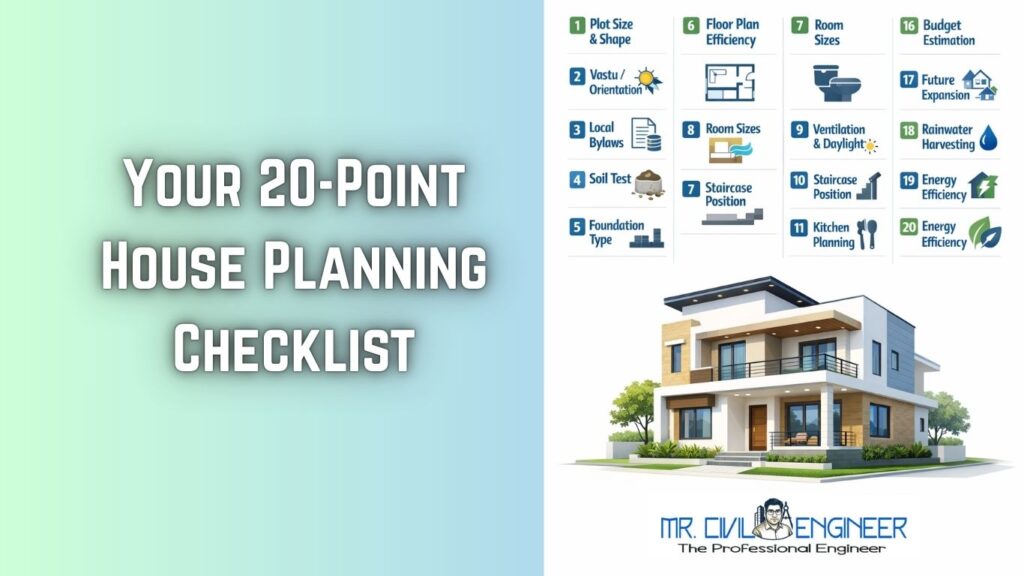
Your 20-Point House Planning Checklist
- Safety, Access & Maintenance
Ensure fire safety, elderly access, waterproofing, and easy repairs. - Plot Dimensions & Shape
Confirm exact plot size, frontage, depth, and any irregular angles before planning. - Orientation & Sun Path
Align rooms to maximize daylight, ventilation, and thermal comfort. - Local Building Rules
Verify setbacks, height limits, FSI/FAR, and approval requirements. - Soil Bearing Capacity
Conduct a soil test to avoid foundation failures and overdesign. - Foundation Strategy
Select footing type based on soil, load, and budget—not guesswork. - Structural System Choice
Decide between load-bearing or RCC framed structure early. - Efficient Floor Planning
Reduce dead spaces like oversized passages and poorly placed walls. - Room Size Proportions
Balance comfort, furniture layout, and cost efficiency. - Ventilation & Cross-Airflow
Ensure every major space has natural air movement. - Staircase Location & Design
Plan safe, comfortable stairs without wasting usable area. - Kitchen Workflow Planning
Follow the work-triangle concept for efficiency and safety. - Toilet & Plumbing Zones
Stack wet areas vertically to reduce plumbing cost and leakage risk. - Electrical Load Planning
Plan switch points, appliance loads, and future upgrades. - Water Supply & Drainage
Design overhead tanks, sump, slopes, and drainage flow in advance. - Material Selection Strategy
Choose materials based on durability, climate, and lifecycle cost. - Realistic Budget Estimation
Include construction, finishes, approvals, and contingency. - Future Expansion Provision
Design columns, foundations, and stairs for vertical growth. - Rainwater Management
Plan harvesting, recharge pits, and surface runoff paths. - Energy-Efficient Design
Use shading, insulation, LED lighting, and efficient layouts.
FAQs: House Planning Mistakes
Most common house planning mistake?
Oversized living room eating functional spaces.
Ideal 3BHK size distribution?
Living 20%, bedrooms 40%, kitchen 8%, circulation 20%, services 12%.
Kitchen planning golden rule?
Work triangle (sink-stove-fridge) 2–7m perimeter.
Conclusion: Plan Right, Live Right
Common mistakes in house planning turn dream homes into daily compromises. Check orientation, right-size rooms, prioritize workflow, future-proof smartly—your plan becomes a legacy. Print checklist, review with architect, avoid ₹10 lakh regrets. What’s your biggest planning worry?
Latest Articles
- Bar Bending Schedule (BBS) – Basics with Example for Civil Engineers
- Cement Grades Explained: OPC vs PPC vs PSC (Complete Guide for House Construction)
- Types of Foundations Used in Residential Buildings: Complete India Guide
- House Construction Cost per Square Feet in India 2026: Complete City-Wise Guide
- Duties and Responsibilities of Site Engineer: What You Need to Know