

Your contractor arrives with 50 bags stamped “OPC 53 – Premium Strength,” but your neighbor swears by PPC for the same house. Which wins? Cement grades confuse everyone because OPC, PPC, and PSC each shine in different scenarios—from fast RCC pours to coastal durability. In India, where 90% of homes use these three, picking wrong means cracks, rework, or weak slabs. This guide explains cement grades (33/43/53 MPa), compares OPC vs PPC vs PSC, and matches each to your home’s needs with real costs and tips.
Understanding Cement Grades: The 33, 43, 53 MPa Mystery
Cement grade = minimum compressive strength (MPa) after 28 days curing. Higher number = stronger concrete potential, but not always “better” for your project.
- 33 Grade: 33 MPa at 28 days. Basic plaster/masonry. Rare now (PPC outperforms).
- 43 Grade: 43 MPa. General RCC, slabs, beams—80% Indian homes use this balance.
- 53 Grade: 53 MPa. High-rise, precast, fast de-shuttering (16–21 days slabs).
Strength timeline matters: OPC 53 hits 70% strength in 7 days (de-shutter fast); PPC/PSC reach same by 28+ days but last longer. All follow IS 269(OPC)/1489(PPC)/456(PSC).
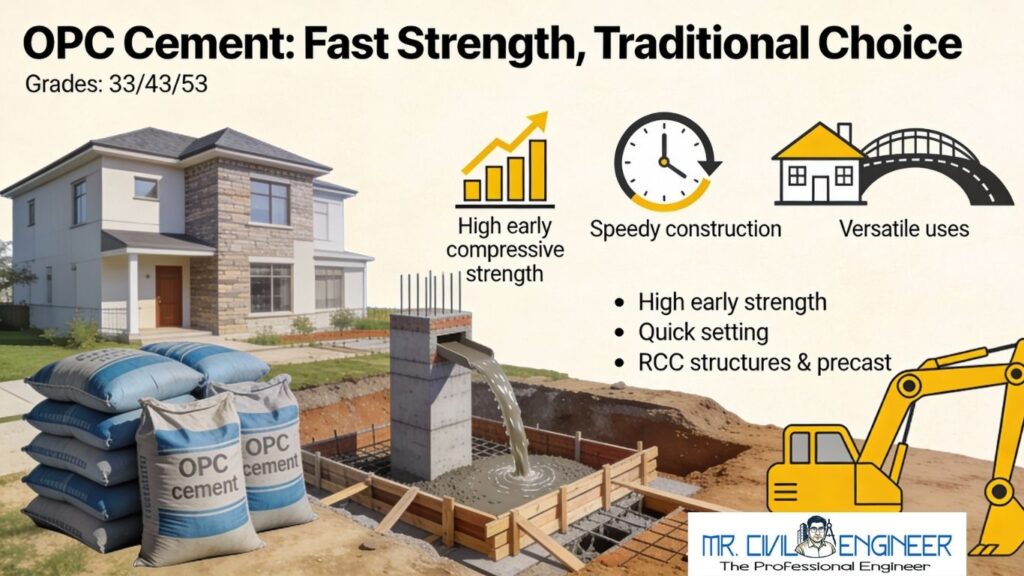
OPC Cement: Fast Strength, Traditional Choice
Ordinary Portland Cement = clinker (95%) + gypsum. No additives. Pure power.
Grades & Features:
- OPC 33: Plaster, flooring. Obsolete for RCC.
- OPC 43: Residential slabs/beams (M20–25 mixes). ₹380–450/bag.
- OPC 53: Columns, high-load RCC. Faster formwork removal. ₹420–500/bag.
Pros: Quick early strength (ideal tight schedules), predictable.
Cons: Higher heat (cracks in mass concrete), less chemical resistance.
Best for: RCC frame, precast elements, cold climates.
Example: Bangalore G+1 slab—OPC 53 de-shuttered in 14 days vs 21 for PPC.
PPC Cement: Fly Ash Blended for Long Life
Portland Pozzolana Cement = OPC clinker (70–80%) + fly ash (15–25%) + gypsum. Thermal power waste becomes strength booster.
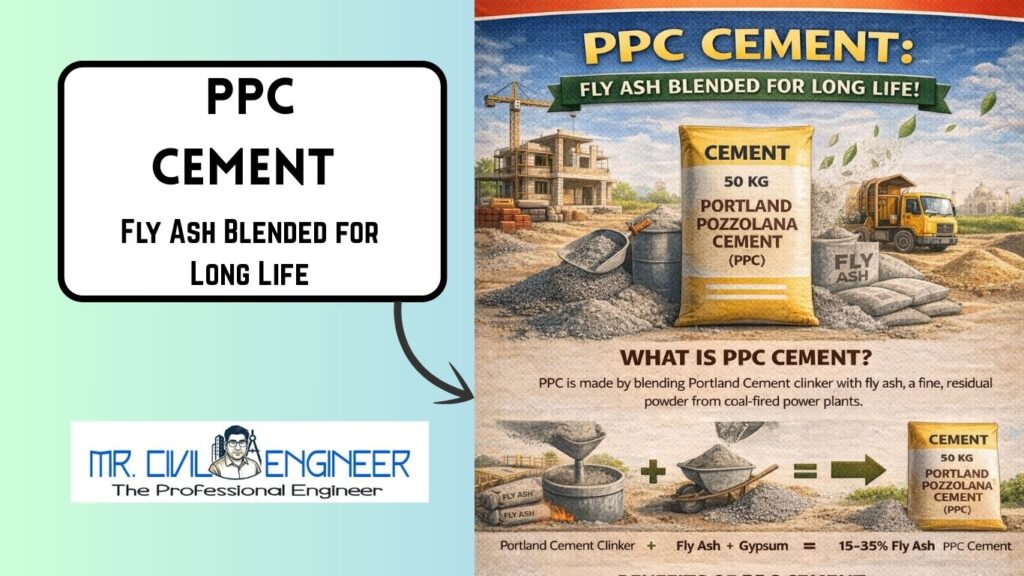
Single grade (equiv. OPC 43): Slower 3–7 day strength, matches/exceeds OPC 43 by 28 days. ₹350–430/bag (10–15% cheaper).
Pros: Lower heat (no thermal cracks), smooth plaster finish, sulphate resistance, eco-friendly.
Cons: Longer curing (10–14 days), slower early strength.
Best for: Masonry, plaster, slabs, mass foundations. 70% Indian homes use PPC.
Real story: Mumbai home with PPC slabs—zero hairline cracks after 5 monsoons.
PSC Cement: Slag for Tough Conditions
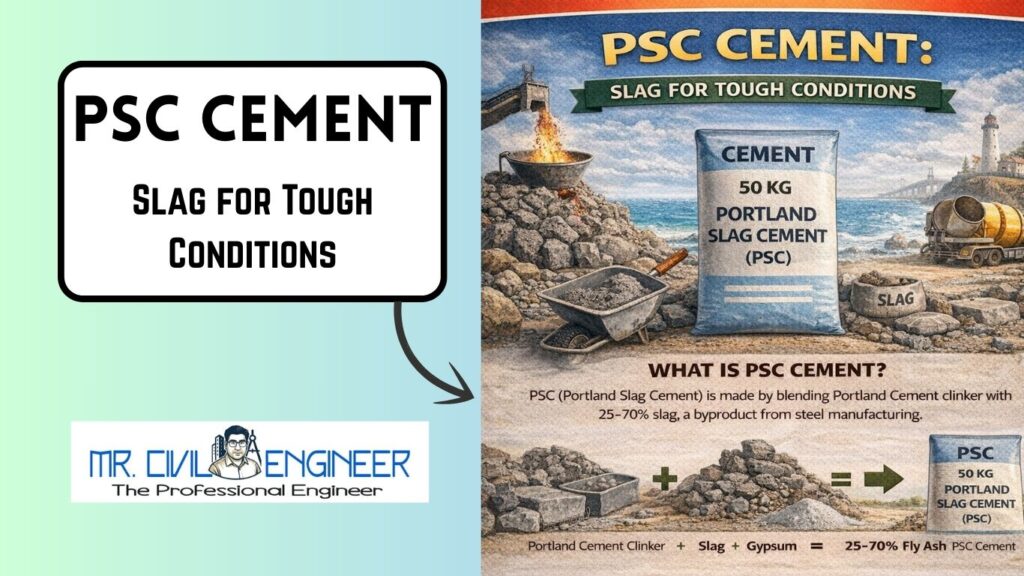
Portland Slag Cement = clinker (40–45%) + blast furnace slag (45–50%). Steel industry byproduct.
Grade equiv. OPC 43/53: Slowest early strength, unbeatable long-term durability. ₹360–440/bag.
Pros: Best sulphate/chloride resistance (coastal king), lowest heat/permeability, dense concrete.
Cons: 14–21 day curing minimum, not for speed.
Best for: Foundations, marine areas, industrial floors, mass concrete (rafts).
Coastal Tamil Nadu? PSC foundations resist salinity 2x better than OPC.
OPC vs PPC vs PSC: Head-to-Head Comparison
| Parameter | OPC (43/53) | PPC | PSC |
|---|---|---|---|
| Composition | Clinker + Gypsum | Clinker + Fly Ash | Clinker + Slag |
| Early Strength (7 days) | High (OPC 53 best) | Medium | Low |
| 28-day Strength | 43/53 MPa | ~43 MPa | ~43–50 MPa |
| Heat of Hydration | High | Low | Lowest |
| Durability | Good | Very Good | Excellent |
| Curing Days | 7–10 | 10–14 | 14–21 |
| Cost (50kg bag) | ₹380–500 | ₹350–430 | ₹360–440 |
| Best Environment | Normal | Normal/Sulphate | Coastal/Severe |
Workability: PPC/PSC = smoother mortar, less water needed.
Which Cement for Which House Part?
Match grade/type to element (IS 456 guidelines):
- Foundation/Footings (M25): PSC/PPC (mass concrete, low heat). Avoid OPC 53 solo.
- Columns/Beams (M25–30): OPC 53 or PPC (balance speed/durability).
- Slabs (M20–25): PPC/OPC 43 (exposed, weather-resistant).
- Masonry/Plaster: PPC (smooth finish, crack-free).
- Coastal Homes: PSC everywhere; OPC only precast.
Mix tip: M20 house slab = 1:1.5:3 cement:sand:aggregate. W/C ratio ≤0.5.
Cement Costs and Smart Buying Tips 2026
Current rates (50kg bag, ex-factory): PPC ₹350–420, OPC 43 ₹380–460, OPC 53 ₹410–500, PSC ₹360–440. Add ₹50–100 transport.
For 1500 sq ft home: ~400–500 bags total (₹1.8–2.2 lakhs cement alone).
Buying checklist:
- ISI mark + grade stamped.
- Manufacturing date <3 months (strength drops 20% after).
- Store elevated, covered (no moisture lumps).
- Reject if setting time wrong (IS test).
- Bulk from 2–3 suppliers = 5–10% discount.
Myth: “Imported = better.” Local PPC/PSC from UltraTech/JK/ASIAN matches global standards.
7 Common Cement Myths Busted
- Myth 1: Higher grade always better. Truth: OPC 53 wastes money on plaster.
- Myth 2: PPC weaker. Truth: Equals OPC 43 at 28 days, outperforms long-term.
- Myth 3: No curing needed. Truth: PPC/PSC need 50% longer or lose 30% strength.
- Myth 4: Coastal = OPC only. Truth: PSC resists corrosion 3x better.
- Myth 5: Mix anything. Truth: Wrong combo = failed cubes, rework.
Site hack: Cube test every 50m³ concrete (₹500/test).
FAQs: Cement Grades Answered
OPC vs PPC—which best for house construction?
PPC for most homes (durability + finish). OPC 53 if speed critical.
Best cement for RCC slab and foundation?
Foundation: PSC/PPC (low heat). Slab: PPC/OPC 43.
Cement grades 33 43 53 difference?
33=plaster, 43=general RCC, 53=high-strength/fast de-shutter.
PSC vs PPC for coastal areas?
PSC superior chloride resistance; both beat OPC.
How long cure PPC cement?
10–14 days minimum for full strength.
Conclusion: Cement Right, Build Right
Cement grades explained simply: OPC for speed, PPC for homes, PSC for harsh conditions. Match your soil, climate, and schedule—test cubes, cure properly, and your home stands strong for generations. Bookmark for site visits, share with your mason, and build confidently.
Read Trending Article
- Building Approval Process in India 2026: Step-by-Step Guide
- Civil Engineering Trends in Smart Cities: India 2026 Guide
- How to Use BIM in Civil Projects: Step-by-Step Guide
- Top 10 Tools Every Site Engineer Must Own (With Practical Field Tips)
- Waterproofing Methods for Homes: A Complete Practical Guide