
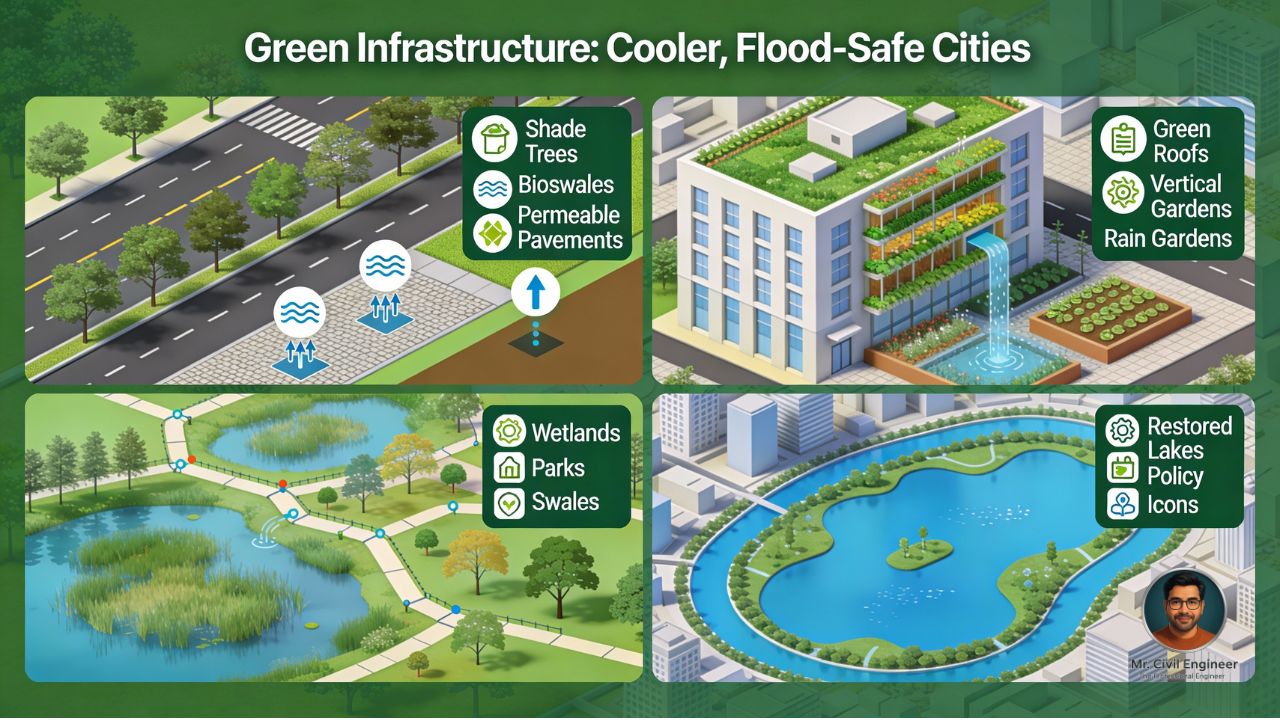

Every monsoon or heavy downpour, the same streets flood, the same basements fill with water, and the same angry phone calls go to city engineers. Green infrastructure offers a different picture: streets lined with trees and rain gardens, roofs that hold water like sponges, and pavements that let rainfall disappear into the soil instead of racing to the nearest drain.
Green infrastructure uses vegetation, soils, and natural processes to capture, absorb, and clean stormwater, while also cooling neighborhoods and adding green space. Unlike traditional “gray” systems that rely mainly on gutters, pipes, and culverts, green infrastructure works with water rather than fighting it, creating streets and public spaces that are both functional and beautiful.
Studies show that well‑designed green roofs can retain about 40–80% of annual rainfall, and permeable pavements can cut runoff by roughly 30–50% compared with standard asphalt. Demand is rising fast: the global stormwater green infrastructure market was valued at around USD 12.34 billion in 2024 and is expected to reach about USD 23.68 billion by 2030. For engineers, planners, and architects, this is the moment to master green infrastructure design.
What is green infrastructure?
In simple terms, green infrastructure (GI) is a network of natural and semi‑natural features that manage water, improve microclimate, and deliver environmental and social benefits in urban areas. Where gray infrastructure relies on concrete pipes and tanks, GI relies on plants, soils, and smart surface design to soak up and slow down stormwater.
Common green infrastructure elements include:
- Rain gardens and bioretention cells: Shallow planted depressions that collect runoff, allow it to pond, infiltrate, and be taken up by plants.
- Bioswales and vegetated channels: Linear, gently sloped ditches planted with grasses and shrubs to convey and filter stormwater.
- Green roofs and living walls: Vegetated layers on roofs and building façades that hold water, insulate buildings, and support biodiversity.
- Permeable pavements: Surfaces like porous asphalt, pervious concrete, and permeable pavers that let water pass through into a storage or infiltration layer.
- Street trees, urban forests, SuDS planters, and parklets: Tree pits, planters, and small plazas that combine shade, aesthetics, and stormwater capture.
Each element works slightly differently, but they all contribute to reducing runoff, improving water quality, and making cities more livable.
Why green infrastructure? Key benefits in practice
1. Water and flood management
Green infrastructure is designed to capture, slow, and soak stormwater instead of sending it directly into overloaded drains.
- Runoff reduction: Rain gardens, green roofs, and permeable pavements reduce the total volume of runoff and delay peak flows, lowering the risk of localized flooding.
- Water quality: As water passes through vegetation and soil, pollutants like sediments, nutrients, and heavy metals are filtered out before they reach rivers and lakes.
2. Climate and environmental benefits
- Cooler neighborhoods: Trees, green roofs, and vegetated streets help reduce urban heat island effects, cutting ambient temperatures and cooling buildings.
- Habitat and biodiversity: Bioswales, wetlands, and connected green corridors create habitat for birds, insects, and urban wildlife.
3. Social and economic gains
- Nicer places to live and work: Green streets, shaded sidewalks, and pocket parks improve walkability and mental health.
- Economic value: Green infrastructure can increase property values and create local jobs in design, construction, and maintenance.
With this context, the question shifts from “Should we use green infrastructure?” to “How do we design it well?”
Step‑by‑step green infrastructure design process
1. Understand your site
Good green infrastructure design starts with a clear picture of the site and its context.
- Hydrology: How does water currently flow? Where does it pond, and where does it leave the site?
- Climate and rainfall: What are typical storm depths, durations, and intensities?
- Soils and groundwater: Are soils sandy and free‑draining, or clayey and slow? Is the water table shallow?
- Constraints: Existing utilities, traffic patterns, right‑of‑way width, underground services, and safety requirements.
This assessment helps you decide what types of GI are realistic and where to place them.
2. Set clear performance goals
Rather than saying “let’s add some green,” define measurable targets.
Examples:
- Capture the first 25 mm of rainfall from all paved surfaces.
- Reduce peak runoff by 30% for a 2‑year storm.
- Improve downstream water quality by removing a set percentage of sediments and nutrients.
Align these goals with local regulations, stormwater manuals, and urban design policies.
3. Choose the right tools for the right places
Different sites call for different GI tools, often in combination.
- Streets and parking lots
- Bioswales along curbs, tree trenches, and permeable parking bays.
- SuDS planters between traffic lanes and sidewalks.
- Roofs and podium decks
- Extensive (shallow) green roofs for large flat roofs.
- Intensive roofs or podium gardens where more soil depth and plant variety are possible.
- Parks, campuses, and open spaces
- Rain gardens, wetlands, detention basins, and swales that double as landscape features.
Design these elements to complement—not completely replace—gray infrastructure, especially for extreme storms.
4. Size and configure your GI
This article will keep sizing principles simple and conceptual.
- Treat the “first flush”: Many guidelines recommend capturing the initial portion of rainfall, which carries most pollutants, through GI elements sized for that volume.
- Allow safe ponding: For rain gardens and bioretention, include a shallow ponding zone, an engineered soil layer, and sometimes an underdrain.
- Plan inlets and overflows carefully:
- Make sure water can easily enter (curb cuts, inlet grates) without causing erosion.
- Provide overflow paths so extreme rainfall safely bypasses to drains or open channels.
Even rule‑of‑thumb sizing, when combined with clear overflow design and standard details, can deliver strong performance.
5. Choose the right soils, plants, and materials
Green infrastructure succeeds or fails on the details.
- Soil media
- Use a well‑draining mix (often sand‑dominated) with enough organic matter to support plants but not so much that the system compacts or clogs.
- Depth depends on plant type and design storage needs.
- Plants
- Prefer native or climate‑adapted species that tolerate both wet and dry conditions, urban heat, and occasional pollution.
- Mix grasses, shrubs, and occasional trees for structure and resilience.
- Hardscape and edging
- Use stable edges, check dams, and rock mulches where needed to control erosion.
- For permeable pavements, ensure appropriate base gradation, geotextiles, and connection to subsoil or drains.
6. Design for maintenance from day one
Many green infrastructure projects fail not because the concept is wrong, but because maintenance was an afterthought.
- Make access easy: Provide paths, ramps, or gentle slopes so crews can reach GI elements with standard tools.
- Plan sediment capture: Small forebays or inlet sumps make it easier to remove debris before it spreads.
- Define responsibilities: Clarify who will maintain each feature—municipality, private owner, or a shared arrangement—and budget for it.
Typical maintenance includes litter removal, pruning, weeding, sediment removal, inspection of inlets and overflows, and occasional media or plant replacement.
Practical green infrastructure design tips
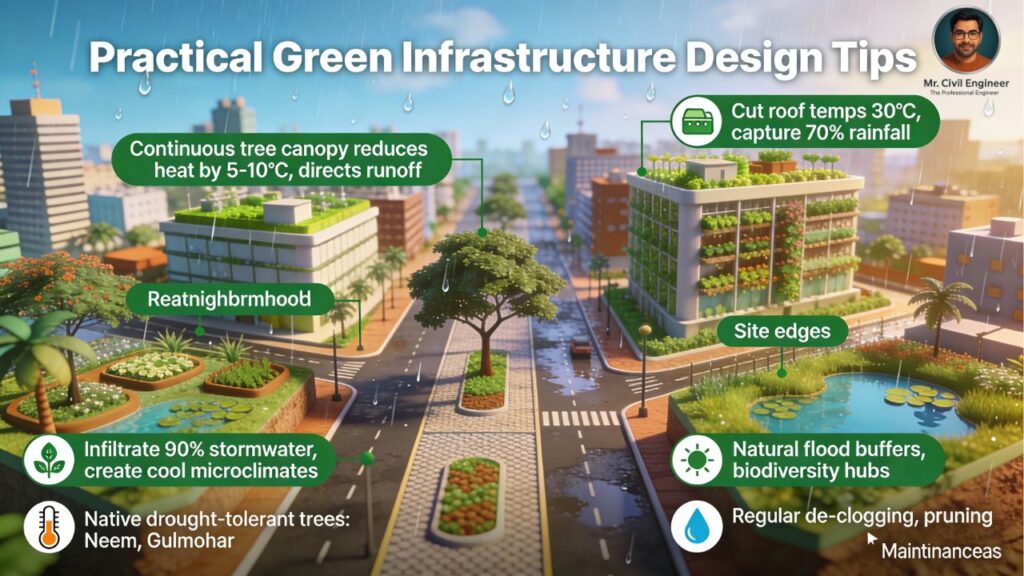
- Think in networks, not isolated pieces
Connect roofs, streets, and open spaces so water flows through a series of GI elements before reaching the drain, increasing performance and resilience. - Keep water visible and legible
When people can see where water goes—into a swale, across stepping stones, into a rain garden—it builds understanding and support, and makes inspection easier. - Start with high‑visibility pilots
Showcase projects on city center streets, civic buildings, or campuses to demonstrate benefits and win political and public backing. - Make spaces multi‑functional
Design plazas, play areas, and car parks that double as temporary storage during storms, rather than separate “technical” and “public” spaces. - Co‑design with maintenance teams and communities
Involving operations staff and residents early helps choose plant species, access points, and design details they can realistically care for. - Monitor and share results
Simple metrics like volume captured, flood incidents avoided, or temperature reductions can be powerful in justifying future GI investments.
Real‑world inspiration
Several cities across North America and elsewhere have adopted green stormwater infrastructure to reduce polluted runoff, meet water quality targets, and manage extreme rainfall. In many cases, GI has helped reduce sewer overflows, cut local flooding, and deliver cooling and amenity benefits at the same time.
As awareness grows and costs become better understood, municipalities are increasingly prioritizing green solutions in their infrastructure portfolios, contributing to the strong global market growth for stormwater GI.
FAQs
1. What is green infrastructure in simple words?
Green infrastructure is a way of using plants, soil, and smart surface designs—like rain gardens, green roofs, and permeable pavements—to manage stormwater and cool cities, instead of relying only on underground pipes.
2. Is green infrastructure only about stormwater?
Stormwater management is a core focus, but green infrastructure also improves air quality, cools urban areas, provides habitat, and makes public spaces more attractive and comfortable.
3. Is green infrastructure more expensive than traditional drains?
Upfront costs can be comparable or slightly higher depending on design, but GI can reduce long‑term spending on drainage upgrades, flood damage, and heat‑related impacts, and can increase property values. Many studies show strong lifecycle value when benefits are fully accounted for.
4. Can green infrastructure work in dense, space‑constrained cities?
Yes. Tools like green roofs, tree trenches, sidewalk planters, permeable pavements, and small parklets can fit into very tight rights‑of‑way and rooftops. The key is careful site selection and integration with existing gray infrastructure.
5. How do I make sure green infrastructure does not fail due to poor maintenance?
Design for simple, predictable maintenance: good access, simple plant palettes, sediment pre‑treatment, and clear ownership. Training maintenance crews and budgeting for regular inspections are just as important as hydraulic calculations.
Conclusion: Designing with nature, not against it
Green infrastructure is not a decorative extra; it is a practical, multi‑benefit way to manage water, reduce heat, and make cities healthier and more resilient. By applying a clear process—understanding the site, setting goals, choosing the right tools, detailing soils and plants carefully, and planning maintenance—engineers and planners can turn every project into an opportunity to work with nature rather than against it.
Whether it is a single street upgrade, a campus, or an entire neighborhood plan, weaving green infrastructure into your designs today will help your city face tomorrow’s storms and heat with confidence.
For New Information, Please click on the link below
- Robot-Assisted Construction Techniques: Faster, Safer Sites in 2026
- Civil Engineering Trends in Smart Cities: India 2026 Guide
- How to Use BIM in Civil Projects: Step-by-Step Guide
- Top 10 Tools Every Site Engineer Must Own (With Practical Field Tips)
- Waterproofing Methods for Homes: A Complete Practical Guide