


Picture this: Mumbai’s traffic grinding to a halt, not from potholes, but from real-time data rerouting signals to ease the jam—before it starts. India’s 100 Smart Cities Mission pumps ₹48,000 crore into such tech-driven urban makeovers, where civil engineers lead the charge. These civil engineering trends in smart cities blend sensors, AI, and green materials to cut congestion 25% and energy use 30%, turning chaotic metros into livable hubs.
Top Trends Transforming Civil Work
Civil engineering trends in smart cities revolve around data-smart, climate-proof infrastructure. IoT sensors embedded in roads detect cracks early, slashing maintenance 40%. Digital twins—virtual city replicas—simulate monsoons or crowds for safer designs. AI optimizes traffic via 5G, while modular green buildings use self-healing concrete. Expect 20% faster builds by 2026 as BIM integrates with these.
- IoT Sensor Networks: 50,000+ sensors per city monitor water, air, traffic—Coimbatore cut energy 30%.
- Digital Twins: Real-time models predict failures; Singapore’s twin handles 50TB data.
- AI-Driven Design: Auto-generates resilient bridges; Tallinn shaved 20% timelines.
- Sustainable Materials: Carbon-capturing concrete, permeable pavements for flood control.
- Smart Mobility: EV charging grids, drone deliveries integrated into infra.
Civil Engineers’ New Playbook
Gone are drawing-board days—civil pros now fuse traditional RCC with IoT-ready rebar. Design phase: Use BIM for 3D models laced with sensors. Construction: Drones scan progress against digital twins. Post-build: AI flags wear on flyovers. Upskill in Revit+Python for ₹10-15 lakh tenders; India’s infra boom needs 10 million engineers versed here.
| Trend | Civil Application | Benefit | India Example |
|---|---|---|---|
| Digital Twins | Simulate loads/floods | 20% less rework | Helsinki-style in Nagpur |
| IoT Sensors | Embed in bridges/roads | Predictive maintenance | Surat traffic |
| Green Infra | Permeable pavements | 30% flood reduction | Coimbatore parks |
| AI Optimization | Traffic/structural analysis | 25% efficiency | Mumbai pilots |
Indian Smart Cities Leading the Way
Nagpur tops charts with IoT waste systems and GIS mapping, converting investments fastest via PPPs. Surat’s smart roads use sensors for zero-pothole zones, cutting accidents 15%. Coimbatore integrates AI for lighting/water, saving 30% energy. These under Smart Cities Mission show civil trends scaling: Nagpur’s multimodal transit hubs blend metro-BRT-EV seamlessly.
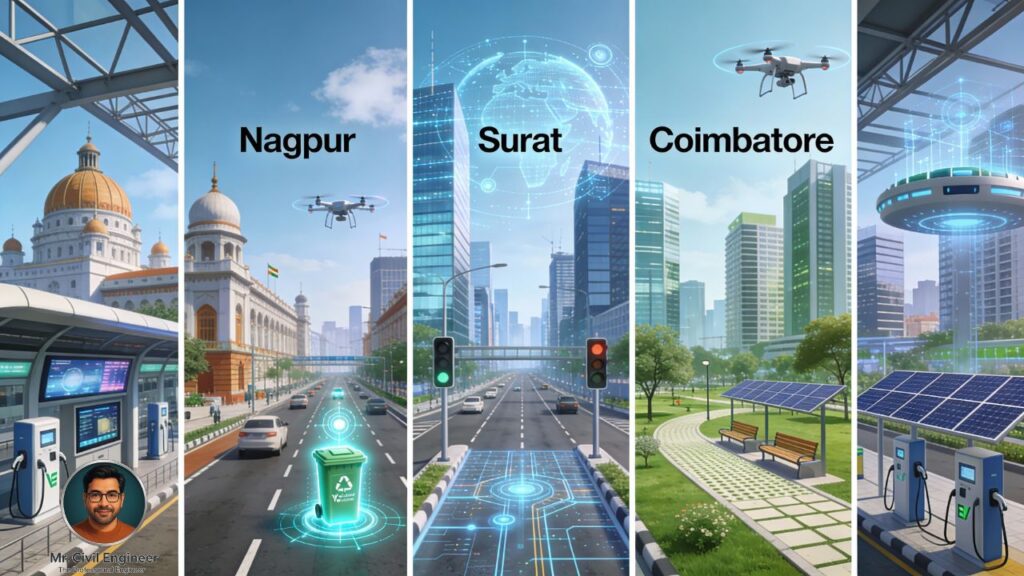
Dehradun fights sprawl with zoned digital planning, proving even hilly terrains adapt.
Hurdles and Smart Fixes
High IoT costs? Phase in: Start with ₹5 crore pilot sensors yielding 2-year ROI. Skill shortages? Free NITI Aayog certs, Autodesk courses. Data privacy? Blockchain secures twins. Climate risks? Resilient codes per NDMA. Civil firms counter by partnering IITs for R&D.
FAQs
What are top civil engineering trends in smart cities 2026? IoT, digital twins, AI infra—expect 5G everywhere.
Digital twins cost in India? ₹2-10 crore/city zone; saves 20% long-term.
IoT for roads viability? Yes, detects 90% cracks early; Surat model.
Smart Cities Mission progress? 100 cities, Nagpur leads implementation.
Civil skills for smart cities? BIM, AI basics, sensor integration.
Green trends impact? 30% energy cut via smart grids/buildings.
AI replacing civil engineers? No—enhances design speed 25%.
2026 and Beyond
By 2026, expect nationwide digital twins linking grids to metros, with civil engineers directing AI for net-zero cities. Quantum sensors, bio-materials rise; India’s $1.4 trillion infra needs trend-savvy pros. Start with IoT audits on your sites.
Civil engineering trends in smart cities aren’t sci-fi—they’re your next project edge. Pick one trend, prototype on a G+3 job, and lead India’s urban revolution.
Recent Posts
- How to Use BIM in Civil Projects: Step-by-Step Guide
- Top 10 Tools Every Site Engineer Must Own (With Practical Field Tips)
- Waterproofing Methods for Homes: A Complete Practical Guide
- Building Approval Process in India 2026: Step-by-Step Guide
- How AI Is Transforming Civil Engineering: Top AI Tools You Must Know