
Brickwork Estimation Guide
A contractor quoted low on brickwork for a G+1 house, only to overrun by 15% due to poor quantity takeoff—losing ₹2 lakh profit. Brickwork often eats 30–40% of RCC frame costs, so accurate estimation keeps projects profitable and clients happy.
This guide walks through how to estimate brickwork step-by-step: from volume to materials, labor, and full rate analysis. Using IS 1200 rules and 2025 Indian rates, you’ll master it for any wall—complete with a real 230mm wall example.
Brickwork Basics Before Estimating
Understand specs first:
- Types: 1st class fire-burnt (strong, ₹8–12 each), 2nd class (₹6–9), modular (lighter, 450x200x100mm).
- Mortar: 1:6 cement: sand (10mm joints common); 1:4 for load-bearing.
- Measurement: Per IS 1200 Part 3—volume in m³, deduct openings >0.1m² half area
Pro tip: Always site-verify dimensions before takeoff.
Step-by-Step Quantity Estimation
Follow this sequence:
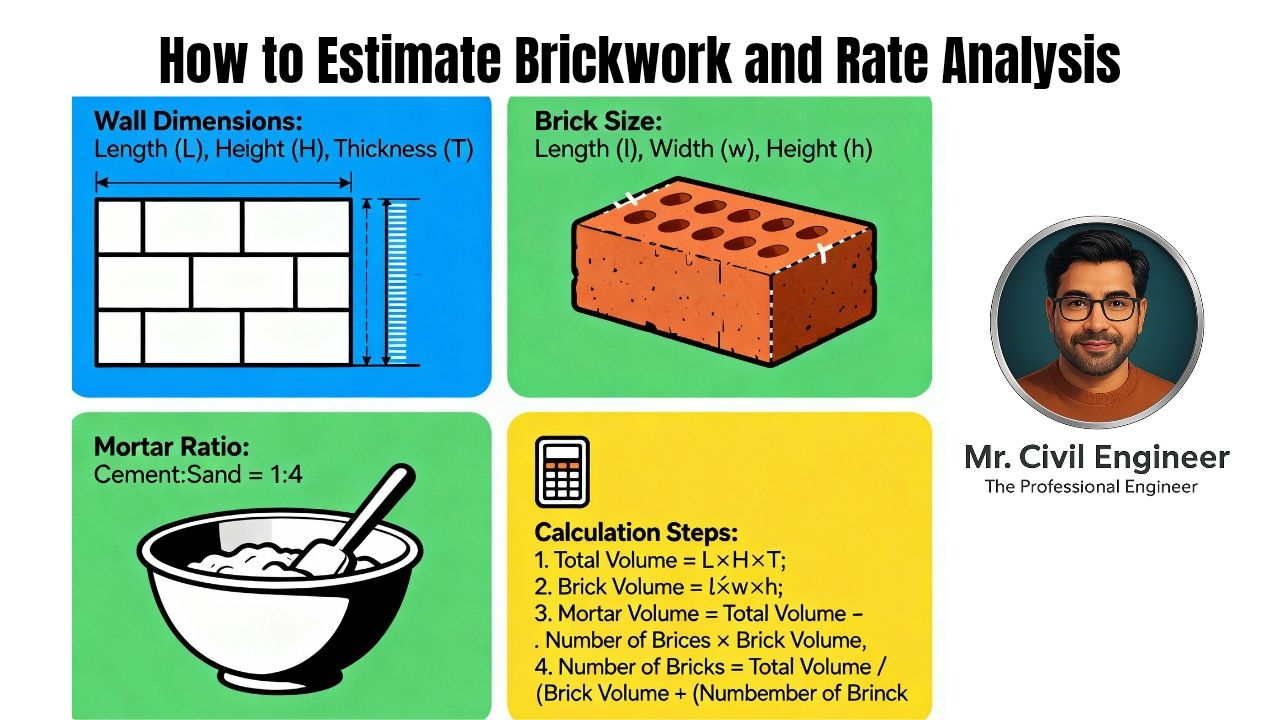
- Calculate gross volume: Length × width × height (e.g., 10m × 0.23m × 3m = 6.9 m³).
- Deduct openings: Doors/windows (half area × thickness).
- Bricks required: 500 nos/m³ (traditional) × net volume × 1.05 wastage.
- Mortar volume: 0.30 m³/m³ brickwork (30% voids).
- Mix ratio: Cement = mortar vol × (1/(1+6)) / 0.035 m³/bag; sand = balance.
Use center-line method for complex walls.
Materials Breakdown for Brickwork
For 1 m³ (1:6 mortar, 10mm joints):
- Bricks: 500 nos (1st class) × ₹10 = ₹5000.
- Modular: 570 nos/m³.
- Cortar (1:6): 0.30 m³ total.
- Cement: 0.047 m³ = 1.34 bags (50kg) × ₹350 = ₹469.
- Sand: 0.253 m³ × ₹80/m³? Wait, ₹6000/tonne (~₹90/m³) = ₹23.
- Water: 0.15 m³ (included in labor).
Formula recap:
Cement bags=Mortar vol×1440(C:S ratio+1)×50Cement bags=(C:S ratio+1)×50Mortar vol×1440
Labor, Machinery, and Overheads
- Labor: 1 mason + 1.5 helper/m³/day (₹1200/mason, ₹800/helper). Total ₹2500/m³.
- Scaffolding/curing: ₹200/m³.
- Overheads/profit: 15–20% + 5% contingencies.
- Machinery: Minimal (mixer ₹100/m³).
Total labor ~55% of rate.
Worked Example: Estimating 50m² 230mm Brick Wall
Scenario: External wall 20m long × 2.5m high = 50m² (gross vol = 50 × 0.23 = 11.5 m³). Door 2×2.1m (deduct 2.1 m³ half-area rule). Net vol = 11.5 – 2.1 = 9.4 m³.
Step 1: Bricks
500×9.4×1.07=5029 nos×₹10=₹50,290500×9.4×1.07=5029 nos×₹10=₹50,290
Step 2: Mortar (1:6, 0.30 m³/m³)
Total mortar = 9.4 × 0.30 = 2.82 m³.
- Cement: 2.82×17÷0.035=11.572.82×1÷0.035=11.5 bags × ₹350 = ₹4025.
- Sand: 2.82 × (6/7) = 2.42 m³ × ₹90 = ₹218.
Step 3: Labor (1.2 m³/mason-day)
Days = 9.4 / 1.2 = 7.83 days.
Mason (₹1200/d) + 1.5 helper (₹800/d each) = ₹3200/d × 7.83 = ₹25,056.
Step 4: Add-ons
- Scaffolding/water/curing: ₹200/m³ × 9.4 = ₹1880.
- Machinery: ₹100/m³ × 9.4 = ₹940.
Subtotal: ₹50,290 + ₹4025 + ₹218 + ₹25,056 + ₹1880 + ₹940 = ₹84,409.
Step 5: Rate Analysis
Per m³: ₹84,409 / 9.4 = ₹8976. Add 20% profit/overheads = ₹10,771/m³ (~₹2477/m²).
| Item | Qty | Rate | Amount |
|---|---|---|---|
| Bricks | 5029 nos | ₹10 | ₹50,290 |
| Cement | 11.5 bags | ₹350 | ₹4025 |
| Sand | 2.42 m³ | ₹90 | ₹218 |
| Labor | 7.83 days | ₹3200 | ₹25,056 |
| Total/m³ | ₹8976 |
Common Mistakes and Pro Tips
- Mistake: Forgetting 5–10% wastage or joint thickness (use 500 nos net).
- Tip: Verify rates locally (Delhi DSR 2025: ₹1800–2200/m³); adjust for 12mm mortar (+10% qty).
- Use Excel for multi-wall takeoffs; cross-check with drawings.
FAQs
How many bricks per m³ brickwork?
500 nos (traditional, 10mm mortar); 570 modular.
Cement bags for 1 m³ 1:6 mortar?
1.34 bags (47kg cement).
Brickwork rate in India 2025?
₹2500–3500/m³ (1st class); varies by city.
Deduct openings how?
Half area × thickness if >0.5m² (IS 1200).
Conclusion
Mastering how to estimate brickwork and rate analysis turns guesswork into precision, safeguarding your margins on every project. Practice with drawings, update rates quarterly, and always build in 10% buffer.
Next tender? You’ll quote confidently—saving time, money, and headaches. Download a template and start calculating.
Read This Also
How to Calculate Building Cost Before Construction: Your Step-by-Step Guide
Building Information Modeling (BIM) and 4D/5D BIM: The 2025 Guide
Artificial Intelligence in Civil Engineering: How Smart Infrastructure is Being Built