
Picture this: You’re designing a cozy 2BHK on a tight 800 sq.ft plot. A grand spiral staircase looks stunning in magazines, but will it fit your family’s daily rush? Choosing the right staircase type turns vertical movement into safe, stylish circulation.
Staircases blend structure, safety, and design. This guide covers complete classification by shape, use, materials—with features, pros/cons, and real-world uses for homes, offices, and beyond. Let’s climb through the options.
Staircase Basics: Parts and Code Essentials
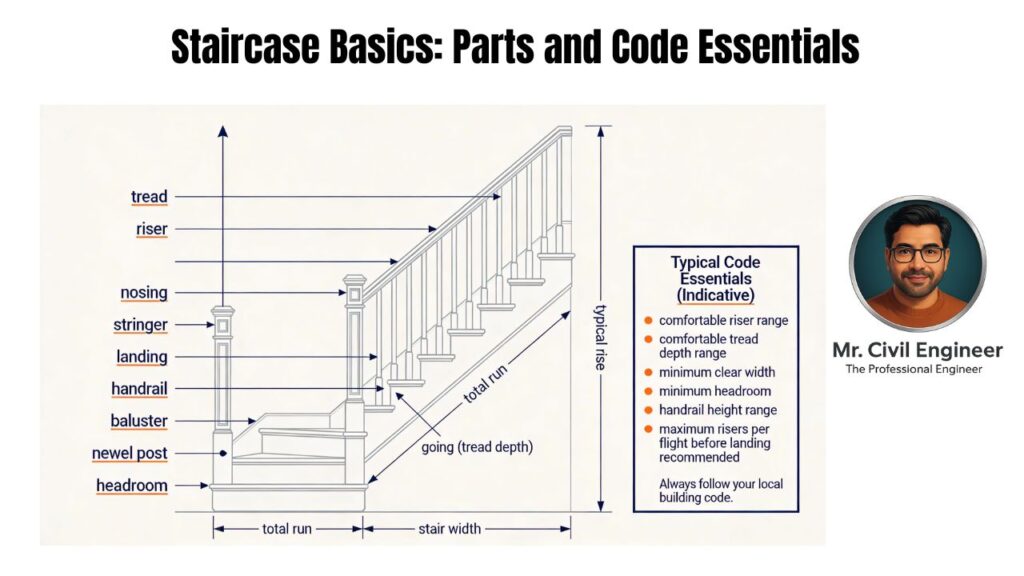
Before types, know the anatomy:
- Tread: Flat stepping surface (min 250–300mm).
- Riser: Vertical height (150–180mm).
- Flight: Continuous steps between landings.
- Landing: Platform for turns/rest.
- Handrail/baluster: Safety grip and side protection (height 900–1000mm).
NBC guidelines ensure comfort: 2R + T = 600–650mm (R=riser, T=tread); width 1m+ for homes, 1.5m+ public. Always get structural approval for RCC landings.
Types by Shape and Layout
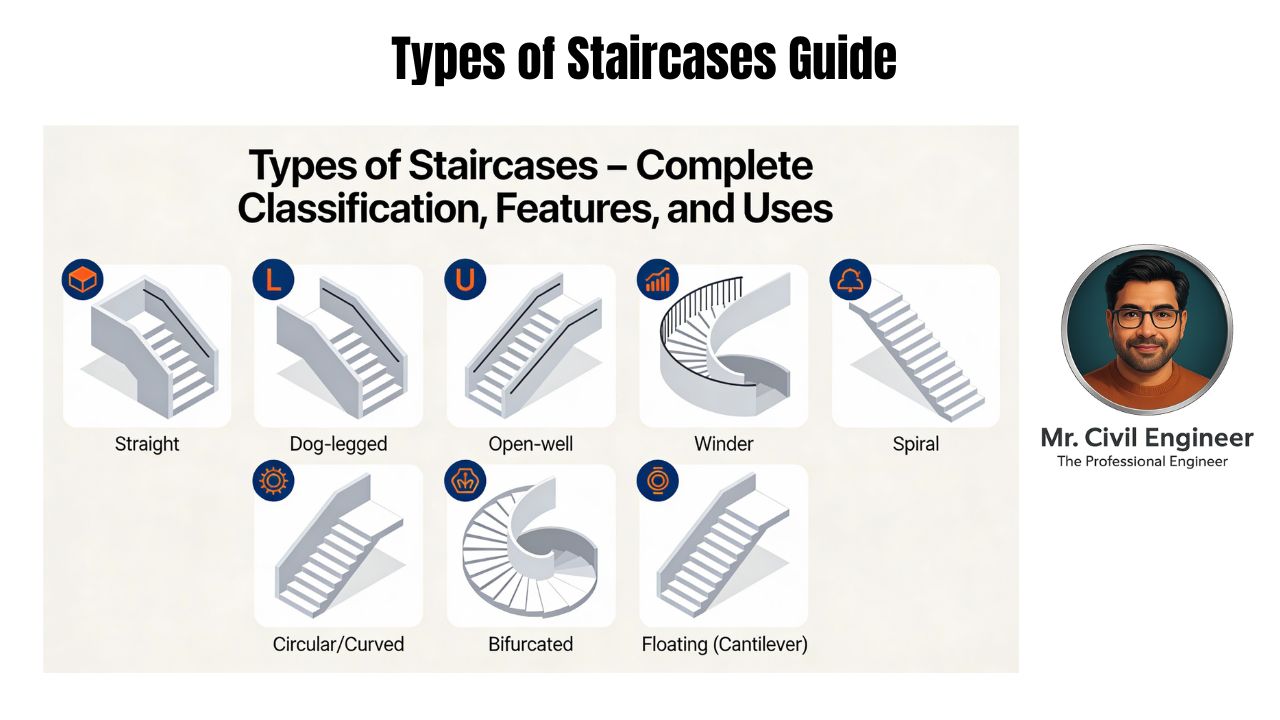
Most staircases classify by step arrangement. Here’s the breakdown:
Straight Stairs
Single flight, no turns. Simplest and cheapest.
- Features: Uniform rise/run; easy construction.
- Uses: Narrow spaces like porches, service stairs.
- Pros: Low cost, quick build. Cons: Needs long run (3m rise = 15–18 steps, ~5–6m length).
Turning Stairs
Changes direction mid-way.
- Dog-Legged (Dog-Leg): Two flights at 180° with common landing; walls enclose both sides. Compact for small homes.
- L-Shaped (Quarter-Turn): 90° turn via landing; fits corners.
- U-Shaped: Like dog-legged but open sides; elegant for duplexes.
Uses: Residential (dog-legged/L for 10×10 rooms). Pros: Space-saving. Cons: Complex shuttering.
Open Well/Newel Stairs
Flights separated by open “well” (1–2m wide). Luxurious look.
- Features: Forward/backward flights around void.
- Uses: Offices, villas. Pros: Grand aesthetics. Cons: Needs more floor space.
Spiral, Circular, Helical Stairs
Steps wind around central post/core.
- Spiral: Tight coil (dia 1.2–2.5m).
- Circular/Helical: Wider curve, winders (triangular treads).
Uses: Space-crunched lofts, fire escapes. Pros: Minimal footprint. Cons: Steep, unsafe for kids/elderly, hard to move furniture.l
Bifurcated/Geometrical Stairs
Wide lower flight splits into two at mid-landing.
- Features: Symmetrical, winders optional.
- Uses: Public lobbies, mansions. Pros: Impressive entry. Cons: Large space (6m+ width).
Winder Stairs
No landing; steps wedge to turn corners.
Uses: Retrofits, tight corners. Pros: Compact. Cons: Uneven treads risky (code restricts).
Types by Function and Building Use
- Residential: Dog-legged/L-shaped (safe, compact).
- Public/Institutional: U-shaped/open well (wide treads, handrails both sides).
- Industrial/Service: Straight/spiral (durable, low-maintenance).
- Fire Escape: External spiral/straight (quick access, non-combustible).
For schools/offices: min 1.8m width, contrasting nosing for visibility.
Material-Based Staircase Types
Layout pairs with materials:
| Material | Features/Uses | Pros | Cons |
|---|---|---|---|
| RCC | Monolithic flights/landings; Indian staple. | Durable, fire-resistant, affordable (~₹2000/sq.m). | Heavy, needs formwork. |
| Wooden | Treads on stringers; homes/villas. | Warm aesthetics, easy mods. | Fire-prone, termites. |
| Steel | Fabricated frames/steps; industrial/modern. | Lightweight, fast install. | Corrosion if exposed. |
| Stone | Treads/risers; luxury/public. | Timeless, hardwearing. | Expensive, slippery. |
| Glass/Composite | Floating treads; contemporary. | Sleek, light-transmitting. | Costly maintenance. |
| Floating (Cantilevered) | Hidden wall supports. | Minimalist wow-factor. | Needs strong substrate. |
RCC dominates 80%+ Indian residential projects for load-bearing efficiency.
Features, Pros/Cons, and How to Choose
| Type | Space Needed | Cost (₹/sq.m) | Safety | Best For |
|---|---|---|---|---|
| Straight | High length | Low | High | Service |
| Dog-Legged | Medium | Medium | High | Small homes |
| Spiral | Very low | Medium-High | Low | Lofts |
| Open Well | High | High | High | Offices |
| Floating | Medium | Very High | Medium | Luxury |
Selection tips: Measure available area (e.g., dog-legged fits 2.5x4m); prioritize family safety over trends; budget 5–10% of build cost. For duplexes: L/U-shaped win.
Modern Trends and Practical Tips
- Hybrids: L-shaped with glass risers.
- Modular prefab: Factory treads for speed.
- Avoid: Winders in homes (slip hazard); undersized spirals (>2m dia min).
Story: A Mumbai architect swapped spiral for dog-legged in a 600 sq.ft flat—saved ₹50k, boosted safety.
FAQs
Best staircase for small house?
Dog-legged or L-shaped: compact yet safe for 8×10 ft spaces.
Safest overall type?
U-shaped/open well: landings reduce fatigue, wide treads.
RCC staircase cost per sq.ft?
₹1800–2500 incl. labor/materials; varies by city/design.
Can I use spiral for main home stairs?
Better as secondary; steep angle limits daily use/kids.
Conclusion: Step Up Your Design Game
From straightforward straight stairs to elegant bifurcated showpieces, types of staircases offer solutions for every space and style. Match layout to your plot, materials to budget, and always prioritize NBC safety—your staircase isn’t just steps, it’s the building’s spine.
Consult a structural engineer early, sketch options, and visualize traffic flow. The right choice elevates your project—literally.