
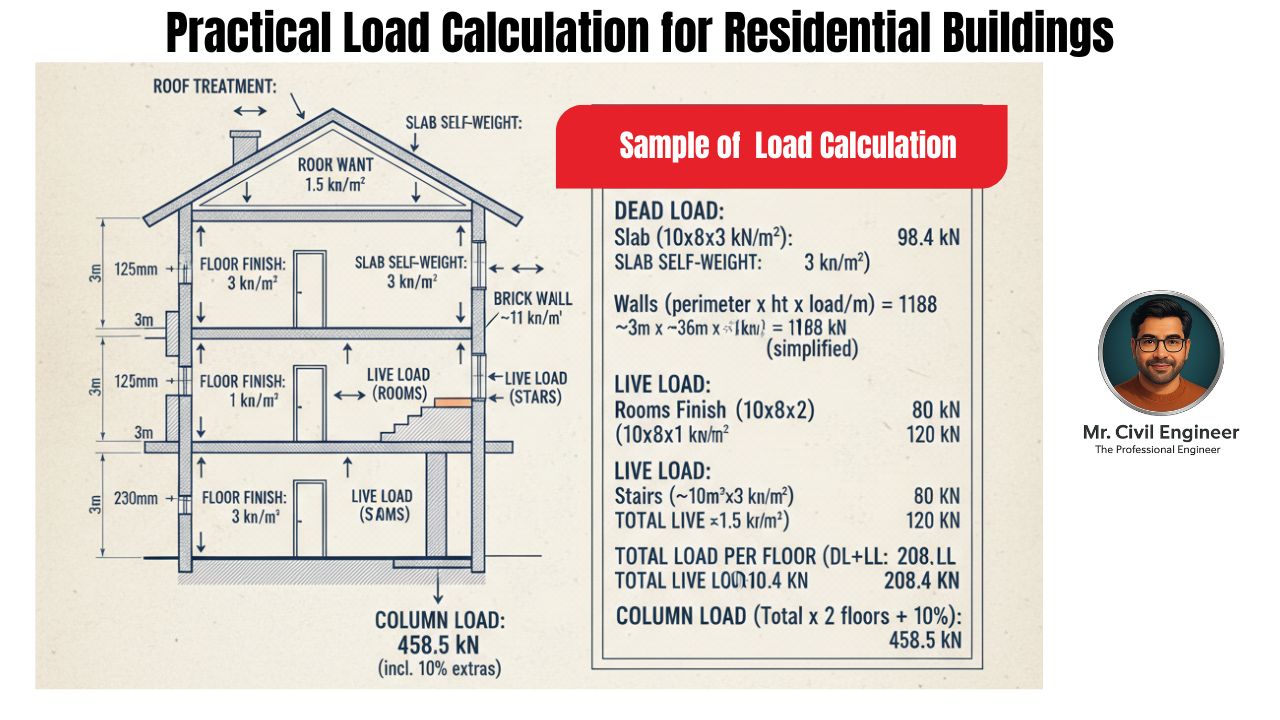

Imagine a young site engineer handing over drawings for a G+1 house, only to get a call from the structural consultant: “Your column loads are off by 20%—we need to redesign everything.” A simple mistake in wall load or slab self-weight snowballs into delays and extra costs. This happens more often than you think.
Load calculation forms the foundation of safe, economical residential design. Using Indian standards like IS 875 and IS 1893, this guide walks through practical steps with real numbers for a typical RCC-framed house. No theory overload—just what you need for site or office work.
Types of loads in residential buildings
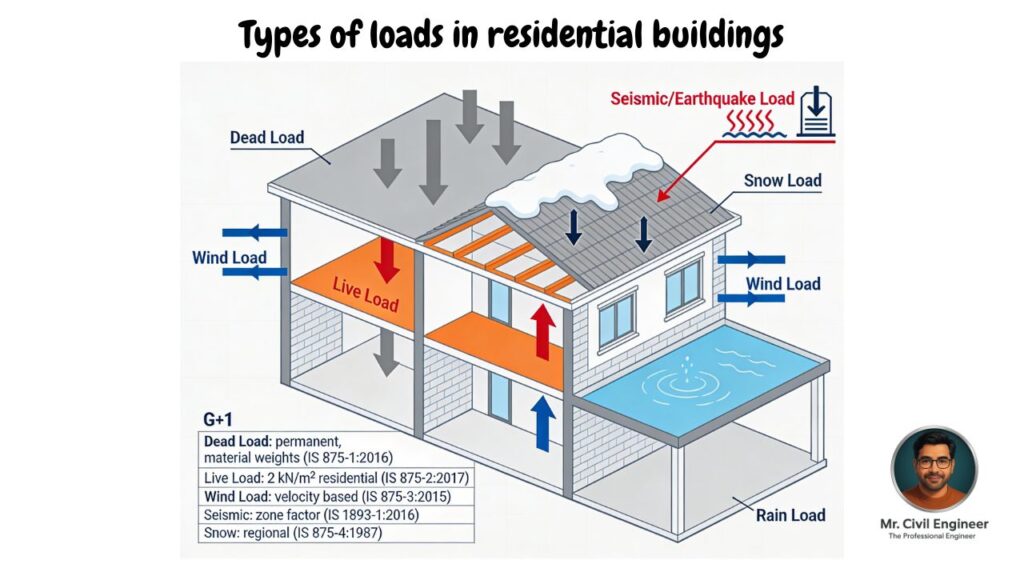
Residential structures face several forces, but focus on these for low-rise G+1/G+2:
- Dead Load (DL): Permanent weights from slab, beams, columns, walls, and finishes like screed or plaster. Calculated using material densities.
- Live Load (LL): Variable loads from people, furniture, and movable items. Fixed by IS 875 Part 2 based on room use.
- Seismic Load (EL): Earthquake forces per IS 1893, important in Zones III–V.
- Wind Load (WL): Usually minor for low-rise; check IS 875 Part 3 if over 15m tall.
Design uses combinations like 1.5(DL + LL) or 1.2(DL + LL + EL).
Key IS code values for residential buildings
Start with standard assumptions to keep calcs consistent:
- Material densities: RCC = 25 kN/m³, brick masonry (230mm) = 20 kN/m³, floor finish = 1.0–1.5 kN/m².
- Live loads (IS 875 Part 2):
- Bedrooms/living rooms: 2 kN/m²
- Stairs/corridors: 3 kN/m²
- Roof (accessible): 1.5 kN/m²; inaccessible: 0.75 kN/m²
- Slab thickness: 125mm (4″) typical for spans up to 4m.
- Wall height: 3m per floor; parapet 1m on terrace.
These match most urban G+1 houses in India.
Step-by-step load calculation process
Follow this sequence for any residential building:
- Note building data: Plan size, slab thickness, wall thickness, floor height, finishes.
- Calculate slab DL: Self-weight + finishes.
- Wall load: Per meter run (height × thickness × density).
- Total floor load: Slab DL + wall + LL.
- Beam load: Slab load × tributary width.
- Column load: Beam loads + self-weight + upper floors.
- Check seismic/wind if applicable.
Worked example: G+1 residential building (10m x 8m plan)
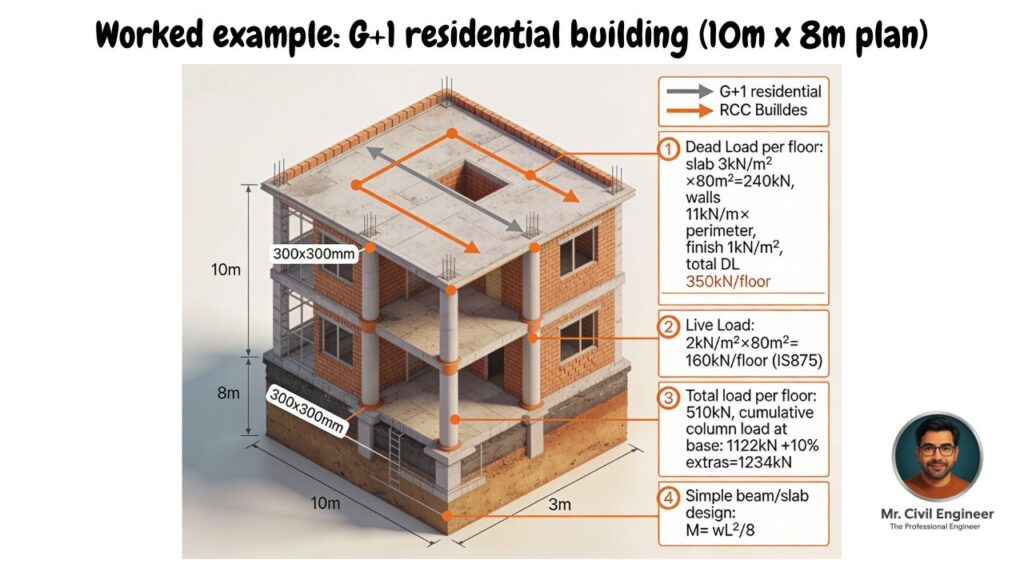
Consider a typical G+1 RCC house:
- Plan: 10m × 8m (80 m²/carpet ~1200 sq.ft built-up).
- Slab: 125mm thick.
- Walls: 230mm external, 115mm internal.
- Floor height: 3m.
- Finish: 1 kN/m²; roof treatment: 1.5 kN/m².
Slab dead load (typical floor)
Self-weight=25 kN/m³×0.125 m=3.125 kN/m²Self-weight=25kN/m³×0.125m=3.125kN/m²
Floor finish = 1.0 kN/m²
Total slab DL = 4.125 kN/m²
Roof slab DL = 3.125 (self) + 1.5 (treatment) = 4.625 kN/m²
Wall load per meter run
External wall (230mm): 20×3×0.23=13.8 kN/m20×3×0.23=13.8kN/m
Parapet (1m): 20×1×0.23=4.6 kN/m20×1×0.23=4.6kN/m
Internal partition (115mm): 20×3×0.115=6.9 kN/m20×3×0.115=6.9kN/m
Total load on slab
Typical floor: Slab DL 4.125 + LL 2.0 = 6.125 kN/m²
Roof: Slab DL 4.625 + LL 1.5 = 6.125 kN/m² (coincidentally same).
Beam load (tributary area)
For a 3m × 4m slab panel, internal beam (4m span) supports 1.5m width each side = 3m tributary width.
Load on beam area = 6.125 kN/m² × 3m × 4m = 73.5 kN
UDL on beam = 73.5 / 4 = 18.375 kN/m (add self-weight ~2–3 kN/m later).
Column load
Assume 4m × 3m grid, internal column.
Loads from 4 beams: 2×(18.375×4) + 2×(shorter beams) ≈ 160 kN/floor (approx).
Per floor to column: ~208 kN (detailed).
G+1 column (ground): 208×2 = 416 kN + 10% misc = 458 kN
| Component | Load (kN/m² or kN) |
|---|---|
| Slab DL | 3.125–4.625 |
| Total floor | 6.125 |
| Beam UDL | 18.4 kN/m |
| Column (G) | 458 |
How loads transfer: slab to beam to column
Slabs span one-way or two-way to beams. Tributary area = half panel width × span.
Beam takes that load as UDL, plus self-weight and walls above.
Columns sum beam end reactions + self-weight from all floors above.
Visual: Interior beam gets load from adjacent slabs; edge beams less.
Practical site tips and common errors
- Verify on-site: Measure actual slab (120–150mm common), deduct openings from walls.
- Errors to avoid: Forgetting parapet on roof columns; using office LL (5 kN/m²) for homes; ignoring beam self-weight initially.
- Software check: Input manual loads into STAAD/ETABS to validate.
- Seismic quick check: For Zone III, base shear ~5–10% of seismic weight (DL+0.25LL).
FAQs
What is standard live load for residential bedrooms?
2 kN/m² as per IS 875 Part 2; use 3 kN/m² for stairs.
How to calculate wall load for 115mm partitions?
20 kN/m³ × height × 0.115m = ~6.9 kN/m for 3m height.
Do I need full seismic calc for Zone II G+1 house?
Basic base shear yes (IS 1893); often <10% of gravity loads.
Conclusion
Mastering practical load calculation means confidently sizing columns, beams, and slabs for any residential project. Practice on your next G+1 design using these IS-based steps, and always cross-check with site realities.





I blog often and I seriously appreciate your information. Your article
has truly peaked my interest. I will book mark your website and keep
checking for new information about once per week.
I subscribed to your RSS feed as well.
Here is my web site ดาราหนังโป๊ฝรั่ง, Halley,
I think this is one of the so much significant information for me.
And i’m satisfied studying your article. But wanna remark on few normal issues, The Buy Website Traffic style is ideal, the articles is really
great : D. Just right job, cheers
I always spent my half an hour to read this blog’s posts every
day along with a mug of coffee.