
When you ask contractors for a house construction quote, you often hear numbers like “₹1,800 per sq.ft” or “₹2,400 per sq.ft”—but rarely a clear explanation of how much of that is “civil work” and how much is for tiles, doors, paint, and other finishes. For most homeowners, this makes budgeting confusing and negotiations stressful.
Civil work cost per square foot focuses only on the structural skeleton of the building. Understanding this number for 2026 helps you compare quotes correctly, plan your budget, and make smarter choices without compromising safety.
What exactly is “civil work”?
In simple terms, civil work covers all the structural and basic masonry activities that create the load‑bearing skeleton of your building:
- Excavation and site preparation
- Foundation and plinth beams
- RCC framework: columns, beams, slabs, sometimes lintels.
- Brickwork or blockwork walls
- Internal and external plastering
- Staircase and parapet walls
- Basic waterproofing in toilets, balconies, and terrace
- Base layers like PCC and flooring bed mortar
This is different from finishing work, which includes tiles, marble or granite, doors and windows, electrical and plumbing fixtures, sanitaryware, false ceiling, paint, wardrobes, kitchen, and decorative items. Many “per sq.ft” packages mix these together, so it is important to ask which part of the quote is strictly civil.
Average civil work cost per sq.ft in India (2026)
Recent data from 2025 suggests that the civil component of house construction usually falls in the range of about ₹800–₹1,500 per sq.ft, depending on quality and location. Many complete house construction guides report all‑inclusive costs of roughly ₹1,500–₹3,000+ per sq.ft, within which civil work accounts for a significant share.
For 2026, with modest increases in steel, cement, and labour, you can expect approximate civil work ranges such as:
- Basic civil construction: around ₹900–₹1,200/sq.ft in many Tier‑2/3 cities and towns.
- Standard civil construction: around ₹1,200–₹1,500/sq.ft in typical urban areas.
- Premium structural specifications (heavier reinforcement, higher grade concrete, complex framing): can go beyond ₹1,500/sq.ft in metros and challenging sites.
These are broad ballpark figures meant to guide planning. Actual quotes will vary from city to city and project to project.
Detailed civil work cost breakdown
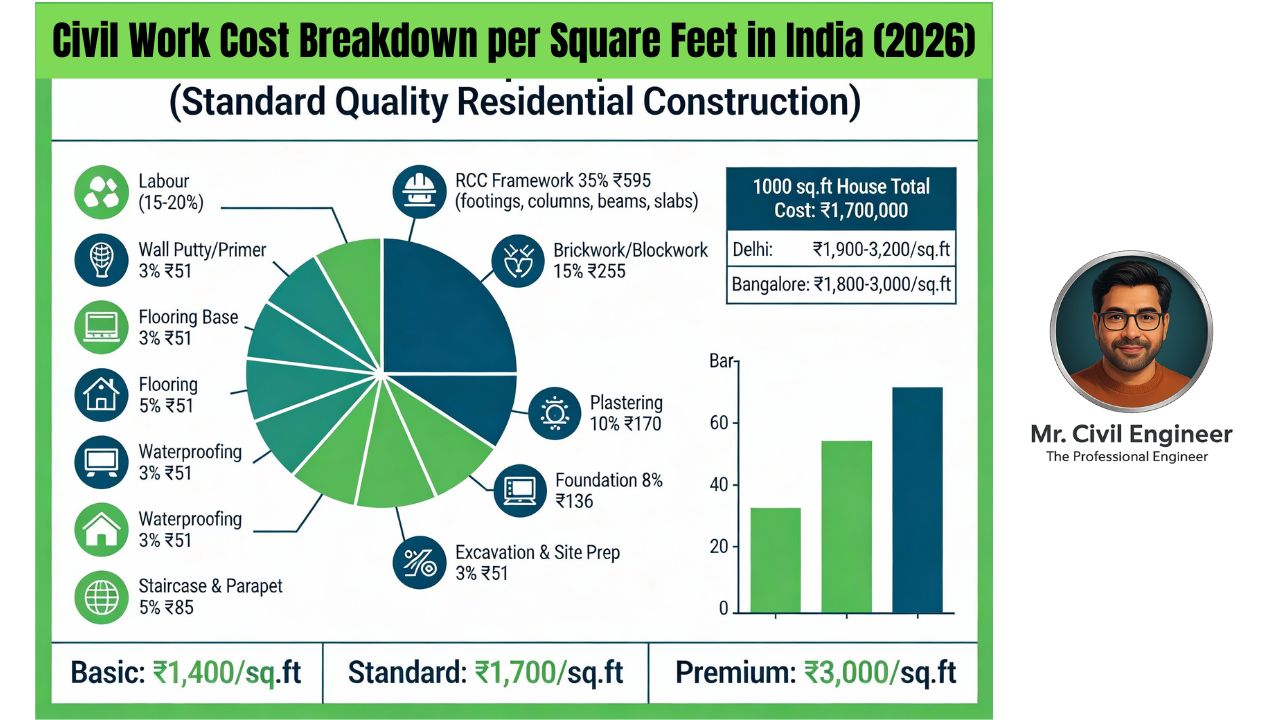
To really understand where the money goes, look at civil work as a set of components. Using standard‑quality construction as a baseline, studies and guides often allocate civil cost roughly as follows:
- Excavation & site preparation – about 3–5% of civil cost
- Foundation (footings, plinth) – around 8–12%
- RCC framework (columns, beams, slabs) – often 30–40% or more
- Brickwork / blockwork – about 12–18%
- Plastering (internal & external) – roughly 8–12%
- Staircase & parapet – about 4–7%
- Basic waterproofing – typically 3–5%
- Flooring base (PCC and mortar) – around 3–5%
If you assume a standard civil rate of, say, ₹1,600/sq.ft in 2025 for a typical house and adjust slightly upward for 2026, each percentage point of cost corresponds to a predictable ₹/sq.ft. For example, a 35% share for RCC on a 2026 reference rate of about ₹1,700/sq.ft would imply around ₹595/sq.ft allocated to RCC work.
Labour is usually embedded across all these items. Many per‑sq.ft analyses show that labour for an entire house (civil + finishing) can account for roughly 30–40% of the total construction cost, depending on locality and skill level. Within civil work, this means a substantial part of what you pay is for masons, carpenters, bar benders, and helpers, not just materials.
Example: civil work cost for a 1,200 sq.ft G+1 home (2026)
Consider a simple G+1 house with a built‑up area of 1,200 sq.ft. Suppose a contractor in a Tier‑2 city quotes a civil work rate of ₹1,700/sq.ft for 2026, which aligns with recent 2025 data plus a moderate increase.
- Total civil work cost ≈ 1,200 sq.ft × ₹1,700/sq.ft = ₹20,40,000
A typical split might look like:
- Excavation & foundation (including PCC, footings, and plinth works) – roughly 10–12% of civil cost.
- RCC frame (columns, beams, slabs, lintels) – often close to one‑third or more of the total civil cost.
- Masonry and plastering – together often around 25–30%.
- Staircase, parapet, basic waterproofing, and miscellaneous RCC elements – the remaining share.
The exact numbers will depend on soil conditions, number of columns, spans, and architectural layout, but this kind of breakdown gives you a realistic picture of how civil cost is distributed.
Civil work vs total construction cost per sq.ft
Several 2025 guides report that total house construction cost (civil + finishing + services + contractor margin) generally lies in these ranges:
- Basic finish: about ₹1,400–₹1,800/sq.ft
- Standard finish: about ₹1,800–₹2,400/sq.ft
- Premium finish: about ₹2,400–₹3,000+/sq.ft
Other sources show similar or slightly higher ranges depending on city and specification. Within these:
- Civil work often forms roughly 45–55% of the total construction bill for a typical home.
- Finishes and services (tiles, doors, windows, plumbing, electrical, sanitaryware, painting, joinery, false ceiling, etc.) along with overheads and profit make up the rest.
So if your total construction rate is ₹2,200/sq.ft, civil work might be in the ₹1,000–₹1,200/sq.ft band, with the balance going to finishes and services. Asking your contractor to split the quote this way improves transparency.
City‑wise and quality‑wise variations
Per‑sq.ft civil cost is strongly influenced by location and quality level:
- Metros like Mumbai, Delhi, Bengaluru, Hyderabad, Chennai usually show higher overall construction rates, driven by higher labour and material costs. Civil work in these cities naturally skews towards the upper end of the ranges.
- Tier‑2 and Tier‑3 cities often have lower labour rates and slightly lower material margins, allowing civil work to be executed closer to the basic–standard band.
- Rural areas may see significantly lower labour cost but sometimes higher transport costs for quality materials, so net civil rates can still vary.
Quality also matters:
- Basic civil quality may use lower steel content (although still within safety norms), simpler layouts, and minimal waterproofing details, bringing rates down.
- Standard civil quality typically uses IS‑marked materials, safer reinforcement percentages, better concrete, and more careful detailing.
- Premium structural solutions may include heavier reinforcement, higher grades of concrete, more complex framing for large spans or basements, and stricter supervision, pushing the rate higher.
Factors that drive civil work cost up or down
Several project‑specific factors influence your civil cost per sq.ft:
- Soil and foundation: Black cotton soil, loose fills, or high water table can require deeper or special foundations, increasing cost.
- Number of floors and spans: More floors and larger column‑free spaces need heavier RCC members, raising cost per sq.ft.
- Site location and access: Narrow lanes, hill slopes, or remote sites increase logistics and labour effort.
- Design complexity: Cantilevers, curved walls, split levels, and complex staircases all add civil cost.
- Market conditions: Local demand, seasonal labour shortages, and material price swings (especially steel and cement) can change civil rates within a year.
Understanding these helps explain why two neighbours might get very different civil quotes for apparently similar houses.
How to control civil work cost without compromising safety
Cutting civil cost blindly—especially by reducing steel or cement—can be dangerous. Instead, focus on smart optimisation:
- Invest in a good structural design: A competent structural engineer can optimize member sizes and reinforcement to be safe and economical at the same time.
- Use regular grids and simple layouts: Column grids aligned with walls, fewer unnecessary offsets, and logical spans reduce wastage in formwork and reinforcement.
- Plan openings and services early: Late changes (extra openings, shifting toilets) lead to structural changes and rework, inflating civil cost.
- Buy materials wisely: Use reputable brands with consistent quality but compare prices, consider bulk ordering, and avoid very low‑grade materials that cause failures or high maintenance.
- Monitor site execution: Regular checks for concrete quality, cover blocks, curing, and alignment prevent costly repairs later.
The aim is to optimise, not to under‑build.
FAQs
What is usually included in civil work rate per sq.ft?
Most civil rates cover excavation, foundation, RCC framework, brick/block masonry, plastering, basic waterproofing, staircase, parapet, and base layers like PCC and floor bed, with both materials and labour included. Always confirm written inclusions and exclusions with your contractor.
Is steel and cement included in civil work cost?
In most per‑sq.ft civil contracts, steel, cement, sand, aggregates, bricks/blocks, and standard formwork are included in the rate along with labour. Some labour‑only contracts exclude all materials, so read the proposal carefully.
How often do civil work rates change?
Civil rates can change every few months when there are major movements in steel, cement, and labour markets, or annually in line with inflation and wage revisions. For long projects, contracts sometimes include escalation clauses.
How much contingency should I keep for civil work?
Many experts suggest keeping at least 5–10% contingency over the estimated civil cost to account for small design changes, quantity variations, and rate fluctuations during the project. Complex sites may need a bit more.
Conclusion: Use cost breakdown as your planning tool
Knowing the civil work cost per square foot in India and how it breaks down across excavation, RCC, masonry, and plastering turns a vague “₹2,000 per sq.ft” quote into something you can analyze and question. For your 2026 project, use these ranges as a starting point, then refine them with local contractor quotes and a structural engineer’s input.
When you understand where each rupee goes, it becomes easier to protect your budget, demand fair quality, and still keep your dream home structurally strong and durable.
Read This Also
- Types of Soil Tests for Building Construction
- Latest Building Materials in Construction (2026 Update)
- How to Estimate Brickwork and Rate Analysis with Example
- Application of Smart Materials in Structural Engineering
- Top 20 Latest Advancements in Concrete Technology (2025–2026)
- Types of Staircases – Complete Classification, Features, and Uses