
Imagine this: your dream house is halfway built, the structure is up, and your family is excited to move in. Then one morning, a notice appears at your gate—“Stop construction: unauthorised building.” For many homeowners in India, this nightmare starts with one mistake: beginning construction without proper building approval.
Building approval is not just a formality. It is the legal green signal that your home or project follows local building bye-laws, safety standards, and land-use rules. This guide breaks down the building approval process in India, step by step, in simple language so you can build confidently and legally.
What is building approval and why it matters
Building approval (or building plan sanction) is official permission from the local authority that your proposed building design complies with applicable laws, including zoning rules, development control regulations, and structural safety norms. It covers aspects like how much you can build (FSI/FAR), how far the building must be from the road and neighbours (setbacks), how high you can go, and where you can place parking and services.
Constructing without approval can lead to heavy penalties, refusal of water and electricity connections, difficulty in selling or mortgaging the property, and in extreme cases, partial or complete demolition. Banks also usually insist on sanctioned plans and occupancy certificates before disbursing or finalizing home loans.
Authorities involved in building approval
The exact authority depends on where your plot is located and what you plan to build.
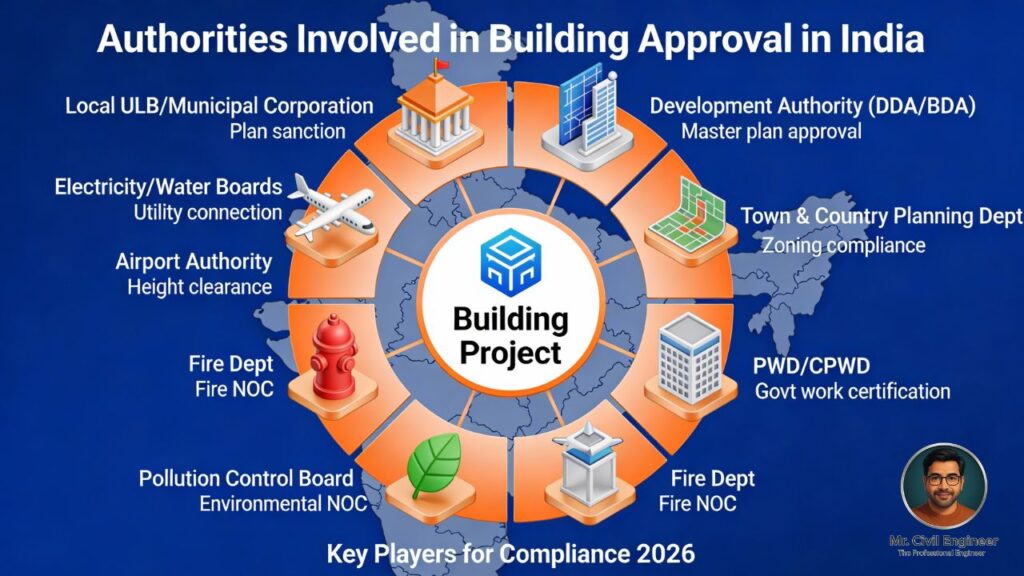
- Municipal Corporations / Municipal Councils: Handle approvals for most urban residential and commercial buildings inside city limits.
- Development Authorities: Bodies like AUDA, MMRDA, DTCP, HMDA, CMDA, etc., regulate development in larger planning areas and often frame detailed development control regulations.
- Town Panchayats / Gram Panchayats: Approvals for smaller buildings in rural and peri-urban areas, usually with simpler documentation but still subject to state-level rules.
- Special regulators and NOC authorities: Fire department, Airport Authority, Pollution Control Board, and environment bodies may be involved for high-rise, commercial, industrial, or environmentally sensitive projects.
Because each state and city issues its own detailed bye-laws, working with a local architect or licensed engineer is essential.
Prerequisites before you apply
Before rushing to the online portal or municipal office, ensure some basics are in place.
- Clear land ownership and records: You should have your registered sale deed, updated property tax receipts, and land record documents such as patta/chitta, khata, or equivalent, plus an encumbrance certificate to prove there are no legal disputes.
- Correct land use and zoning: The land must be in a permitted zone (residential, commercial, mixed, etc.) and converted from agricultural use where required through NA (non-agricultural) or similar approvals.
- Compliance with development control regulations: Check the Master Plan / Development Control Regulations for FSI/FAR, setbacks, maximum height, parking requirements, and road width norms applicable to your plot.
- Engage a registered architect / engineer: Most authorities require plans to be signed and submitted by a qualified professional registered with the council or local body.
Getting these foundations right saves weeks of back-and-forth later.
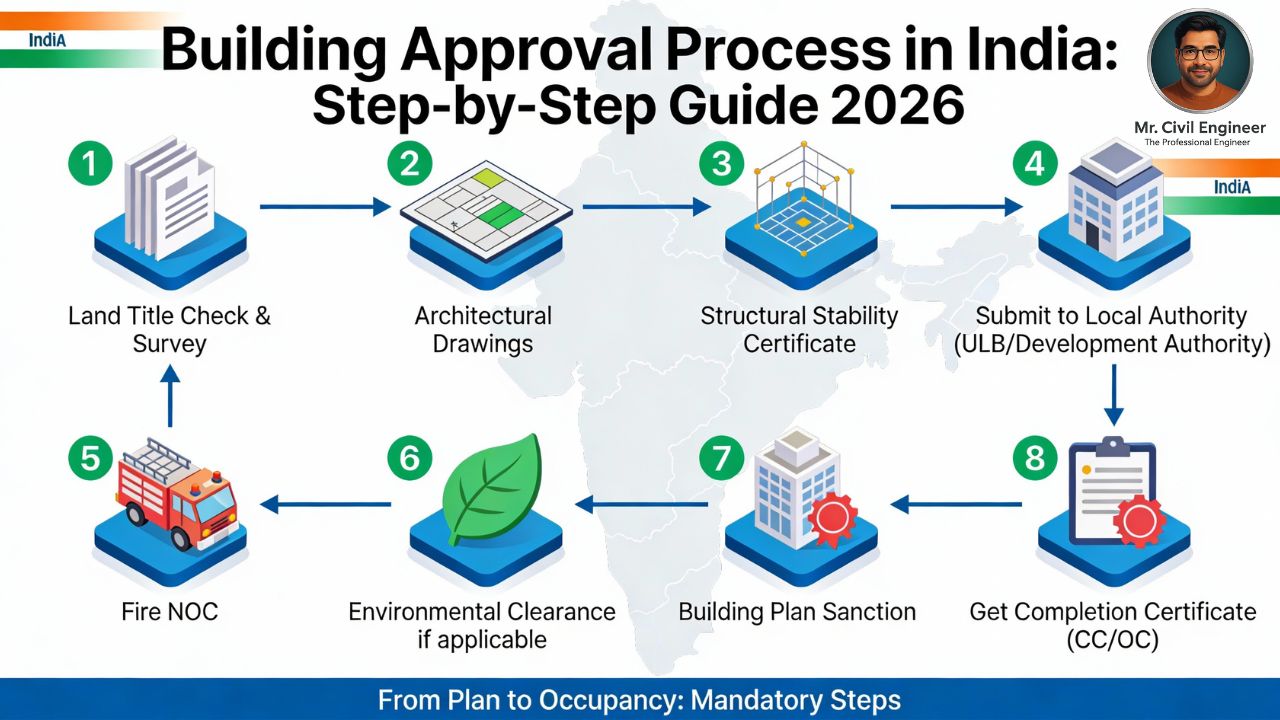
Step-by-step building approval process in India
Step 1: Hire a licensed architect or engineer
Your architect is your navigator through bye-laws and drawings. Authorities insist that the building plan be prepared and signed by a licensed architect or structural engineer who understands local regulations and standard formats. A good professional will also advise you on optimal use of FSI, ventilation, light, and structural safety.
Step 2: Prepare drawings and technical reports
Based on your requirements and the plot details, your architect prepares:
- Site plan showing plot boundaries, access road, north direction, and surroundings.
- Floor plans of each level with room sizes, walls, doors, and windows.
- Elevations and sections showing height, setbacks, and overall form.
- Area statements and FSI/FAR calculations as per rules.
- Structural drawings and design basis prepared with a structural engineer.
- Service layouts (water, drainage, septic tank or STP, rainwater harvesting) where needed.
For many cities, a soil investigation report and structural stability certificate are also required, especially for multi-storey buildings.
Step 3: Collect required documents
Authorities typically publish document checklists, and missing even one item can cause delays. Common requirements include:
- Land ownership proof (registered sale deed, gift deed, etc.).
- Latest property tax paid receipt.
- Up-to-date land records (patta, chitta, khata, EC) depending on the state.
- ID and address proof of owner (Aadhaar, PAN, etc.).
- Architect’s registration certificate or license copy.
- Building drawings (hard copy plus PDF or CAD versions as prescribed).
- Structural stability certificate, soil report (where applicable).
- NOCs: fire, environment, airport, heritage, high-tension line, or others based on project nature and location.
Many states now host these checklists on integrated portals such as UPYOG, TN online PPA, and similar e-governance platforms.
Step 4: Register and apply (online or offline)
In most major cities and several states, the building approval process has shifted to online systems:
- Examples include portals in Delhi (AutoDCR-based systems), West Bengal (e-Grihanaksha), J&K (OBPS), Uttar Pradesh and others.
- Typical steps:
- Citizen registration on the portal with mobile and email.
- Login and selection of building plan approval service.
- Filling a common application form with plot, owner, and building details.
- Uploading required documents and drawings (often in specific templates).
- Payment of scrutiny/approval fees online and obtaining an acknowledgement with tracking ID.
In some smaller towns and rural areas, submission may still be offline, where printed drawings and documents are submitted physically at the local office.
Step 5: Scrutiny and site inspection
After submission, the authority examines:
- Whether drawings match bye-law requirements regarding FSI, coverage, setbacks, height, parking, and land use.
- Whether documents are complete and consistent with land records.
A site inspection is usually conducted to verify plot boundaries, access road width, existing structures, and nearby features. Any mismatch between site conditions and submitted documents may trigger queries or objections.
Step 6: Clarifications, corrections, and NOCs
It is common for authorities to raise objections or seek clarifications—this does not necessarily mean rejection. Your architect may need to:
- Slightly adjust plans to meet setback, FSI, or parking norms.
- Submit additional documents or updated drawings.
- Coordinate with external departments for fire NOC, airport NOC, environmental clearance, or utility approvals where required.
Quick responses to these queries significantly speed up the process.
Step 7: Sanction or rejection of building plan
If all standards are met, the authority issues a building permit or sanction letter, often with conditions on permitted use, number of floors, and validity period (commonly 3–5 years). Approved drawings are stamped and signed (physically or digitally) and must be kept carefully.
If the plan is not acceptable, it may be rejected or returned with reasons, giving you an opportunity to modify and resubmit. Persistent violations of core rules like FSI, road encroachment, or building on restricted land are common grounds for outright rejection.
Step 8: Construction as per sanctioned plan
Once you receive the sanctioned plan, you can start construction, but only within the approved parameters. Key points:
- Display the permit and basic project details at the site where mandated.
- Ensure your contractor and site engineer work strictly according to the sanctioned drawings.
- Major deviations or extra floors without approval can cause big problems later, including denial of completion and occupancy certificates.
If design changes become necessary, discuss with your architect and apply for revised approval rather than informally altering on site.
Step 9: Completion Certificate (CC) and Occupancy Certificate (OC)
After construction is completed:
- Your architect/engineer prepares “as-built” drawings or completion drawings and a structural completion certificate.
- You submit an application for completion certificate and then for occupancy certificate, along with photographs, tax proof, and any pending NOCs.
The authority verifies whether the constructed building matches the sanctioned plan and conditions. If satisfied, it issues an OC, confirming that the building is safe and legally fit for occupation. Many utilities, like permanent water and electricity connections, and bank-financed transactions, depend on this OC.
Timelines and typical duration
Actual approval time varies widely, but some indicative ranges are:
- Individual house / small residential building: around 15–30 days in cities with streamlined online systems, provided documents are complete and there are no major violations.
- Commercial buildings and larger complexes: generally 6–12 weeks or more, due to multiple NOCs and more complex scrutiny.
Many state portals emphasize “ease of doing business” targets and publish expected timelines; delays can often be reduced through proper documentation and timely responses to queries.
Documents checklist for building approval
Here is a simplified grouped checklist you can adapt:
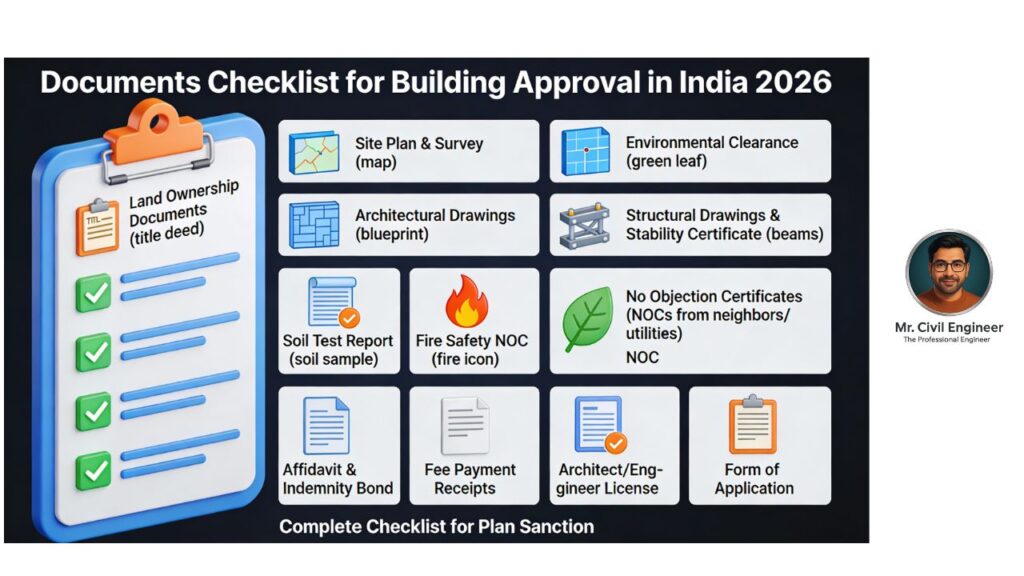
- Property and land documents
- Registered sale deed / gift deed / conveyance deed.
- Latest property tax paid receipt.
- Land records (patta/chitta/khata/RTC/EC as applicable).
- Owner and professional documents
- ID and address proof (Aadhaar, PAN, etc.).
- Architect/engineer registration certificate and stamp.
- Drawings and technical reports
- Site plan, key plan, location plan.
- Floor plans, elevations, sections.
- Area statement and FSI/FAR calculations.
- Structural drawings and stability certificate.
- Soil investigation report (where required).
- NOCs and additional approvals (if applicable)
- Fire NOC for high-rise or public buildings.
- Environmental clearance for large layouts or specific categories.
- Airport/defence NOC for buildings near airports or sensitive zones.
- Utility NOCs for water, sewerage, and electricity in some jurisdictions.
Always cross-check with your local authority’s latest checklist before submission.
Common reasons for rejection or delay
Many applications get stuck for avoidable reasons:
- Violation of FSI/FAR, coverage, or setbacks – trying to squeeze extra built-up area beyond what rules allow.
- Insufficient road width or access – plots on very narrow lanes may have stricter limits.
- Disputed or encroached land – inconsistency between land records and on-site boundaries.
- Incomplete or inconsistent documents – missing signatures, outdated tax receipts, or unmatched names across documents.
- Non-standard or wrongly scaled drawings – plans not prepared as per local bye-law formats.
Identifying these issues early with your architect avoids months of delay.
Tips to get building approval faster
- Work with a local architect who regularly handles approvals in your city; they know unwritten practical details that save time.
- Use official checklists from portals like UPYOG, TN-Online PPA, or your city corporation website to ensure no document is missed.
- Adopt auto-DCR or drawing validation tools where mandated, so basic rule checks happen even before submission.
- Track your application online using the acknowledgement number and respond to queries within the specified time.
- Do not start major construction before plan sanction; regularization later is uncertain, costly, and sometimes impossible.
These practical steps can significantly reduce both time and stress.
FAQs
Can I start construction without building approval?
No. Starting construction without approval is considered unauthorized and can lead to stop-work notices, fines, and even demolition orders in serious cases.
What is the difference between Completion Certificate and Occupancy Certificate?
The completion certificate confirms that construction is finished as per sanctioned plans and conditions, while the occupancy certificate certifies that the building is safe and fit for occupation and that you can legally use or occupy it.
How long is a building permit valid?
Validity varies by state and bye-laws, but many authorities grant permits for about 3–5 years, after which extensions or fresh approvals may be required if construction is incomplete.
Is online building approval available everywhere in India?
Online building permission systems cover most major cities and many towns, but some smaller local bodies and rural panchayats still use partially offline methods.
Conclusion: Build your dream home the right way
The building approval process in India may look complex at first, but when broken into clear steps—land checks, compliant design, proper documents, online submission, scrutiny, and OC—it becomes manageable. With a trusted architect and a solid understanding of approvals, you can avoid legal headaches and focus on creating a safe, comfortable, and future-proof home.
Treat this guide as your checklist before starting any construction discussion, and use it to ask the right questions to your architect, contractor, or local authority.
Read This Also
- Types of Soil Tests for Building Construction
- Latest Building Materials in Construction (2026 Update)
- How to Estimate Brickwork and Rate Analysis with Example
- Application of Smart Materials in Structural Engineering
- Top 20 Latest Advancements in Concrete Technology (2025–2026)
- Types of Staircases – Complete Classification, Features, and Uses