

Introduction
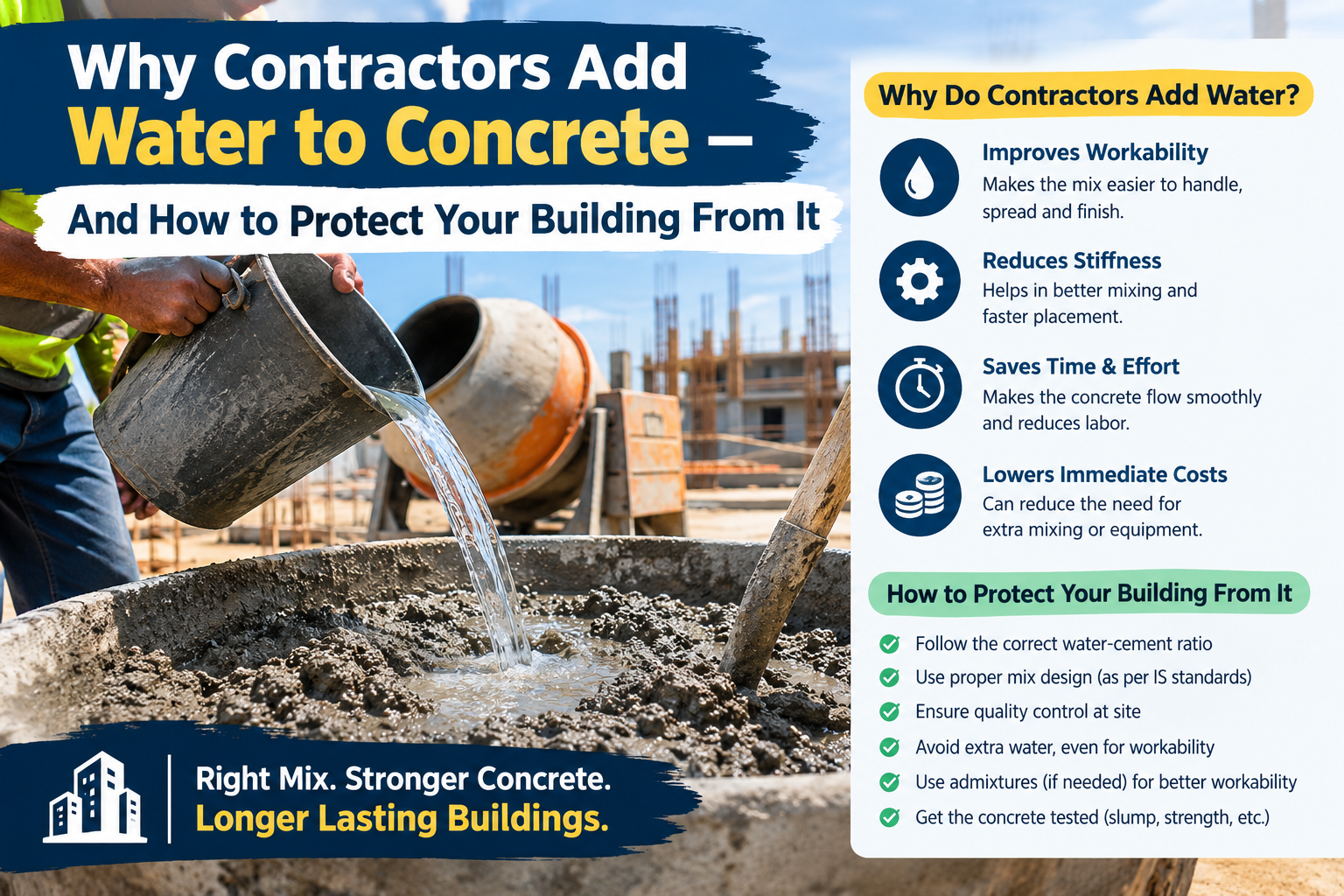
Most articles about excess water in concrete focus purely on the technical damage — reduced strength, increased porosity, compromised structural integrity. What often gets left out is the more uncomfortable question: why does this keep happening despite everyone in the industry knowing it’s wrong?
The answer isn’t ignorance. It’s a business incentive that quietly works against the client’s best interest, and understanding it is the first step to protecting your own project from it.
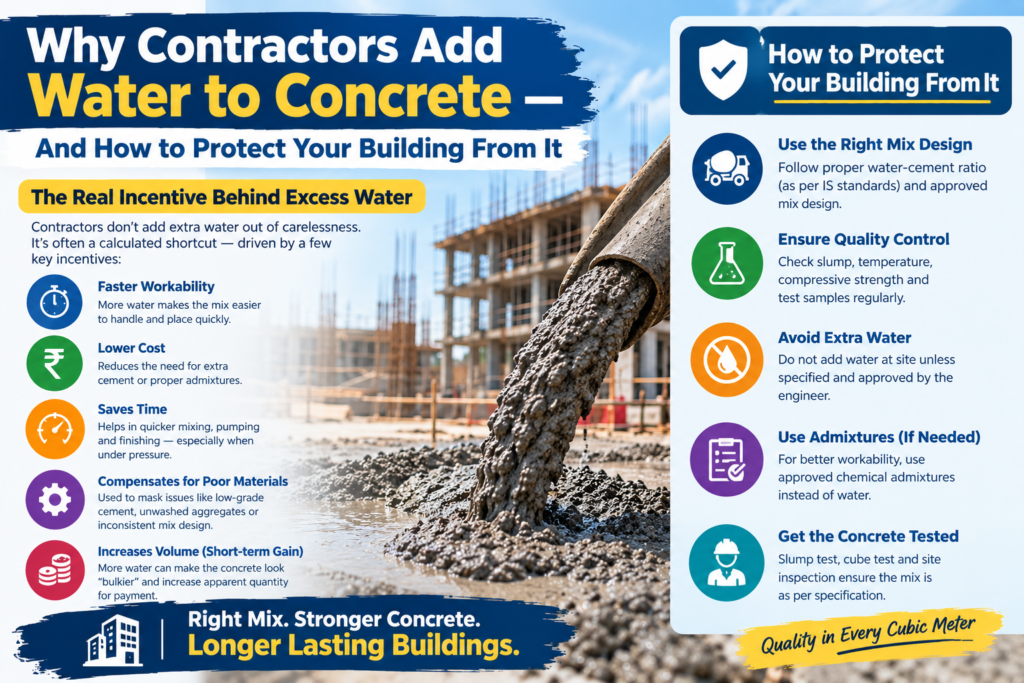
The Real Incentive Behind Excess Water
Speed Directly Translates to Labor Savings
Concrete mixed with slightly more water flows and finishes noticeably faster. For a labor crew paid by the day or working under a tight schedule, a wetter mix means more area covered per shift. For a contractor managing labor costs across an entire project, this translates directly into savings — savings that come at the direct expense of the client’s structural safety margin.
It’s Rarely a Single Worker’s Decision
It’s tempting to frame this as one careless mason making a bad call. In reality, it’s often a structural incentive across the entire site — schedule pressure from the top down creates conditions where speed gets rewarded and strength verification gets skipped.
Why This Mistake Is So Hard to Catch
No Immediate Visible Consequence
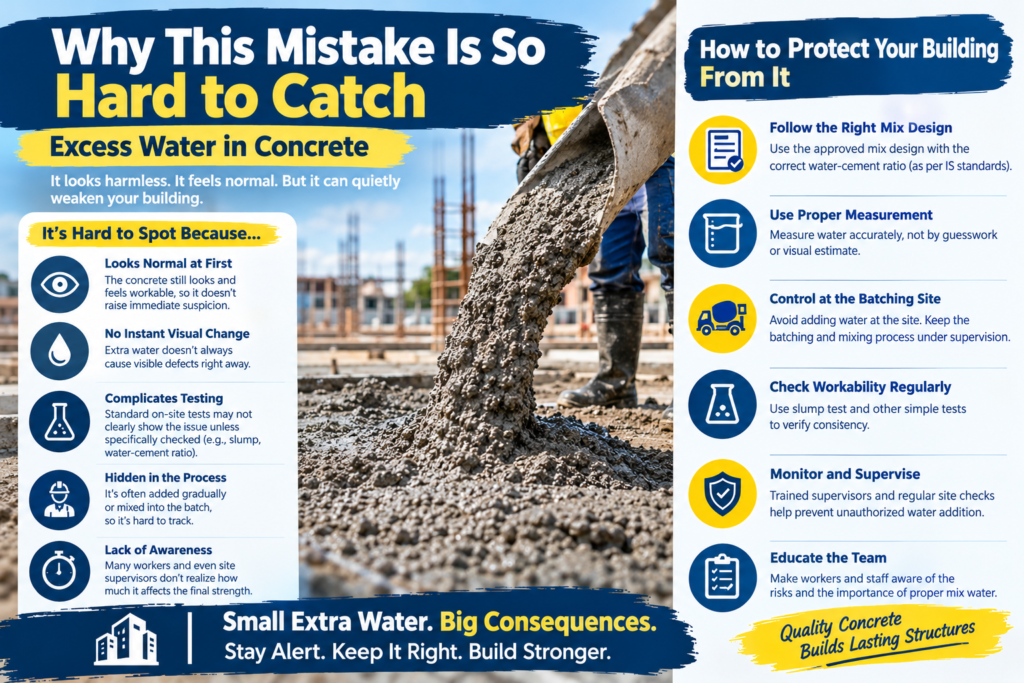
Concrete mixed with excess water looks, sets, and behaves almost identically to properly mixed concrete in the short term. There’s no visible red flag on pour day — the real consequence, reduced compressive strength, only reveals itself in a 28-day cube test or, worse, structural distress years later.
Clients Rarely Ask for Testing
Cube testing — casting sample concrete cubes during a pour and testing their compressive strength after 28 days — is standard practice on larger commercial projects but almost never requested by individual homeowners building a house. Without this test, there’s simply no data point that would reveal a problem until it’s already structural.
What This Actually Costs You
A water-cement ratio that rises from a designed 0.45 to 0.55 can reduce compressive strength by roughly 15-20%. For a column or slab designed with a specific safety margin, this reduction eats directly into that margin — meaning the structure is technically still standing, but with meaningfully less reserve capacity than the design intended.
How to Protect Your Project as a Client

Be Present During Critical Pours
Physically observing water quantity during mixing, especially for major structural pours like columns and slabs, is one of the simplest and most effective checks available to any client — no technical expertise required, just attentiveness.
Request Cube Testing
Even for a small residential project, requesting cube tests for major structural elements gives you an objective data point rather than relying entirely on trust. Many local labs offer this service affordably.
State the Water Ratio as Non-Negotiable
Communicating clearly and early — ideally in writing as part of your contract — that the water-cement ratio must match the mix design, and that plasticizers should be used for workability instead of extra water, sets a clear expectation before work begins rather than trying to correct it after the fact.
What This Means for Contractors and Engineers Too
For contractors and site engineers reading this from the other side, there’s a genuine business case for doing this correctly rather than viewing it purely as a compliance burden. A structural repair years after construction — often involving demolition, disruption, and reputational damage — costs dramatically more than the marginal cost of a plasticizer and slightly slower pour today. Being able to explain and demonstrate proper quality control also becomes a genuine differentiator with increasingly aware clients.
Conclusion
Excess water in concrete persists not because the industry doesn’t understand the damage, but because the incentive to cut corners is immediate and the consequence is delayed and often invisible until it’s serious. Breaking that pattern doesn’t require new technology — it requires clients who ask the right questions and site teams willing to prioritize verified quality over unverified speed.
Key takeaway: If you’re building anything structural, don’t rely on trust alone — be present for critical pours, request testing where possible, and set water-ratio expectations clearly before construction begins.
Related Reading:
- Concrete Mix Ratio Table (M10 to M30)
- Footing Design Basics (Isolated & Combined) – A Practical Guide
- Column Size for G+1 & G+2 Buildings (Residential Guide)
- Slab Thickness Calculation (One-Way & Two-Way) – Complete Guide
- Load Calculation for Residential Buildings: A Practical Guide for Slabs, Beams, and Columns