

Introduction
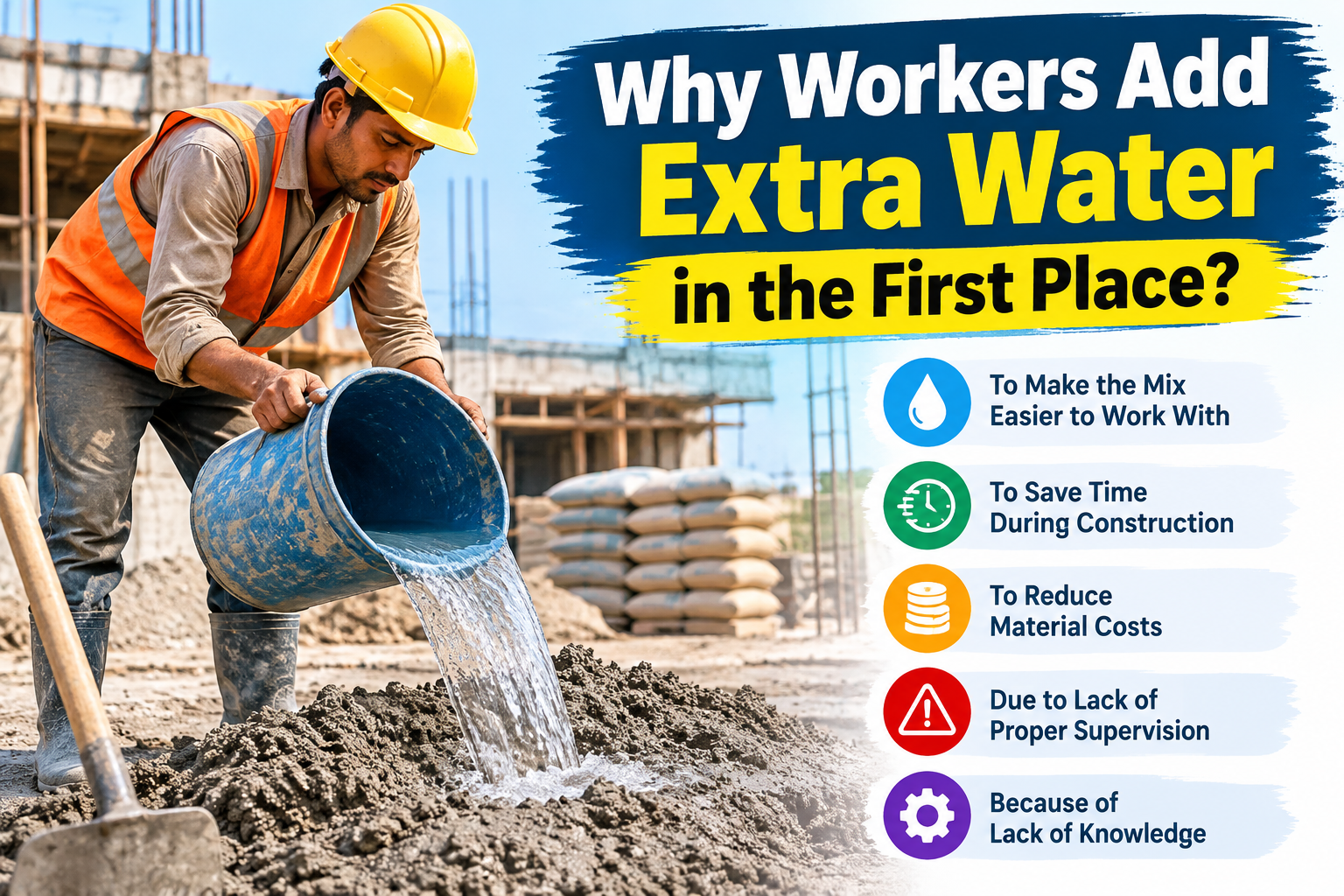
If you’ve ever stood near a concrete mixer on a construction site, you’ve probably seen it happen — a worker grabs a bucket of water and tips it in, “just to make it flow better.” It looks harmless. It happens on almost every site. And it’s one of the most damaging habits in construction, precisely because the damage is invisible until it’s too late to fix.
Why Workers Add Extra Water in the First Place
Concrete that’s mixed strictly to the design water-cement ratio is often thick and harder to place, especially around congested reinforcement in columns and beams. Adding water makes it flow more easily and finish faster — which matters when a crew is trying to complete a pour before the end of a shift.
The problem is that nobody on the pouring team is thinking about the 28-day strength test that’s still a month away. The immediate convenience wins over a consequence that won’t show up for weeks.
The Chemistry Behind the Strength Loss
Concrete gains strength through hydration — a chemical reaction between cement and water that forms the bonding structure holding aggregate together. The water-cement ratio is calculated precisely so there’s enough water for complete hydration, without leaving excess water that creates capillary pores once it evaporates.
Every bit of water added beyond that ratio creates additional pores in the hardened concrete, directly reducing its density and compressive strength.
How Much Strength Are We Actually Talking About?
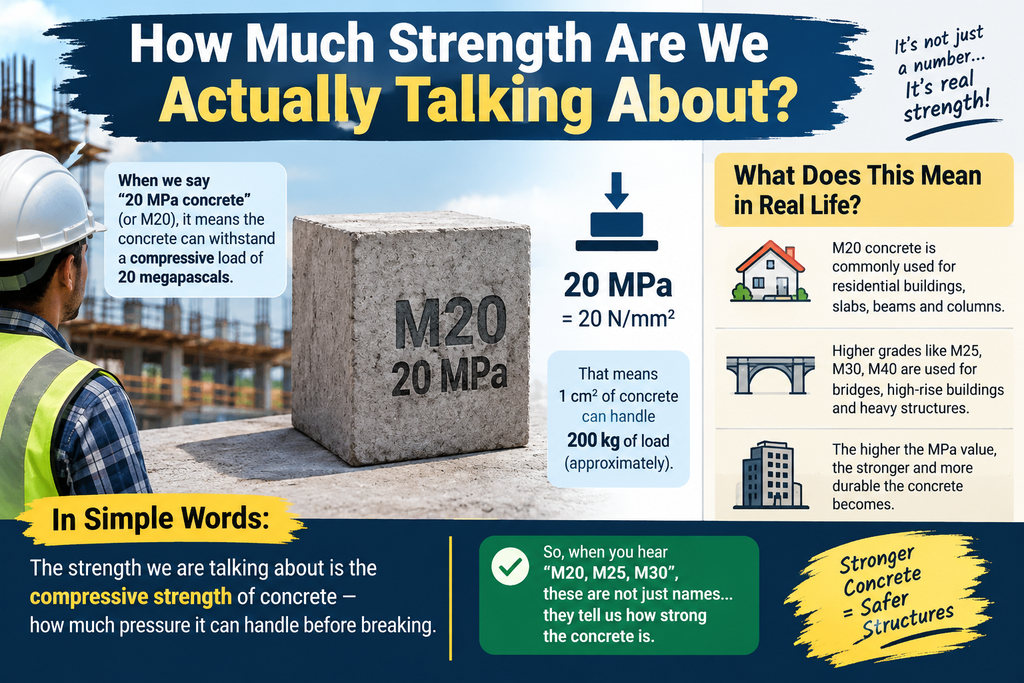
A concrete mix designed for a 0.45 water-cement ratio can lose approximately 15-20% of its designed compressive strength if that ratio rises to 0.55 — a change that might look like “just a bit more water” on site but represents a significant structural compromise.
For a column designed to carry a specific load with a safety margin, that kind of strength reduction can meaningfully eat into the safety factor engineers built in during design.
Why This Doesn’t Show Up Immediately
Concrete continues gaining strength for weeks after pouring, and standard testing happens at 28 days. By the time a cube test reveals lower-than-expected strength, the structural element is already cast, cured, and often already loaded with the next floor’s construction.
This delay between the mistake and its discovery is exactly why so many sites keep making it — there’s no immediate visible consequence to correct the behavior.
The Right Way to Improve Workability
The good news is that there’s a well-established solution that doesn’t require sacrificing strength for workability.
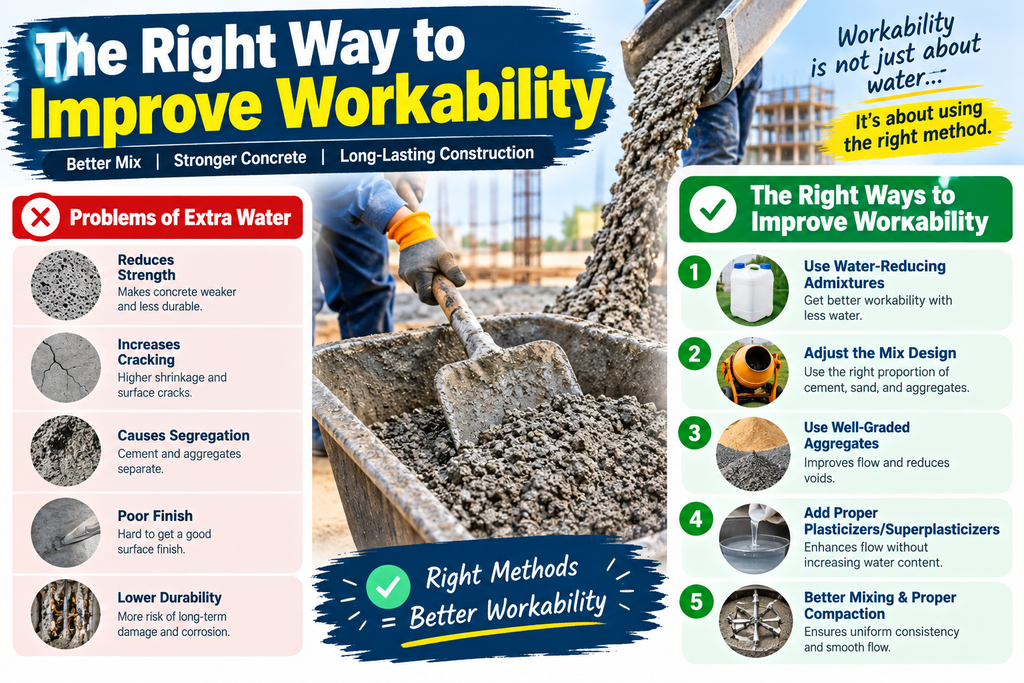
Using Plasticizers Instead of Water
Plasticizers and superplasticizers are chemical admixtures designed specifically to improve concrete flow and workability without increasing the water content. They work by reducing the surface tension of water and dispersing cement particles more evenly, achieving the same “easy to pour” result without diluting the mix.
Practical Site-Level Fixes
- Fix the water-cement ratio clearly in the mix design and communicate it directly to whoever operates the mixer
- Keep a measured water container at the mixing station rather than allowing free access to a water source
- Assign one person to verify water quantity at each batch, rather than assuming it happens automatically
Site Note: On one site I supervised, simply moving the water tap further from the mixer and requiring measured buckets cut this problem almost entirely — sometimes the fix is more about workflow design than instruction.
Common Mistakes to Watch For
- Assuming a slightly runnier mix is “not a big deal” without measuring the actual water added
- Not training mixer operators on why the water ratio matters, only that it should be followed
- Skipping slump tests that would reveal excess water before the pour continues
Conclusion
The extra bucket of water that makes concrete easier to pour today is the same reason a structural element might underperform its design strength years later. This is one of the easiest mistakes to prevent — it requires no additional cost, only discipline and a small process change at the mixing station.
Key takeaway: If workability is a genuine concern, solve it with a plasticizer, not water. The difference in long-term structural performance is significant enough to make this a non-negotiable site practice.
Related Reading: