
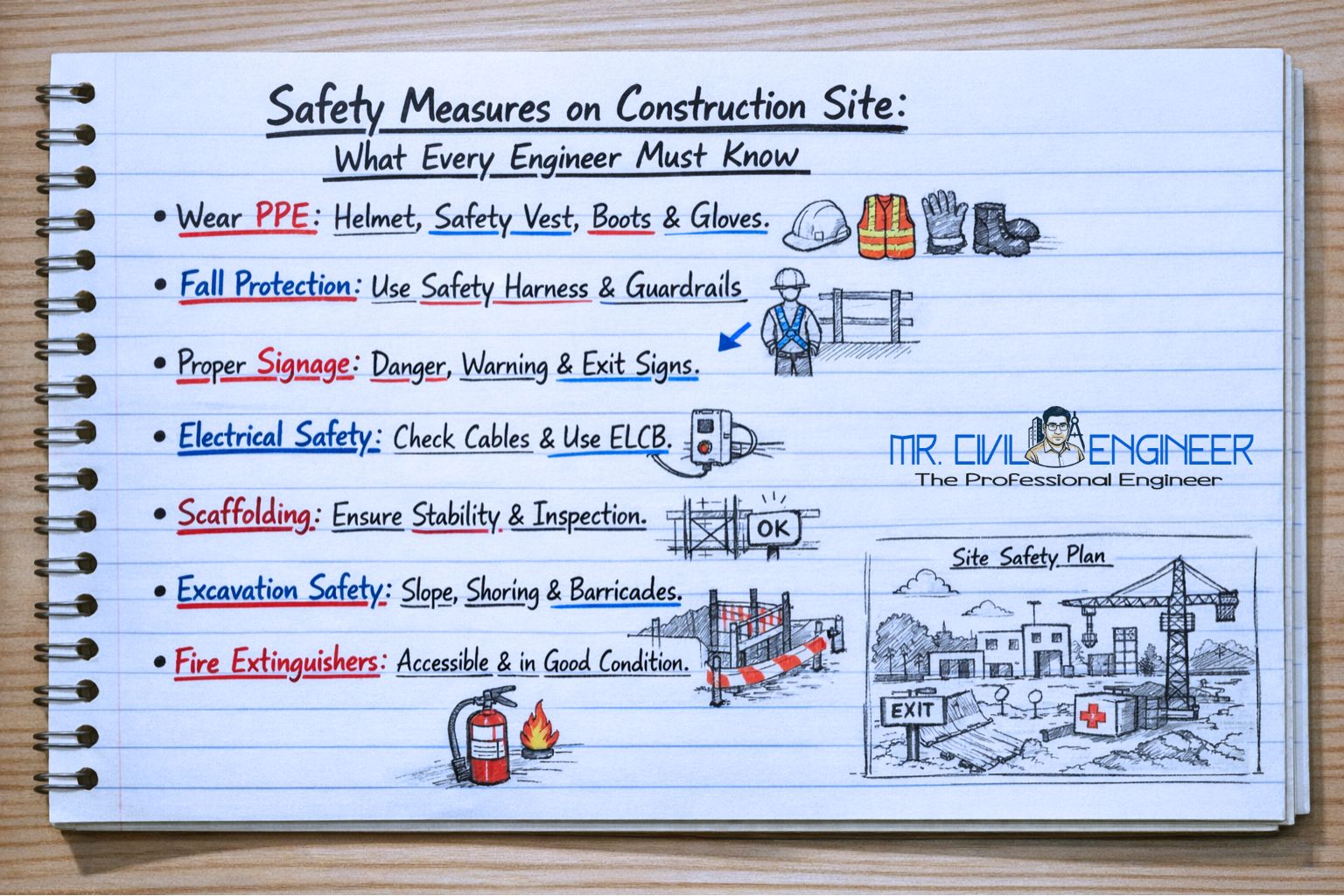

One Small Mistake Can Change Everything
A missing helmet.
An unguarded slab edge.
A loose electrical wire.
Most construction site accidents happen not because work is difficult, but because basic safety rules are ignored. Every year, thousands of injuries occur on sites that could have been prevented with simple safety measures.
If you are a site engineer, contractor, or civil engineering student, this guide will help you understand practical, real-life safety measures on construction site—not theory, but what actually works on site.
Why Construction Sites Are High-Risk Zones
Construction sites change every single day. New activities, new workers, new hazards.
Common reasons sites become unsafe:
- Multiple activities happening at the same time
- Temporary electrical connections
- Work at height without protection
- Untrained or rushed labor
Safety is not about slowing work.
It is about making sure everyone goes home safely.
What Does “Construction Site Safety” Really Mean?
Construction site safety means identifying hazards in advance and controlling them before accidents happen.
Safety is a shared responsibility:
- Contractor provides systems and PPE
- Site engineer enforces rules
- Workers follow safe practices
When even one person ignores safety, everyone is at risk.
Most Common Construction Site Hazards You See Every Day
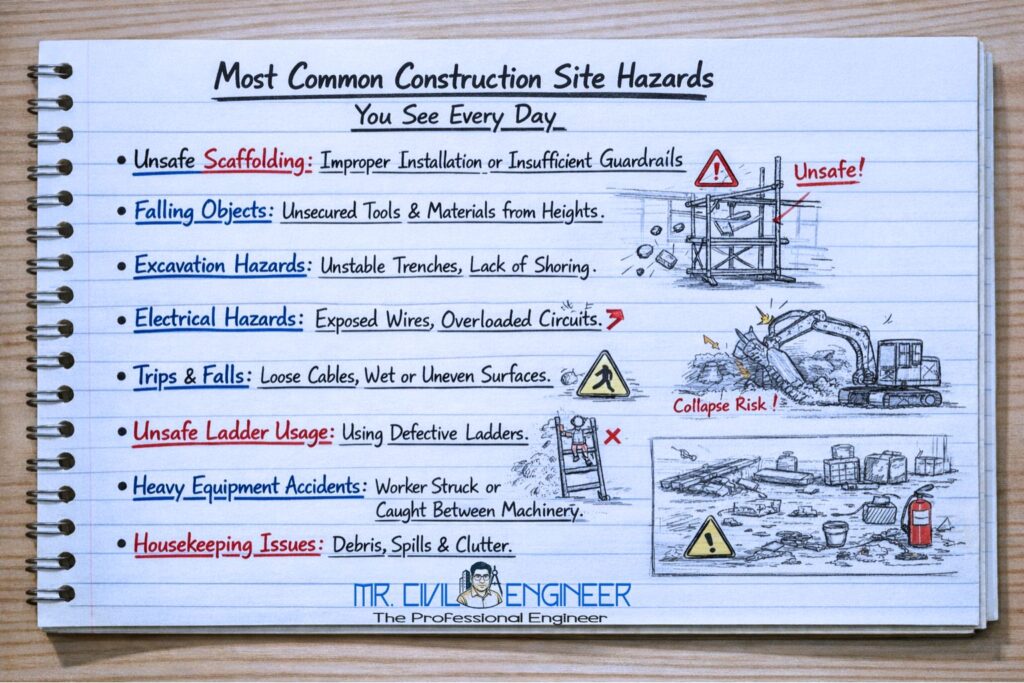
⚠️ Falls from Height
- Slab edges without barricades
- Improper scaffolding
- Unsafe ladders
Falls are the number one cause of serious injuries on construction sites.
⚡ Electrical Hazards
- Loose temporary wiring
- Exposed cables
- Improper earthing
Even low-voltage shocks can be fatal in wet site conditions.
🧱 Falling Objects
- Tools slipping from height
- Bricks and debris
- Reinforcement bars
This is why helmets are non-negotiable.
🚜 Machinery & Equipment Accidents
- Untrained operators
- No safety guards
- Poor maintenance
Machines don’t make mistakes—people do.
Essential Safety Measures on Construction Site (Must-Follow)
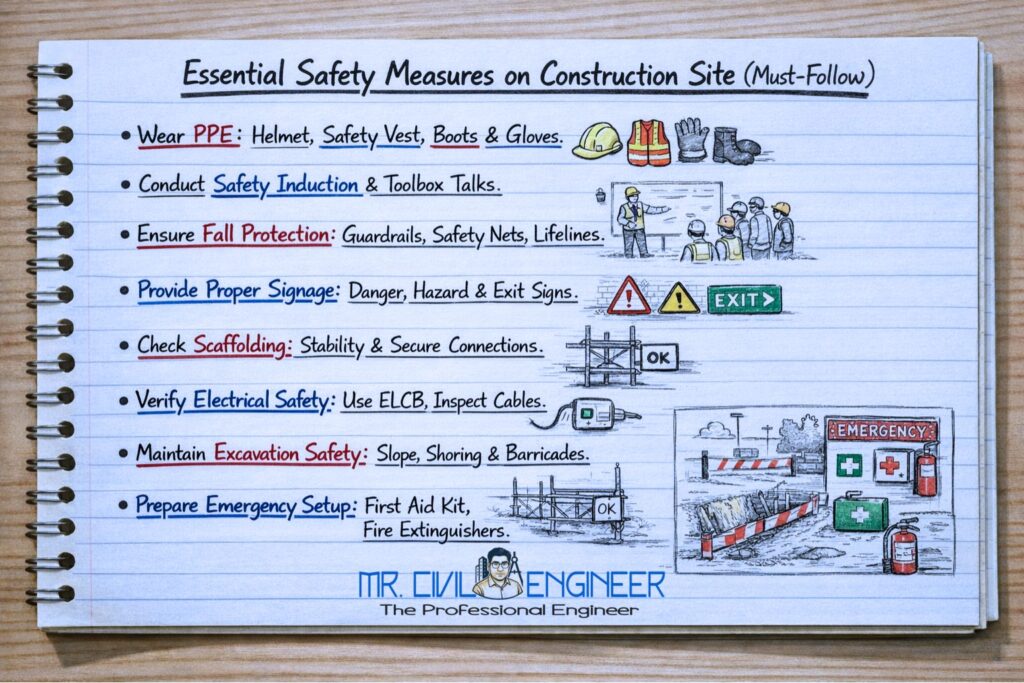
🦺 1. Personal Protective Equipment (PPE)
PPE is the first line of defense.
Mandatory PPE on site:
- Safety helmet
- Safety shoes
- Reflective jacket
- Gloves
- Goggles (for cutting/welding)
Golden Rule:
👉 No PPE = No Work
🏗️ 2. Safe Working at Height
Height work requires extra attention.
Best practices:
- Guardrails on slab edges
- Safety nets below working areas
- Properly erected scaffolding
- Safety belts for high-rise work
If a worker can fall, he eventually will—unless protected.
🔌 3. Electrical Safety Measures
- Use ELCB / MCB
- No open joints or hanging wires
- Proper earthing for all equipment
- Only trained electricians allowed
Temporary power should never mean temporary safety.
⚙️ 4. Machinery & Equipment Safety
- Daily equipment checks
- Only trained operators
- Emergency stop switches
- No loose clothing near machines
One careless moment near machinery can cause permanent damage.
🧹 5. Housekeeping: The Most Ignored Safety Rule
Bad housekeeping causes:
- Slips
- Trips
- Falls
Simple habits:
- Clear debris daily
- Stack materials properly
- Keep walkways free
A clean site is a safe site.
🚧 6. Barricading & Safety Signage
- Barricade excavations
- Mark danger zones clearly
- Warning boards for visitors
If a hazard is visible, accidents reduce automatically.
Safety Training: Awareness Saves More Lives Than Rules
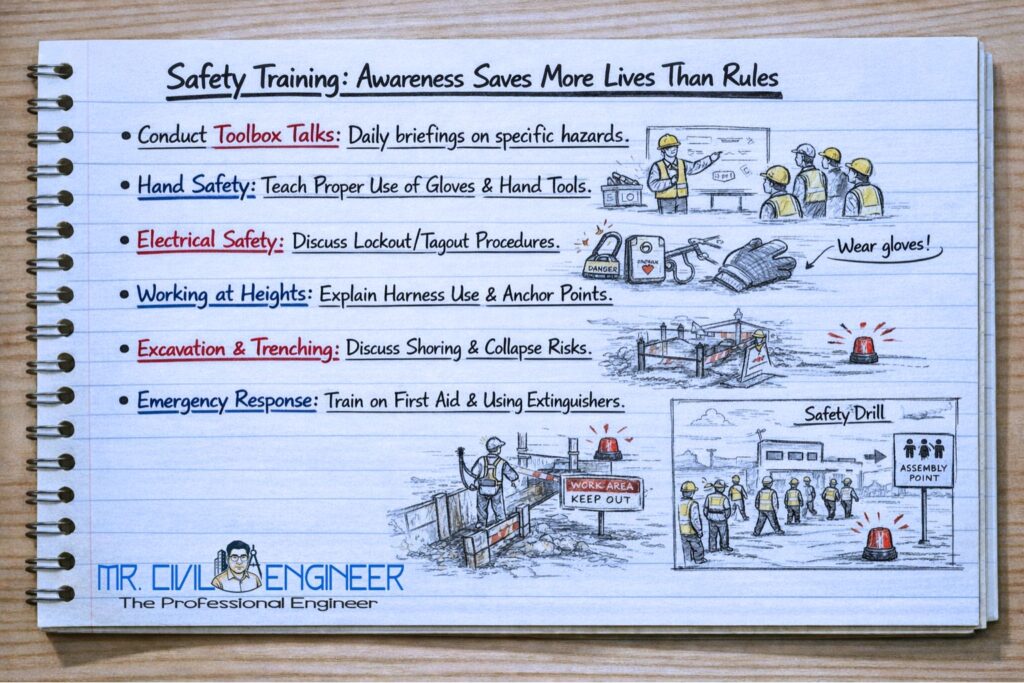
Many workers don’t ignore safety intentionally—they don’t understand the risk.
Effective safety practices:
- Daily toolbox talks (5–10 minutes)
- PPE demonstrations
- Safety posters in local language
- Induction training for new workers
Education creates habit.
Punishment creates fear.
Role of Site Engineer in Construction Site Safety
A site engineer is the real safety controller, not the paperwork.
Your responsibilities:
- Daily safety inspection
- Enforce PPE strictly
- Stop unsafe work immediately
- Lead by example
Workers follow what you do, not what you say.
Most Common Safety Mistakes Seen on Indian Sites
- “Just 2 minutes work” without helmet
- Working at height without belts
- Overloaded scaffolding
- Ignoring safety during fast-track projects
Most accidents happen during routine work, not complex work.
Quick FAQs (Discover-Friendly)
❓ Is wearing a helmet compulsory on site?
Yes. For workers, engineers, supervisors, and visitors.
❓ Who is responsible for site safety?
Safety is a shared responsibility of contractor, engineer, and workers.
❓ Can safety slow down construction?
No. Safety actually improves productivity and quality.
Final Thoughts: Safety Is Not Optional
Safety is not a delay to work—it is a foundation for quality and productivity. A safe construction site protects lives, saves money, and builds trus
You can replace a machine.
You can replace materials.
But you cannot replace a life.
Make safety a daily habit, not a rule written on a board.
Related Articles
- Construction Joints – Types & Location (Complete RCC Guide)
- Concrete Pouring Checklist for Hot Weather (Site-Practical Guide)
- Shuttering Types & Removal Time (Complete RCC Site Guide)
- Step-by-Step Slab Casting Procedure (Complete On-Site Guide)
- Common Estimation Mistakes on Site: Why Projects Go Over Budget